Name generator
Italian Name Generator
Explore 298 distinct Italian names from this guide. Compare names by style and origin, with spelling and meaning context in the guide. Choose a category or letter to narrow your results, then copy or save your favorites.
Showing 15 of 298 matching Italian names.
Results use different initials when available. Counts reflect the names in this guide; some letters and categories naturally have fewer matches. Letters without matches are hidden.
- Sofia
Wisdom, from Greek
- Beatrice
Linked to “blessed” or “happy”
- Tiziana
- Xavier (international use)
- Aurora
Dawn; Roman dawn goddess
- Kevin
- Raffaello
Raphael (Raffaello Sanzio)
- Helena (international)
- Ginevra
Italian form related to Guinevere; origin debated
- Pietro Bianchi
Calm and classic
- Leopoldo
Germanic-rooted traditional name
- Ugo
- Vittoria
Victory
- Irene
- Carmela
Meanings depend on the exact spelling, language and context. Read the guide for pronunciation, writing and naming traditions. View your shortlist
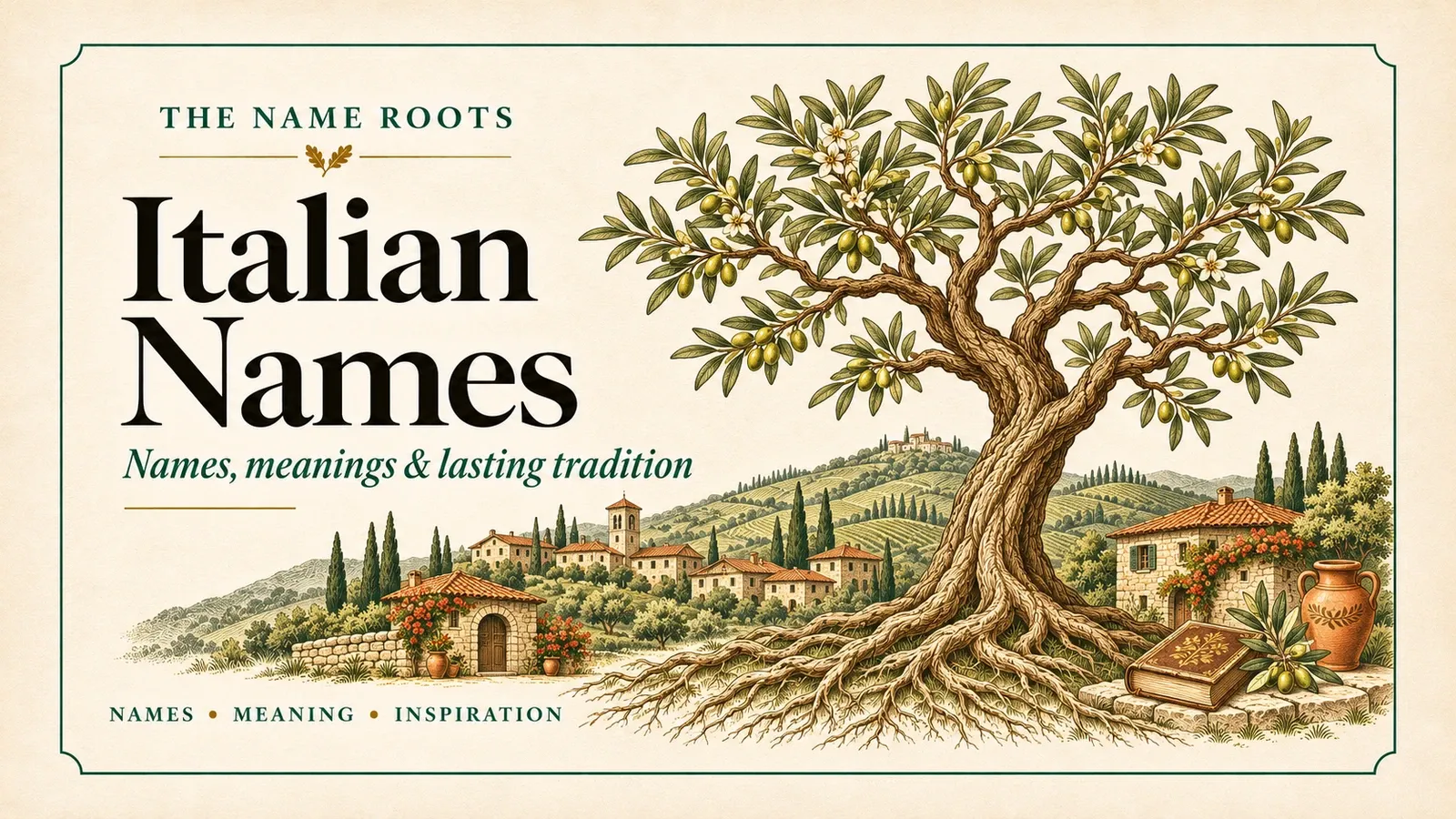
Choosing an Italian name is easier when you can compare the sound, meaning, history, and everyday usability in one place. This guide brings together popular baby names in Italy, distinctive traditional choices, short names, Italian-American favorites, surnames, and name-pairing ideas. Each group is organized for quick scanning, with tables instead of long repetitive descriptions. Whether you are naming a baby, a fictional character, or simply exploring Italian heritage, start with the names that match your preferred style.
Quick guide: “popular” refers to an identifiable dataset when a year is supplied; “classic,” “rare,” and “modern-feeling” are editorial style descriptions, not official popularity rankings. Meanings are concise summaries of established linguistic roots, and some ancient names have debated etymologies.
Best Italian Names at a Glance
| Style | Girls | Boys |
|---|---|---|
| Popular in 2024 | Sofia, Aurora, Ginevra, Vittoria | Leonardo, Edoardo, Tommaso, Mattia |
| Short and easy to say | Mia, Ada, Eva, Lia | Luca, Leo, Enzo, Elio |
| Romantic and elegant | Beatrice, Bianca, Eleonora, Viola | Lorenzo, Gabriele, Alessandro, Giulio |
| Nature and light | Alba, Stella, Fiorella, Azzurra | Elio, Silvio, Marino, Leone |
| Traditional | Maria, Caterina, Teresa, Agnese | Giovanni, Giuseppe, Antonio, Pietro |
| Distinctive | Fiammetta, Elettra, Ottavia, Sveva | Tancredi, Enea, Tiziano, Alvise |
| Italian-American friendly | Gianna, Bella, Lucia, Gia | Luca, Matteo, Nico, Marco |
A good shortlist usually contains one timeless name, one contemporary option, and one distinctive alternative. Say each candidate aloud with the intended surname before deciding.
Most Popular Italian Baby Names: Verified 2024 Rankings
Italy’s national statistical institute (ISTAT) reported that Leonardo led the boys’ names and Sofia led the girls’ names among registered newborns in 2024. These are historical 2024 rankings, not an unverified list of 2026 births. The top five for each sex are shown below in their official order.
To check the frequency of a particular name across birth years, use the official ISTAT “Conta nomi” name finder rather than treating an undated list as a live popularity chart.
| Rank | Boys (2024) | Girls (2024) |
|---|---|---|
| 1 | Leonardo | Sofia |
| 2 | Edoardo | Aurora |
| 3 | Tommaso | Ginevra |
| 4 | Mattia | Vittoria |
| 5 | Alessandro | Giulia |
These rankings reveal two useful trends: long classical names remain strong, while several easily recognized forms such as Sofia, Aurora, and Giulia travel well internationally. A popular choice is not necessarily overused in every region or country; popularity also changes considerably over time.
Beautiful Italian Girl Names With Meanings
Italian girl names range from straightforward word names such as Gioia (“joy”) to historical names whose meanings come from Latin, Greek, Germanic, or Hebrew roots. The following choices mix familiar favorites with elegant options that work in everyday life.
| Name | Meaning or root | Style |
|---|---|---|
| Adelaide | Noble type; from Germanic elements | Regal, classic |
| Agnese | Italian form of Agnes; “pure” | Traditional |
| Alba | Dawn in Italian | Nature |
| Alessandra | Defender of people | Strong |
| Alessia | Related to Greek “defender” | Modern classic |
| Alice | From a Germanic noble-name family | Simple |
| Allegra | Cheerful, lively in Italian | Playful |
| Ambra | Amber | Nature |
| Anna | Grace or favor, via Hebrew | Timeless |
| Antonella | Diminutive of Antonia | Traditional |
| Aurora | Dawn; Roman dawn goddess | Radiant |
| Azzurra | Azure blue | Distinctive |
| Beatrice | Linked to “blessed” or “happy” | Literary |
| Benedetta | Blessed | Traditional |
| Bianca | White; Italian form of Blanche | Elegant |
| Camilla | From a Roman name | Classic |
| Carlotta | Feminine form of Carlo | Charming |
| Caterina | Italian form of Katherine; meaning debated | Classic |
| Chiara | Clear, bright | Elegant |
| Claudia | From a Roman family name | Timeless |
| Diletta | Beloved in Italian | Romantic |
| Elena | Italian form of Helen; etymology debated | Classic |
| Eleonora | A historic form; origin debated | Regal |
| Elisa | Short form of Elisabetta | Gentle |
| Emma | From a Germanic “whole” root | Short |
| Eva | Italian form of Eve | Simple |
| Federica | Peaceful ruler | Strong |
| Fiammetta | Little flame | Poetic |
| Fiorella | Little flower | Nature |
| Francesca | Feminine of Francesco | Timeless |
| Gemma | Gem; precious stone | Vintage |
| Giada | Jade | Nature |
| Ginevra | Italian form related to Guinevere; origin debated | Literary |
| Gioia | Joy in Italian | Bright |
| Giulia | Roman family name; etymology debated | Popular |
| Grazia | Grace | Vintage |
| Ilaria | Cheerful; related to Hilarius | Upbeat |
| Isabella | Italian/Spanish form of Elizabeth | Elegant |
| Lavinia | Ancient Roman literary name | Classical |
| Lia | Short form used in Italy | Minimal |
| Ludovica | Famous in battle | Refined |
| Lucia | Associated with Latin light | Classic |
| Maddalena | From Magdala | Traditional |
| Margherita | Daisy in Italian; from Greek “pearl” | Floral |
| Matilde | Strength in battle | Vintage |
| Mia | Short form used internationally | Modern |
| Noemi | Italian form of Naomi | Soft |
| Olivia | Linked to olive | Elegant |
| Ottavia | Related to the number eight | Roman |
| Serena | Calm; tranquil | Gentle |
| Sofia | Wisdom, from Greek | Popular |
| Stella | Star | Celestial |
| Teresa | Traditional name; etymology uncertain | Classic |
| Valentina | Strong, healthy | Romantic |
| Viola | Violet | Floral |
| Vittoria | Victory | Popular |
Italian Girl Names That Feel Romantic and Elegant
For a flowing, feminine sound, compare Eleonora, Alessandra, Isabella, Ludovica, and Francesca. For the same atmosphere in fewer syllables, choose Bianca, Chiara, Lucia, or Viola. An elegant name does not need an elaborate invented meaning; pronunciation and the way it sits beside a surname matter just as much.
| Name | Why it stands out | Practical note |
|---|---|---|
| Beatrice | Literary associations and soft vowels | Bé-a-TREE-cheh in a simple English guide |
| Eleonora | Long, graceful rhythm | Potential nickname Nora or Ele |
| Ludovica | Formal and recognizable in Italy | Nickname Ludo |
| Isabella | Accessible in multiple languages | Often shortened to Isa or Bella |
| Ginevra | Distinctive literary connection | Pronounced jee-NEH-vra approximately |
| Fiorella | Floral and unmistakably Italian | Can shorten to Fio |
| Caterina | Established historic choice | Cati or Cate are possible nicknames |
| Valentina | Warm, energetic ending | Vale is a common short form |
To compare distinctive styles, use beautiful rare girl names and unique names. A name that feels uncommon to an English-speaking reader may have a different level of familiarity in Italy.
Strong and Handsome Italian Boy Names With Meanings
Italian boy names are especially varied: Leonardo and Lorenzo feel sophisticated, Pietro and Giovanni sound traditional, while Luca and Enzo are brief and international. The origin column below is simplified for readability. A name’s cultural identity can be Italian even when its linguistic root is Latin, Hebrew, Greek, or Germanic.
| Name | Meaning or root | Style |
|---|---|---|
| Achille | Italian form of Achilles; ancient Greek | Mythic |
| Adriano | From Hadria/Adria | Classic |
| Alberto | Noble and bright | Traditional |
| Alessandro | Defender of people | Classic |
| Alessio | Italian form related to Alexios | Modern |
| Alfonso | Historic Germanic name; interpretation varies | Vintage |
| Andrea | From Greek “manly”; masculine in Italy | Classic |
| Angelo | Angel or messenger | Traditional |
| Antonio | From Roman Antonius; origin uncertain | Timeless |
| Armando | Related to Germanic army/man roots | Vintage |
| Arturo | Italian form of Arthur; etymology debated | Classic |
| Carlo | Italian form of Charles | Royal |
| Cesare | From the Roman name Caesar | Roman |
| Christian | Christian; international use | Modern |
| Daniele | God is my judge | Biblical |
| Dante | Short form of Durante; enduring | Literary |
| Davide | Italian form of David; beloved | Biblical |
| Diego | Used in Italy; not uniquely Italian | International |
| Domenico | Belonging to the Lord | Traditional |
| Edoardo | Wealthy guardian | Popular |
| Elia | My God is Yahweh | Biblical |
| Elio | Sun; Greek-rooted form | Bright |
| Emanuele | God is with us | Biblical |
| Enea | Italian form of Aeneas | Classical |
| Enrico | Home ruler | Classic |
| Enzo | Italian short form with multiple sources | Short |
| Fabio | From Roman Fabius | Classic |
| Federico | Peaceful ruler | Classic |
| Filippo | Lover of horses | Traditional |
| Francesco | Frenchman; Italian name of Francis | Traditional |
| Gabriele | God is my strength | Biblical |
| Giacomo | Italian form of James/Jacob | Classic |
| Giorgio | Farmer, earthworker | Classic |
| Giovanni | God is gracious | Traditional |
| Giulio | From Roman Julius | Roman |
| Leonardo | Lion + brave/hardy Germanic elements | Popular |
| Leone | Lion | Powerful |
| Lorenzo | From Laurentum | Elegant |
| Luca | Traditional Italian form; origin debated | Short |
| Luigi | Famous in battle | Classic |
| Marco | From Roman Marcus; associated with Mars | Timeless |
| Massimo | Greatest | Strong |
| Matteo | Gift of God | Modern classic |
| Mattia | Gift of God | Popular |
| Michele | Who is like God? | Biblical |
| Niccolò | Victory of the people | Classic |
| Nino | Traditional nickname-form | Short |
| Paolo | Small or humble | Classic |
| Pietro | Stone, rock | Classic |
| Raffaele | God heals | Traditional |
| Riccardo | Brave ruler | Classic |
| Roberto | Bright fame | Traditional |
| Samuele | Hebrew-rooted name; etymology debated | Biblical |
| Simone | Italian masculine name; Biblical root | Classic |
| Stefano | Crown, wreath | Classic |
| Tiziano | From Roman Titianus | Artistic |
| Tommaso | Twin | Popular |
| Valentino | Strong, healthy | Romantic |
| Vincenzo | Conquering | Traditional |
Cool Italian Boy Names With a Short, Modern Sound
Short Italian names are easy to recognize internationally and often fit longer surnames. Enzo, Elio, Leo, Luca, Nico, and Marco have different histories, so choose based on personal preference rather than assuming that all short names have been modern inventions.
| Name | Sound or appeal | Useful distinction |
|---|---|---|
| Luca | Friendly and versatile | Traditionally masculine in Italy |
| Enzo | Compact and energetic | Nickname/full given-name use varies |
| Leo | International and direct | May stand alone or shorten Leonardo |
| Elio | Bright, three-vowel rhythm | Associated with the sun |
| Nico | Easy to spell | Often short for Nicola or Niccolò |
| Marco | Two clear syllables | Established traditional name |
| Dante | Strong literary association | Connected with poet Dante Alighieri |
| Enea | Distinctive and ancient | Italian form of the Trojan hero’s name |
| Leone | Bold word name | Literally means lion |
| Aldo | Compact vintage feel | Germanic origin |
Rare and Uncommon Italian Names That Feel Distinctive
“Uncommon” is relative to your location and birth year; it does not mean the name is absent from registries. These are distinctive or less internationally familiar options suitable for readers who prefer a different sound from Sofia or Leonardo. Always review a current name database before making a strict rarity claim.
Distinctive Italian Girl Names
| Name | Meaning / background | Style |
|---|---|---|
| Addolorata | Traditional Marian title; “sorrowful” | Heritage |
| Amaranta | Form of Amarantha; unfading flower | Poetic |
| Aurelia | Golden; Roman family name | Classical |
| Azzurra | Sky blue | Nature |
| Celestina | Heavenly | Romantic |
| Clorinda | Historic literary name; origin disputed | Literary |
| Delfina | Italian form of Delphine | Soft |
| Elettra | Italian form of Electra | Mythic |
| Fiamma | Flame | Bold |
| Fioralba | Flower + dawn | Floral |
| Gelsomina | Jasmine | Floral |
| Gilda | Traditional literary and opera association | Vintage |
| Immacolata | Immaculate | Heritage |
| Isotta | Medieval romantic legend | Literary |
| Luce | Light | Minimal |
| Ornella | Italian literary name; exact root debated | Vintage |
| Ottavia | Roman numeral root | Classical |
| Rachele | Italian form of Rachel | Biblical |
| Sveva | Associated with Suebi/Suabia | Distinctive |
| Teodora | Gift of God | Historic |
| Zita | Historic saint’s name | Vintage |
Distinctive Italian Boy Names
| Name | Meaning / background | Style |
|---|---|---|
| Alvise | Venetian form of Louis | Regional |
| Amadeo | Related to Amadeus; love God | Artistic |
| Aniello | Linked to Italian agnello, lamb | Southern |
| Arcangelo | Archangel | Traditional |
| Baldassarre | Italian form of Balthazar | Historical |
| Beniamino | Italian Benjamin | Biblical |
| Corrado | Bold counsel, from Germanic roots | Vintage |
| Cosimo | Italian form of Cosmas | Renaissance |
| Ercole | Italian Hercules | Mythic |
| Ettore | Italian Hector | Epic |
| Fausto | Fortunate, favorable | Roman |
| Fulvio | Roman family name | Classical |
| Gualtiero | Italian form of Walter | Traditional |
| Iacopo | Variant of Jacopo/Giacomo | Historic |
| Italo | Connected with Italia | Patriotic |
| Leopoldo | Germanic-rooted traditional name | Regal |
| Manfredi | Peace/strength name of Germanic origin | Medieval |
| Orazio | Italian form of Horace | Literary |
| Ruggero | Italian form of Roger | Medieval |
| Tancredi | Historic Norman/Italian name | Epic |
| Tobia | Italian Tobias | Biblical |
| Zeno | From Greek Zenon | Ancient |
Traditional, Vintage, and Old-Fashioned Italian Names
Traditional names often feel familiar across generations because of family naming customs, saints, artists, and local history. A classic does not have to be old-fashioned for the family choosing it: many long-established names return in new generations, sometimes with modern nicknames.
| Girls | Traditional association | Boys | Traditional association |
|---|---|---|---|
| Maria | Marian and family tradition | Giuseppe | Italian Joseph |
| Caterina | Historic queens and saints | Giovanni | Italian John |
| Teresa | Widely established saint name | Antonio | Roman-rooted family name |
| Agnese | Italian Agnes | Pietro | Italian Peter |
| Rosa | Flower and traditional given name | Paolo | Italian Paul |
| Concetta | Marian devotional name | Domenico | Sunday/Lord-linked name |
| Lucia | Light-linked saint name | Salvatore | Savior; devotional |
| Vincenza | Feminine of Vincenzo | Vincenzo | Conqueror-rooted name |
| Grazia | Grace | Franco | Italian short form of Francesco |
| Assunta | Assumption-related name | Raffaele | Archangel Raphael |
Our old lady names and old man names collections are useful for generation-based comparisons. For a separate naming tradition with its own familiar forms, explore Russian names.
Short Italian Names: Three to Five Letters
Short names usually fit easily on official documents, school lists, and travel bookings. Some are standalone names, while others are common short forms. For children living outside Italy, always ask how the written name will be pronounced locally; a short name is not automatically pronunciation-proof.
| Girls | Why it works | Boys | Why it works |
|---|---|---|---|
| Ada | Classic and direct | Aldo | Vintage and compact |
| Alba | Simple nature word | Dino | Familiar nickname/standalone use |
| Alma | Soft vowels | Elio | Four-letter sun association |
| Eva | Recognizable in many languages | Enzo | Energetic short form |
| Gia | Very short; often diminutive | Leo | Global appeal |
| Gina | Classic nickname | Lino | Vintage short form |
| Lia | Minimal and gentle | Luca | Popular internationally |
| Luce | Means light | Marco | Clear two syllables |
| Mia | Easy to say | Nico | Short for Nicola/Niccolò |
| Nina | Friendly and musical | Nino | Vintage nickname |
| Rosa | Floral classic | Paolo | Traditional |
| Viola | Flower name | Piero | Established form of Pietro |
Italian Names Inspired by Nature, Flowers, Stars, and Color
One strength of Italian name lists is that several given names are also ordinary Italian words. That makes their literal meanings easier to explain than the debated roots of ancient Roman names. A name inspired by an element of nature is not necessarily a newly invented baby name.
| Name | Literal meaning or association | Use / nuance |
|---|---|---|
| Alba | Dawn | Feminine |
| Aurora | Dawn (from Latin) | Feminine |
| Azzurra | Azure blue | Feminine |
| Bianca | White | Feminine |
| Fiore | Flower | Both, uncommon |
| Fiorella | Little flower | Feminine |
| Fiamma | Flame | Feminine |
| Gemma | Gem | Feminine |
| Gelsomina | Jasmine | Feminine |
| Giada | Jade | Feminine |
| Luce | Light | Feminine |
| Margherita | Daisy in Italian | Feminine |
| Marina | Connected with the sea | Feminine |
| Olivia | Associated with olive | Feminine |
| Rosa | Rose | Feminine |
| Stella | Star | Feminine |
| Viola | Violet | Feminine |
| Elio | Connected with the sun | Masculine |
| Leone | Lion | Masculine |
| Marino | Of the sea | Masculine |
| Silvio | Woodland/forest | Masculine |
Italian Names That Mean Love, Joy, Strength, and Hope
| Theme | Female options | Male options |
|---|---|---|
| Love and affection | Diletta (“beloved”), Valentina | Valentino, Amato |
| Joy and celebration | Gioia, Allegra, Beatrice | Felice, Feliciano |
| Strength and courage | Matilde, Valentina, Federica | Riccardo, Leonardo, Federico |
| Peace and calm | Serena, Irene | Federico, Pacifico (rare) |
| Faith and devotion | Fede (nickname), Benedetta | Benedetto, Emanuele |
| Light and renewal | Lucia, Luce, Aurora | Elio, Lucio |
| Victory and achievement | Vittoria, Nicoletta | Vittorio, Niccolò |
The associations above mix literal word meanings and inherited name roots. They should not all be read as direct translations of the modern Italian word beside them.
Italian Names From Art, Literature, Mythology, and History
Italian names appear throughout opera, Renaissance art, poetry, Roman history, and folk traditions. Cultural references can make a familiar name feel personal, but the name is not automatically tied to a single historical figure.
| Name | Recognizable association | Useful context |
|---|---|---|
| Dante | Dante Alighieri | Poet and author of the Divine Comedy |
| Leonardo | Leonardo da Vinci | Renaissance artist and inventor |
| Michelangelo | Michelangelo Buonarroti | Sculptor and painter |
| Raffaello | Raphael (Raffaello Sanzio) | High Renaissance artist |
| Giacomo | Giacomo Puccini | Opera composer |
| Giuseppe | Giuseppe Verdi | Opera composer |
| Lorenzo | Lorenzo de’ Medici | Florentine Renaissance patron |
| Galileo | Galileo Galilei | Astronomer and physicist |
| Tiziano | Titian (Tiziano Vecellio) | Renaissance painter |
| Vittoria | Vittoria Colonna | Renaissance poet |
| Beatrice | Beatrice Portinari in Dante tradition | Literary association |
| Lavinia | Lavinia in the Aeneid | Roman epic |
| Enea | Italian version of Aeneas | Ancient epic hero |
| Elettra | Italian version of Electra | Greek myth and theater |
| Achille | Italian form of Achilles | Greek epic hero |
| Orlando | Chivalric legends and Italian poetry | Literary name |
Italian Christian, Biblical, and Saints’ Names
Many Italian naming traditions were shaped by Christian saints and Biblical figures. The Italian term onomastico refers to a name-day celebration associated with a saint or name. Families differ widely in whether they observe it, and individual names may have more than one saint or feast-day association.
| Female name | Related tradition | Male name | Related tradition |
|---|---|---|---|
| Maria | Mary | Giovanni | John |
| Lucia | Saint Lucy | Pietro | Peter |
| Caterina | Saint Catherine | Paolo | Paul |
| Chiara | Saint Clare | Francesco | Saint Francis |
| Teresa | Saint Teresa | Antonio | Saint Anthony |
| Maddalena | Mary Magdalene | Giacomo | James |
| Benedetta | Benedict tradition | Benedetto | Benedict tradition |
| Elisabetta | Elizabeth | Emanuele | Emmanuel |
| Rachele | Rachel | Daniele | Daniel |
| Sara | Sarah | Samuele | Samuel |
| Gabriella | Gabriel | Gabriele | Gabriel |
| Raffaella | Raphael | Raffaele | Raphael |
Italian Names and Nicknames: Everyday Short Forms
Nickname use is a personal and regional choice. Some diminutives below are strongly established, while others are convenient family short forms rather than guaranteed conventions. A child may keep the full formal name in school and professional contexts and use a nickname at home.
| Full name | Possible everyday form | Full name | Possible everyday form |
|---|---|---|---|
| Alessandro | Ale, Sandro | Alessandra | Ale, Sandra |
| Giovanni | Gianni | Giovanna | Gianna |
| Giuseppe | Beppe, Peppe | Giuseppina | Pina |
| Francesco | Fra, Franco | Francesca | Fra, Franci |
| Lorenzo | Lori, Renzo | Ludovica | Ludo |
| Leonardo | Leo | Eleonora | Nora, Ele |
| Niccolò | Nico | Nicoletta | Nico, Coletta |
| Matteo | Teo | Matilde | Tilde |
| Antonio | Toni, Tonino | Antonella | Tonia |
| Vincenzo | Enzo | Vincenza | Enza |
| Federico | Fede | Federica | Fede |
| Gabriele | Gabri | Gabriella | Gabri |
Italian Surnames and Last Names With Origins
Many Italian surnames began as descriptions of ancestors, places, occupations, or personal traits. Their histories are not always a single clean definition, because spelling changed across regions and time. A surname’s apparent meaning does not tell you a particular family’s ancestry without records.
| Surname | Common association or source | Type |
|---|---|---|
| Rossi | Red-haired or reddish complexion | Descriptive |
| Russo | Southern form associated with “red” | Descriptive |
| Ferrari | Blacksmith / ironworker connection | Occupation |
| Ferraro | Smith/ironworker | Occupation |
| Bianchi | White-haired or pale | Descriptive |
| Romano | A person from or connected with Rome | Place |
| Ricci | Curly hair | Descriptive |
| Rizzo | Curly-haired nickname | Descriptive |
| Colombo | Dove | Nickname |
| Conti | Count/noble title connection | Title |
| Esposito | Historically associated with foundlings; usage varies | Historical |
| Gallo | Rooster; nickname or other origins | Nickname |
| Greco | Greek / Greek connection | Ethnic/geographic |
| Lombardi | Connected to Lombard/Lombardy | Geographic |
| Marino | Of the sea, or a personal name | Personal/geographic |
| Moretti | Related to dark-haired descriptors | Descriptive |
| Costa | Coast or hillside/slope | Place |
| Fontana | Fountain | Place |
| De Luca | Of/from Luca, a given name | Patronymic |
| Di Marco | Son/family of Marco | Patronymic |
| Caruso | Sicilian/Southern occupational or nickname use | Regional |
| Giordano | From the Jordan given name | Personal |
| Vitale | Derived from “life/vital” name | Personal |
| Leone | Lion / given name | Nickname/personal |
| De Santis | Of the saints; family naming tradition | Patronymic |
In normal Italian presentation the given name generally comes before the surname, as in “Giulia Rossi.” The surname does not typically change its final vowel to match the person’s gender; Rossi stays Rossi for a woman or a man. Historical family spellings and regional conventions vary.
For the family-name half of a combination, consult Italian last names. Compare Greek names if you want another Mediterranean first-name tradition, while checking the actual form used in each language.
Northern, Southern, and Regional Italian Naming Styles
Italy is linguistically and historically diverse. A name with regional roots may be used nationwide today. These examples illustrate interesting local associations, not boundaries or claims that a name belongs exclusively to one province.
| Regional tradition | Example names | What to know |
|---|---|---|
| Venetian / Veneto | Alvise, Zeno | Alvise is a Venetian form of Louis. |
| Tuscan and Renaissance heritage | Dante, Cosimo, Lorenzo | Strong literary and Florentine associations. |
| Southern traditions | Carmela, Concetta, Aniello | Some devotional or regional forms remain distinctive. |
| Sicilian heritage | Rosalia, Salvatore, Agata | Patron saints and local family history may matter. |
| Roman / Latin roots | Giulio, Ottavia, Cesare | Ancient personal and family names continue in use. |
| Italian names used internationally | Luca, Sofia, Matteo, Giulia | Families may choose names that travel easily. |
How to Pronounce Italian Names Correctly
Italian spelling is more regular than English spelling, but stress still needs attention. The sound guide below is an English-friendly approximation, not a substitute for listening to a native Italian pronunciation. Two people with the same name can also prefer different pronunciations abroad.
| Letter pattern | Example | Approximate sound |
|---|---|---|
| ci / ce | Lucia, Cesare | “ch” sound before i/e |
| chi / che | Chiara, Michele | Hard “k” sound |
| gi / ge | Giulia, Ginevra | English “j” sound |
| ghi / ghe | Ghirlanda (word), Margherita | Hard “g” sound |
| gn | Agnese | Similar to “ny” in canyon |
| gli | Guglielmo | Soft palatal “ly” sound |
| sc + e/i | Francesco, scienza | “sh” before e/i in many contexts |
| c + a/o/u | Carlo, Cosimo, Luca | Hard “k” sound |
| Double consonant | Benedetta, Matteo | Hold the consonant slightly longer |
| Final vowel | Marco, Sofia | Usually clearly pronounced |
| Accent marks | Niccolò, Giosuè | Written accent helps show stress |
Ten Italian Name Pronunciations You Can Practice
| Name | English approximation | Common mistake to avoid |
|---|---|---|
| Giulia | JOO-lya | Pronouncing the G like in “go” |
| Chiara | KYAH-ra | Starting with English “ch” |
| Ginevra | jee-NEH-vra | Overemphasizing final vowel |
| Francesca | fran-CHES-ka | Pronouncing ce as “see” |
| Beatrice | beh-ah-TREE-cheh | Dropping final e |
| Alessandro | ah-less-SAHN-dro | Putting stress at the start |
| Giacomo | JAH-ko-mo | Hard G at the start |
| Giorgio | JOR-jo | Saying “gee-or-gee-oh” |
| Lorenzo | lo-REN-tso | Ignoring the ts/z sound |
| Niccolò | nik-ko-LO | Forgetting final stress |
Italian Names That Work Well in English and Abroad
Families choosing bilingual names often value easy spelling, a stable everyday form, and a pleasant match with the surname. The “cross-cultural” suggestions below are editorial options, not claims that every language pronounces them identically.
| Italian name | Familiar alternative or note | Consideration |
|---|---|---|
| Giovanni | John | Choose the Italian form if heritage matters |
| Giuseppe | Joseph | Giuseppe can be shortened to Beppe |
| Giacomo | James / Jacob | Different sound but related historical names |
| Francesco | Francis / Frank | Full Italian form is longer |
| Matteo | Matthew | Recognized widely as Matteo |
| Pietro | Peter | Pietro stays visibly Italian |
| Alessandro | Alexander | Alessandro offers Ale/Sandro |
| Lucia | Lucy / Lucia | Pronunciation can vary across countries |
| Chiara | Clara / Claire | Italian Chiara begins with k |
| Giulia | Julia | Italian G is like English j here |
| Beatrice | Beatrice | Stress differs by language |
| Sofia | Sophia | Spelling and sound both travel well |
| Vittoria | Victoria | Italian initial V is the same |
| Isabella | Isabella | Widely recognizable |
Are There Gender-Neutral Italian Names?
Italian has fewer widely established unisex given names than some English-speaking naming systems. It is particularly important not to label Andrea, Luca, Simone, Michele, or Gabriele as typically female merely because they resemble female names in another language: in Italy these are traditionally masculine. Families living across countries can still use names differently according to their own traditions.
| Name | Usual Italian use | Why readers may be confused |
|---|---|---|
| Andrea | Masculine | Often feminine in English-speaking settings |
| Luca | Masculine | Sometimes read as gender-neutral abroad |
| Simone | Masculine | Often feminine in English/French contexts |
| Michele | Masculine | Resembles English Michelle |
| Gabriele | Masculine | Resembles Gabrielle |
| Fiore | Uncommon; used for more than one gender | Word name meaning “flower” |
| Celeste | Primarily feminine in contemporary Italian usage | Can appear for other genders elsewhere |
A–Z Italian Name List for Girls and Boys
This alphabetical index is a discovery tool, not a popularity ranking. Some entries are rare, historic, or international names used in Italy. Letters such as J, K, W, X, and Y are less common in traditional Italian spellings, so the examples in those rows are explicitly marked as imported or internationally used forms.
| Letter | Girls | Boys |
|---|---|---|
| A | Aurora, Alessia, Alba | Alessandro, Andrea, Alberto |
| B | Beatrice, Bianca, Benedetta | Bruno, Benedetto, Beniamino |
| C | Chiara, Camilla, Carlotta | Carlo, Cesare, Cosimo |
| D | Diletta, Daniela, Diana | Dante, Davide, Domenico |
| E | Elena, Eleonora, Elisa | Edoardo, Elio, Enrico |
| F | Francesca, Fiorella, Federica | Federico, Filippo, Francesco |
| G | Giulia, Giorgia, Ginevra | Giacomo, Giovanni, Gabriele |
| H | Helena (international), Heidi | Hugo (international), Henry |
| I | Ilaria, Isabella, Irene | Ivan, Italo, Ignazio |
| J | Jessica (international), Jennifer | Jacopo, Joel (international) |
| K | Katia (borrowed), Karin | Kevin, Karim (international) |
| L | Lucia, Ludovica, Laura | Luca, Lorenzo, Leonardo |
| M | Matilde, Maria, Margherita | Matteo, Marco, Massimo |
| N | Noemi, Nicoletta, Nina | Niccolò, Nicola, Nino |
| O | Olivia, Ottavia, Ornella | Orazio, Orlando, Oscar |
| P | Paola, Petra, Patrizia | Paolo, Pietro, Piero |
| Q | Quirina (rare), Quintilia (historic) | Quirino, Quinto |
| R | Rosa, Rachele, Rosalia | Riccardo, Roberto, Raffaele |
| S | Sofia, Sara, Serena | Stefano, Samuele, Simone |
| T | Teresa, Teodora, Tiziana | Tommaso, Tiziano, Tancredi |
| U | Ursula, Umberta | Umberto, Ugo |
| V | Vittoria, Viola, Valentina | Vincenzo, Valentino, Vittorio |
| W | Wanda (borrowed), Wendy | Walter, William (international) |
| X | Xenia (international use) | Xavier (international use) |
| Y | Yara (international use) | Yuri (international use) |
| Z | Zita, Zoe, Zara | Zeno, Zaccaria, Zefiro |
Italian First and Last Name Combinations
Pairing a given name with a surname helps test rhythm, repeated sounds, and length. The combinations below are invented examples using established Italian given names and surnames; they are not intended to identify actual people. Try substituting your family surname or character’s setting.
| For a girl | For a boy | Style |
|---|---|---|
| Sofia Bianchi | Leonardo Romano | Contemporary classic |
| Aurora Moretti | Lorenzo Conti | Romantic |
| Giulia Ferrari | Matteo Costa | Familiar |
| Chiara Marino | Enzo De Luca | Short + surname |
| Beatrice Rossi | Alessandro Ricci | Traditional |
| Ginevra Colombo | Edoardo Greco | Modern Italian |
| Fiorella Vitale | Elio Fontana | Nature-inspired |
| Alessandra Rizzo | Federico Lombardi | Formal |
| Valentina Russo | Riccardo Ferraro | Strong |
| Bianca Di Marco | Leone De Santis | Bold, compact |
| Ottavia Conti | Giulio Romano | Roman heritage |
| Serena Greco | Pietro Bianchi | Calm and classic |
Matching Italian Names for Twins and Siblings
Matching names should share a style without sounding interchangeable. Avoid identical initials if forms will often appear together, and test whether either child has a comfortable individual nickname.
| Pairing type | Examples | Why they work |
|---|---|---|
| Two girls | Sofia & Giulia | Recognizable and balanced |
| Two girls | Aurora & Vittoria | Flowing, different initials |
| Two girls | Bianca & Viola | Color and nature |
| Two boys | Luca & Matteo | Compact modern classics |
| Two boys | Leonardo & Lorenzo | Similar heritage, distinct endings |
| Two boys | Pietro & Giovanni | Traditional heritage |
| Girl and boy | Chiara & Elio | Light associations |
| Girl and boy | Beatrice & Alessandro | Elegant long forms |
| Girl and boy | Alba & Leone | Nature and animal imagery |
| Girl and boy | Francesca & Federico | Shared initial; easy to distinguish |
| Girl and boy | Gioia & Felice | Joy and happiness theme |
| Girl and boy | Ludovica & Riccardo | Strong established names |
How to Choose an Italian Baby Name That Lasts
- Start with meaning, sound, or family history. Decide which of those matters most before comparing dozens of names.
- Check the spelling you genuinely want to use: Giulia and Julia, or Niccolò and Niccolo, create different paperwork experiences.
- Say the full name aloud, not only the first name. Look out for repeated consonants and awkward initials.
- Choose one or two nicknames you like, while accepting that friends and family may develop others naturally.
- If a name comes from Greek, Hebrew, or Germanic roots, distinguish the origin from its Italian-language form.
- Check official yearly statistics when popularity is a deciding factor; avoid rankings labeled “2026” without a dated source.
- Ask a fluent Italian speaker to pronounce your finalists before adopting an unusual spelling.
- Test the name in the country where the child is likely to grow up, including accents, forms, and daily introductions.
- For heritage choices, speak with relatives about local spelling, saints, and family surnames when possible.
- Keep a final shortlist of three names and revisit it after a day rather than collecting endlessly.
Italian Name Generator: Create a Shortlist by Style
A useful name generator should filter existing names by gender usage, syllables, style, and an honest meaning category. It should not invent a meaning by translating syllables or claim a random combination is a historically attested name. The following examples show how a practical on-page finder could be organized.
| Filter | Example input | Sample results |
|---|---|---|
| Style | Modern and short | Mia, Lucia, Luca, Enzo |
| Theme | Light and sky | Luce, Aurora, Elio, Stella |
| History | Ancient Rome | Ottavia, Giulio, Cesare, Lavinia |
| Sound | Soft and melodic | Sofia, Noemi, Matteo, Lorenzo |
| Heritage | Classic family name | Maria, Giuseppe, Caterina, Giovanni |
| Distinctive | Less international | Sveva, Fiorella, Tancredi, Alvise |
| Length | Three to five letters | Ada, Eva, Alba, Luca, Leo |
| Name pair | Match with Rossi | Beatrice Rossi, Elio Rossi |
Suggested on-page tool placement: insert the Italian name finder immediately after the main headline and before the detailed article when developing the WordPress page. A shared generator engine can use a page-specific Italian names dataset and filters, as with the other name categories on the site.
Frequently Asked Questions About Italian Names
What is the most popular Italian boy name?
In the officially published 2024 Italian newborn rankings, Leonardo ranked first for boys, followed by Edoardo and Tommaso. Popularity is linked to a particular year and group: a name that leads in Italy may not lead among Italian-American families or in another country. Check ISTAT’s name finder to compare years rather than relying on an undated “most popular” list.
What is the most popular Italian girl name?
Sofia ranked first among girls born and registered in Italy in 2024, followed by Aurora and Ginevra. Vittoria and Giulia completed the top five. These are Italian national 2024 results; they should not be presented as confirmed 2026 rankings.
What are some beautiful Italian names for girls?
Sofia, Giulia, Chiara, Beatrice, Bianca, Eleonora, Aurora, Viola, Lucia, and Valentina are strong places to start. For something less internationally familiar, explore Fiorella, Fiammetta, Gelsomina, Ottavia, Sveva, and Diletta. “Beautiful” is a personal preference, so try saying each name aloud with its surname.
What are strong Italian boy names?
Alessandro, Leonardo, Riccardo, Federico, Valentino, Massimo, and Leone all have confident sounds or roots associated with strength and leadership. Pietro, Giovanni, and Lorenzo offer a more traditional kind of presence. If the meaning is essential, check the historical language rather than assuming a modern translation from the spelling.
What are short and cute Italian names?
For girls, consider Mia, Eva, Ada, Lia, Alba, Gina, and Nina. For boys, Leo, Luca, Elio, Enzo, Nino, Nico, and Aldo are compact options. Some are independent given names and some began as shortened forms, so that distinction may influence the choice.
Are all Italian names originally Latin?
No. Many established Italian names have Latin roots, but others came through Greek, Hebrew, Germanic, French, or regional traditions. Matteo, for example, is a form of a Hebrew-rooted name, while Alessandro ultimately comes from Greek. Italian usage and the oldest linguistic origin are two different questions.
Do Italian babies receive middle names?
Some do, and multiple given names are possible, but practices differ among families. Traditional naming is also influenced by grandparents, saints, and local customs. A name’s appearance on a birth certificate and its everyday form can differ, so it is best to consider the applicable registration rules where the birth occurs.
Why do many Italian girl names end in A?
Italian morphology often places feminine given names in forms ending in -a, such as Giulia, Bianca, and Francesca. It is a pattern rather than an absolute rule: Irene, Beatrice, Alice, and many others do not end in -a. Names also change over time and reflect borrowed forms.
Is Andrea a boy or girl name in Italy?
Andrea is traditionally masculine in Italian usage. In some English-speaking communities it is familiar as a feminine name, which is why bilingual families sometimes encounter confusion. The same cross-language issue arises with Simone, Michele, and Gabriele, traditionally masculine in Italy.
What Italian names mean light or sunshine?
Luce literally means light, while Lucia is associated with Latin lux, light. Aurora means dawn, and Elio is connected with the Greek sun name Helios. These names provide different imagery, so “light” is not the exact literal translation of every entry.
What are Italian names that mean flower?
Fiore literally means flower, while Fiorella is a diminutive and Fiammetta has a different, flame-related meaning despite the similar sound. Viola means violet, and Margherita is the Italian word for daisy as well as a given name historically derived from Greek for pearl. Gelsomina is the Italian form of Jasmine.
What are rare Italian names?
Uncommon-feeling possibilities include Elettra, Sveva, Fiammetta, Ottavia, Tancredi, Alvise, Ercole, and Cosimo. Exact rarity must be measured against birth-year registration figures and geography. A name can be unusual in the United States but more familiar in Italy, or vice versa.
What are some famous Italian names?
Dante, Leonardo, Michelangelo, Galileo, Giuseppe, and Giacomo appear prominently in Italy’s literary, artistic, and scientific history. Vittoria and Beatrice are also important literary and historic names. A historical association is useful inspiration, but it does not mean every bearer was named in honor of that individual.
How do Italian names and surnames appear together?
The normal display order is given name followed by family name, for example Sofia Rossi or Matteo Bianchi. Surnames themselves can have occupational, geographic, nickname, or family-name origins. Some surnames have multiple regional histories, so one short dictionary gloss should not be treated as a complete genealogical explanation.
How can I check the meaning of an Italian name?
Start by checking whether the name is a literal Italian word, an Italian form of an older name, or a modern borrowed spelling. Linguistic references can help trace the older root. For further exploration of individual etymologies and variant forms, see the
name-entry explanations in Behind the Name’s Italian names directory. Where a source says the origin is debated, preserve that uncertainty in published content rather than turning it into a definite translation.
Can I use an Italian name for a fictional character?
Yes. Choose a name that fits the character’s approximate era, region, family background, and social environment. A Renaissance Florentine might call for a different name style from a contemporary Milanese teenager. For realism, pair the first name with a plausible surname and check historical spellings, nicknames, and pronunciation.
Is it better to choose a popular name or a unique name?
There is no universal winner. Popular names are recognizable and often easier to spell; unusual names may feel more personal but can require explanation. For a practical compromise, compare a timeless choice, a distinctive alternative, and a short international option, then decide which fits the child or character best.
Can Italian names have more than one accepted spelling?
Yes. Variants may reflect regional tradition, changes in family records, or adaptation to other languages. Niccolò and Niccolo, for example, raise questions about writing accents outside Italy. If using a name officially, settle on the exact spelling you intend for documents.
Conclusion
Italian names offer an appealing combination of musical sounds, family history, and varied linguistic roots. Sofia, Leonardo, Giulia, and Tommaso represent a recognizable contemporary style, while Bianca, Pietro, Cosimo, Fiorella, and Ottavia open the door to classic or more distinctive choices. The best decision is the name that sounds natural with the surname, carries an association you value, and works in the places where it will be used.
Use the meaning tables as a starting point, the 2024 ISTAT ranking as dated popularity evidence, and the pronunciation guide as a practical check. Shortlist a few favorites, say them aloud, and choose the one that still feels right beyond the first impression.
Looking for more? Explore name origins and meanings across all eight categories.