Name generator
Italian Last Name Generator
Explore 261 distinct Italian surnames from this guide. Start with rare and uncommon picks, or explore every category. Choose a category or letter to narrow your results, then copy or save your favorites.
Showing 15 of 261 matching Italian surnames.
Results use different initials when available. Counts reflect the names in this guide; some letters and categories naturally have fewer matches. Letters without matches are hidden. “Rare” and “uncommon” follow the guide’s descriptions, not a worldwide frequency ranking.
- IngannamorteGuide: rare
Cheat death
- TestagrossaGuide: rare
Big head
- MangiaficoGuide: rare
Eat figs
- SquarcialupiGuide: rare
Wolf tearer
- NonfarmaleGuide: rare
Don’t do harm
- AcquavivaGuide: rare
Living water
- QuarantottoGuide: rare
Forty-eight
- CantaruttiGuide: rare
Little singer
- GustapaneGuide: rare
Enjoy bread
- ZappacostaGuide: rare
Hoe the coast
- BentivoglioGuide: rare
I wish you well
- PassacantandoGuide: rare
Passes by singing
- TagliaferroGuide: rare
Iron cutter
- MalaspinaGuide: rare
Bad thorn
- ScannapiecoGuide: rare
Sheep slaughterer
These are surnames from the guide, not invented combinations. Follow the guide for meanings, regional context, and spelling variants. View your shortlist
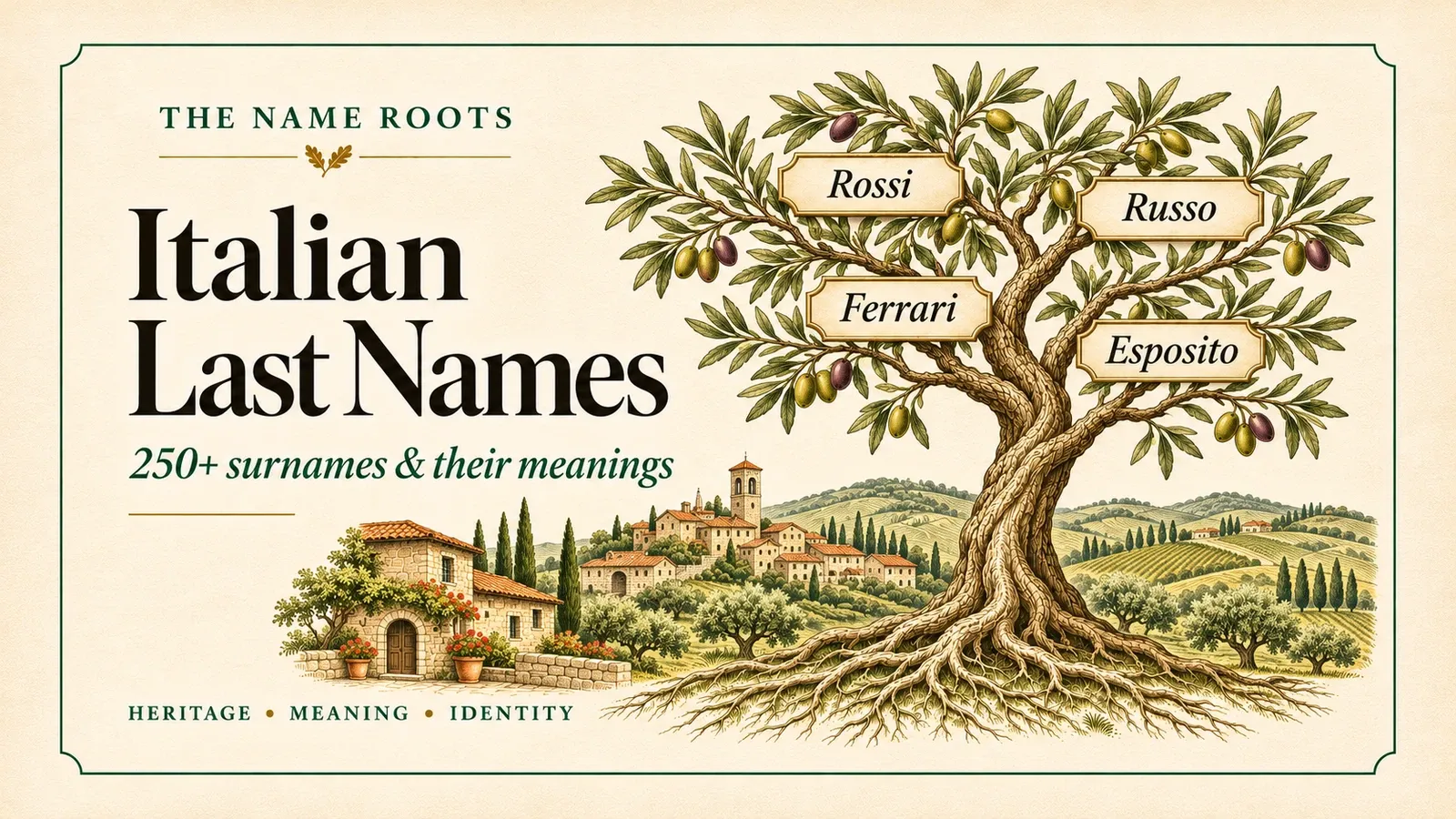
Italy has more surnames than any other country in Europe, an estimated 350,000 of them. Yet one color, red, sits behind two of the most common: Rossi and Russo.
Italian last names usually describe an ancestor’s looks, job, father or hometown. Rossi means “red-haired.” Ferrari means “blacksmith.” Esposito tells a far sadder story, and we’ll get to it.
In this guide, you’ll find more than 250 Italian surnames with their meanings, origin types and home regions. You’ll also learn to read the clues hidden in a name’s ending, which often reveals the exact part of Italy your family came from.
Italian Last Names at a Glance (Quick Facts)
Here’s the short version before we dig in.
| Fact | Answer |
|---|---|
| Most common Italian last name | Rossi (“red”), followed by Russo, Ferrari and Esposito |
| Number of surnames in Italy | About 350,000, the most varied in Europe |
| When surnames became standard | Gradually from the 1400s; church records locked them in after the Council of Trent (1563) |
| Most common origin types | Nicknames, jobs, fathers’ names, places |
| Typical endings | -i in the north, -o in the south, -u in Sardinia |
| Do Italian women change surnames at marriage? | No. They legally keep their own surname |
| Can children take the mother’s surname? | Yes. A 2022 court ruling ended the automatic father’s-surname rule |
How to Read the Tables in This Guide
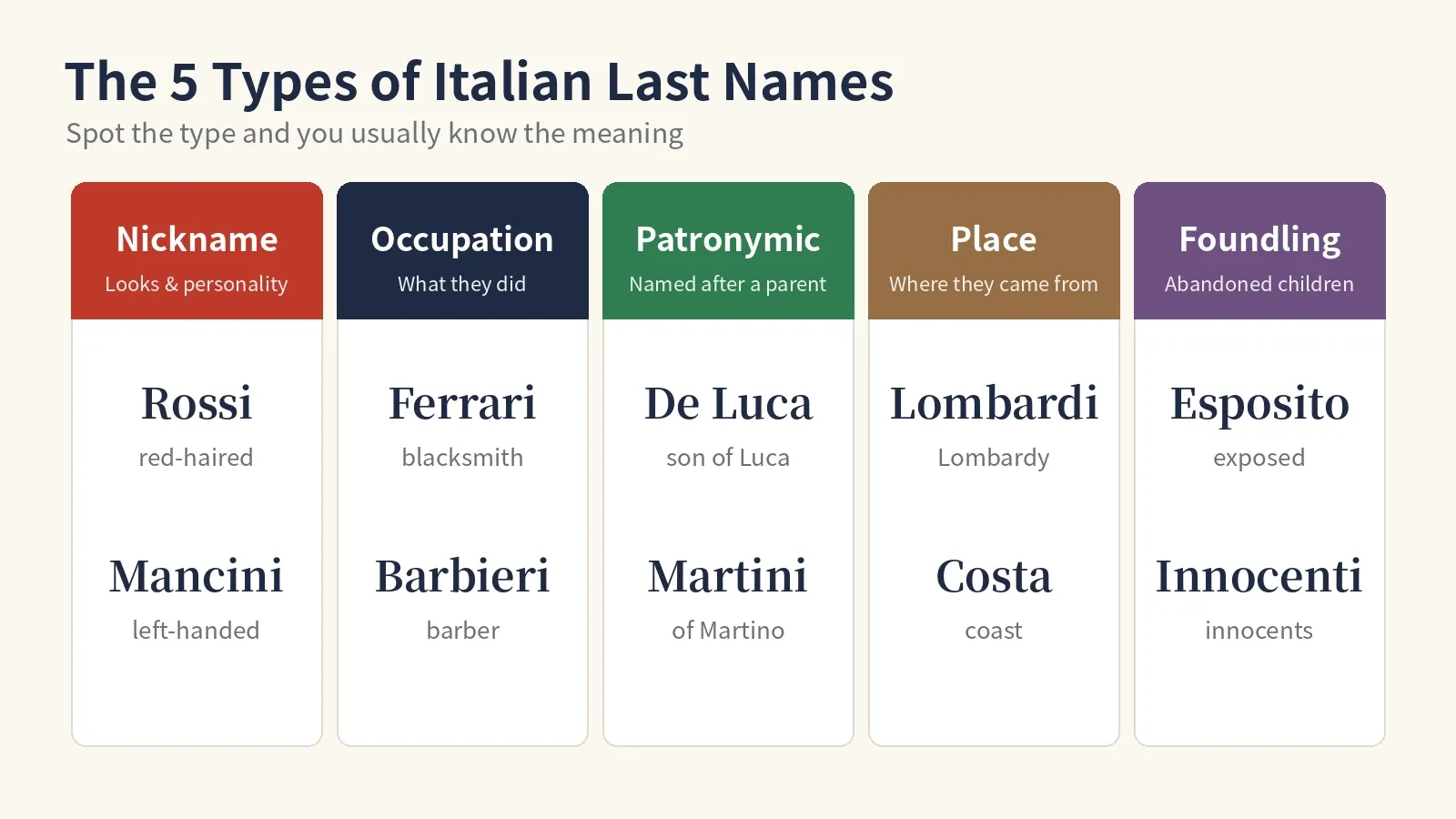
Every surname comes with a meaning and an origin type. Once you know the five types, you’ll start spotting them everywhere.
| Origin type | What it tells you | Example |
|---|---|---|
| Nickname | How an ancestor looked or behaved | Rossi (red-haired), Mancini (left-handed) |
| Occupation | What an ancestor did for a living | Ferrari (blacksmith), Barbieri (barber) |
| Patronymic | The father’s (sometimes mother’s) name | De Luca (son of Luca), Martini (of Martino) |
| Place | Where an ancestor came from or lived | Lombardi (from Lombardy), Costa (coast) |
| Foundling | Given to abandoned children | Esposito (exposed), Innocenti (innocents) |
Why this matters: Most lists just translate a name. Knowing its type tells you something real about your ancestor, whether they were a craftsman, an outsider from another region or a child left at a church door.
The 50 Most Common Italian Last Names and Their Meanings
The most common Italian last names are Rossi, Russo, Ferrari, Esposito and Bianchi. Notice a pattern? Three of the top five describe hair or skin color.
The ranking below follows 2023 data from the Surnam.es database, as published by Daily Italian Words. The “found most in” column is a general guide, since every name here now appears all over Italy.
| Rank | Surname | Meaning | Origin type | Found most in |
|---|---|---|---|---|
| 1 | Rossi | Red-haired | Nickname | North and center |
| 2 | Russo | Red-haired | Nickname | South and Sicily |
| 3 | Ferrari | Blacksmith | Occupation | North |
| 4 | Esposito | “Exposed” (abandoned child) | Foundling | Campania (Naples) |
| 5 | Bianchi | White, fair-haired | Nickname | North |
| 6 | Colombo | Dove | Nickname / foundling | Lombardy |
| 7 | Romano | Roman, from Rome | Place | South |
| 8 | Ricci | Curly-haired | Nickname | Nationwide |
| 9 | Gallo | Rooster | Nickname | South |
| 10 | Bruno | Brown, dark-haired | Nickname | South |
| 11 | Greco | Greek | Place | South |
| 12 | Marino | Of the sea; from Marinus | Patronymic | South |
| 13 | Conti | Counts | Status nickname | Nationwide |
| 14 | Giordano | Jordan (the river) | Patronymic | South |
| 15 | Rizzo | Curly | Nickname | Sicily |
| 16 | De Luca | Son of Luca | Patronymic | South and center |
| 17 | Costa | Coast, hillside | Place | Liguria |
| 18 | Mancini | Left-handed | Nickname | Center |
| 19 | Lombardi | From Lombardy | Place | Nationwide |
| 20 | Barbieri | Barbers | Occupation | North |
| 21 | Fontana | Fountain, spring | Place | North |
| 22 | Moretti | Dark-skinned (“little Moor”) | Nickname | North |
| 23 | Mariani | Of Mario or Maria | Patronymic | Center and north |
| 24 | Caruso | Boy; close-cropped head | Nickname | Sicily and Campania |
| 25 | Galli | Roosters | Nickname | North |
| 26 | Ferrara | From Ferrara | Place | South |
| 27 | Santoro | All Saints (born on that feast) | Religious | South |
| 28 | Rinaldi | Of Rinaldo | Patronymic | North |
| 29 | Longo | Tall | Nickname | South |
| 30 | Villa | Country house, farm | Place | North |
| 31 | Sala | Hall, manor house | Place | Lombardy |
| 32 | Leone | Lion | Nickname | South |
| 33 | Martini | Of Martino | Patronymic | Center |
| 34 | Dalla | “From the” (a place) | Place | Veneto, Emilia |
| 35 | D’Angelo | Of Angelo | Patronymic | South |
| 36 | Bianco | White | Nickname | Northwest and south |
| 37 | Martinelli | Little Martino | Patronymic | North |
| 38 | Gatti | Cats | Nickname | North |
| 39 | Vitale | Full of life | Augural | South |
| 40 | Serra | Mountain ridge | Place | Sardinia, Liguria |
| 41 | Coppola | Flat cap | Nickname | Campania |
| 42 | Gentile | Noble, kind | Nickname | South |
| 43 | Cattaneo | Captain | Status | Lombardy |
| 44 | Ferri | Iron (tools) | Occupation | Center and north |
| 45 | Messina | From Messina | Place | Sicily |
| 46 | Monti | Mountains | Place | North |
| 47 | Marchetti | Little Marco | Patronymic | Center |
| 48 | Marini | Of Marino; the sea | Patronymic | Center |
| 49 | Fabbri | Smiths | Occupation | Emilia-Romagna |
| 50 | Ferraro | Blacksmith | Occupation | South |
The Top 10 Popular Italian Last Names Explained
- Rossi and Russo: Same meaning, different regions. Northern dialects formed Rossi, while southern ones formed Russo. Both describe a red-haired or ruddy ancestor.
- Ferrari: From ferro (iron). Every village needed a blacksmith, which is why the name is everywhere. Yes, it’s the same Ferrari as the car.
- Esposito: Given to abandoned babies in the Naples area. We cover its story in its own section below.
- Bianchi: “White.” It often described pale skin or fair, and later white, hair.
- Colombo: “Dove,” a symbol of the Holy Spirit. It was sometimes given to foundlings, too. Christopher Columbus was Cristoforo Colombo.
- Romano: Someone from Rome, or someone who had traveled there.
- Ricci: “Curly,” from riccio, which also means hedgehog.
- Gallo: “Rooster.” Likely a nickname for a proud or loud man.
- Bruno: “Brown.” It usually described dark hair or complexion.
Why Do So Many Italian Surnames End in -i?
Here’s a detail most lists skip. In medieval Italy, people were often identified by their family group, in the plural. Filippo from the Ormanno family was Filippo degli Ormanni, “Filippo of the Ormannos.”
Over time, the “of the” dropped away, and the plural -i stuck: Filippo Ormanni. That’s why northern and central names like Rossi, Bianchi and Ferrari end in -i. In the south, the singular -o form won out, which is why you get Russo, Bianco and Ferraro.
The same logic explains Lorenzo de’ Medici: literally “Lorenzo of the Medici,” the family of “doctors.”
Italian Last Names You Already Know From Famous People
| Famous person | Surname | Meaning |
|---|---|---|
| Enzo Ferrari (carmaker) | Ferrari | Blacksmith |
| Francis Ford Coppola (director) | Coppola | Flat cap |
| Giancarlo Esposito (actor) | Esposito | “Exposed,” a foundling name |
| Joe DiMaggio (baseball) | DiMaggio | Of Maggio (May) |
| Robert De Niro (actor) | De Niro | Of Nero, “black” |
| Guglielmo Marconi (radio pioneer) | Marconi | “Big Marco” |
| Giacomo Puccini (composer) | Puccini | Little Puccio |
| Lorenzo de’ Medici (Florence) | Medici | Doctors |
How to Decode Any Italian Last Name: Meanings by Type
Almost every Italian surname falls into one of five groups: nickname, occupation, patronymic, place or foundling. Spot the group and you’ve usually found the meaning.
Nickname Surnames (Looks and Personality)
Medieval villagers were blunt. If you were tall, bald or left-handed, that became your name.
| Surname | Meaning |
|---|---|
| Grasso | Fat, stout |
| Basso | Short |
| Calvi | Bald |
| Biondi | Blond |
| Bellini | Little handsome one |
| Allegri | Cheerful |
| Sordi | Deaf |
| Zoppi | Lame |
| Mancuso | Left-handed (southern form) |
| Quattrocchi | “Four eyes” (wore glasses) |
| Boccaccio | Big ugly mouth |
| Gambacorta | Short leg |
Occupation Surnames (Italian Last Names From Jobs)
| Surname | Occupation |
|---|---|
| Sartori | Tailor |
| Pastore | Shepherd |
| Molinari | Miller |
| Fornari | Baker (oven worker) |
| Pescatore | Fisherman |
| Contadino | Farmer |
| Notaro | Notary |
| Cavalieri | Knights, horsemen |
| Speziale | Spice seller, apothecary |
| Tessitore | Weaver |
| Calzolari | Shoemakers |
| Balestrieri | Crossbowmen |
Patronymic Surnames (Named After a Parent)
More than a third of Italian surnames come from a first name. They often start with De, Di or D’ (“of”), or end in a plural -i.
| Surname | Meaning |
|---|---|
| Di Giovanni | Son of Giovanni (John) |
| De Rosa | Of Rosa (a mother’s name) |
| D’Amico | Of Amico (“friend”) |
| Di Stefano | Son of Stefano |
| De Santis | Of the saints |
| Bernardi | Of Bernardo |
| Benedetti | Of Benedetto (“blessed”) |
| Pellegrini | Of Pellegrino (“pilgrim”) |
| Giuliani | Of Giuliano |
| Antonelli | Little Antonio |
Place Surnames (Where Your Family Came From)
A place name usually means the family moved. At home, nobody needs to be called “the one from Genoa.”
| Surname | Meaning |
|---|---|
| Genovese | From Genoa |
| Napolitano | From Naples |
| Veneziano | From Venice |
| Calabrese | From Calabria |
| Siciliano | From Sicily |
| Pugliese / Puglisi | From Puglia |
| Toscano | From Tuscany |
| Fiorentino | From Florence |
| Bosco | Woods |
| Valle | Valley |
| Riva | Riverbank, shore |
| Montanari | Mountain dwellers |
Prefixes: Di, De, Del, Della, La and Lo
| Prefix | Meaning | Example |
|---|---|---|
| Di / De / D’ | Of, son of | Di Maria, De Marco, D’Onofrio |
| Del / Dello / Della | Of the | Del Monte (of the mountain), Della Rovere (of the oak) |
| Lo / La | The | Lo Bianco (the white one), La Rocca (the fortress) |
| Dal / Dalla | From the | Dal Pozzo (from the well) |
Suffixes: Little, Big and Not-So-Nice
Italian loves suffixes. They can turn one root into a whole family of surnames.
| Suffix | Meaning | Example |
|---|---|---|
| -ini, -ino | Little | Rossini (little red one) |
| -etti, -etto | Little | Rossetti |
| -elli, -ello | Little | Rossellini, Rosselli |
| -one, -oni | Big | Rossoni (big red one) |
| -acci, -accio | Rough, bad | Boccacci (big rough mouth) |
| -ucci, -uccio | Dear little | Bertolucci, Petrucci |
So Gioachino Rossini, the composer, was essentially “little red.” And director Roberto Rossellini? Another “little red,” with an extra diminutive.
For another Mediterranean naming system, compare Spanish last names and Greek last names. Regional endings are useful clues, but they need the history and language of the particular family name.
Italian Surnames by Region: What Your Last Name’s Ending Reveals
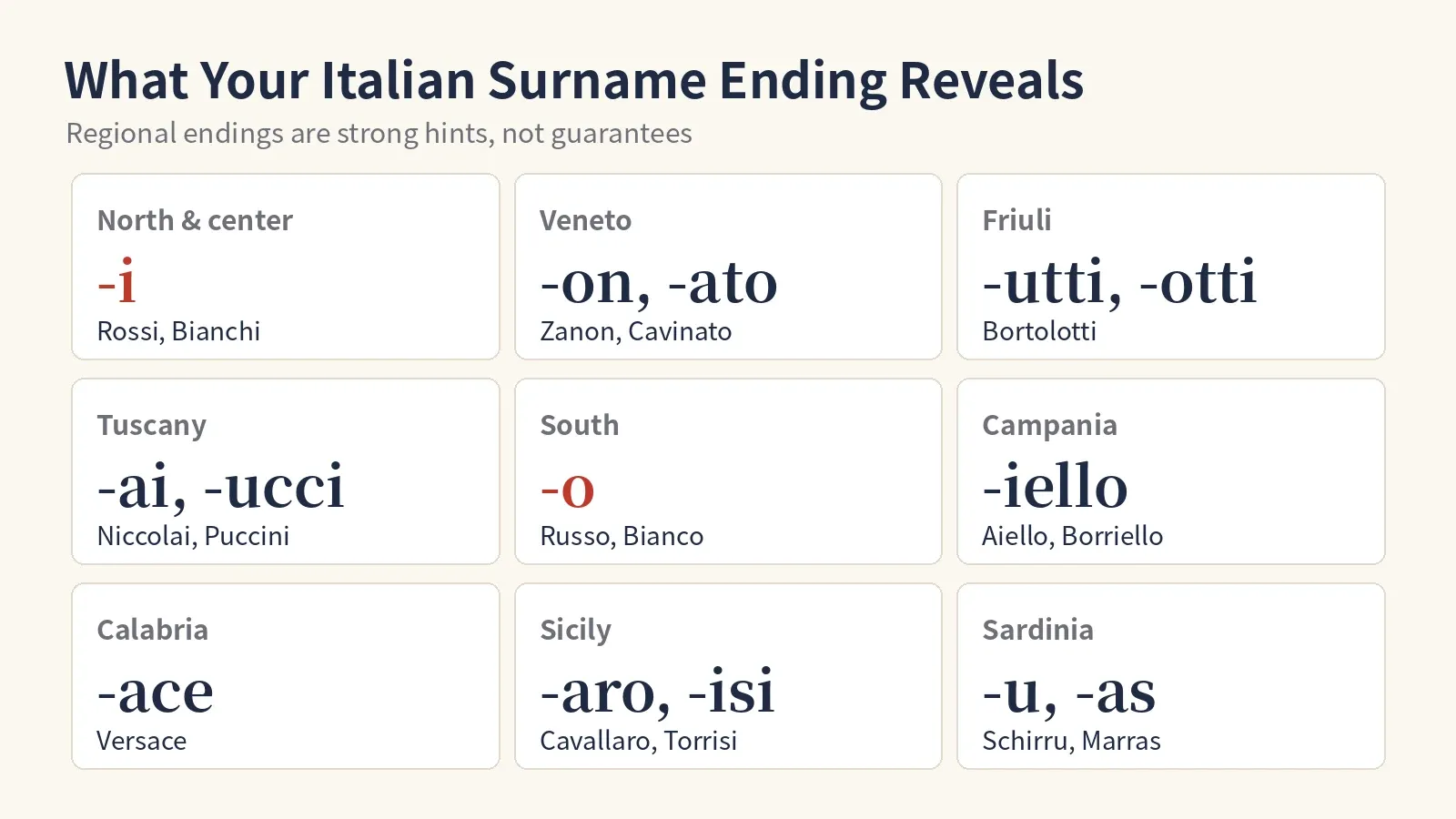
The ending of an Italian surname is often a regional fingerprint. An -i usually points north or center, an -o points south, and endings like -u, -iello or -on narrow it down to a single region.
Italy only unified in 1861. Before that, it was a patchwork of kingdoms and city-states, each with its own dialect. Those dialects shaped the surnames.
| Ending | Region | Examples |
|---|---|---|
| -i | North and center (general) | Rossi, Bianchi, Ferrari |
| -o | South (general) | Russo, Bianco, Ferraro |
| -on, -ato, -asso | Veneto | Zanon, Cavinato, Bissacco |
| -utti, -otti, -t | Friuli | Bortolotti, Cantarutti, Rigonat |
| -ago, -aghi | Lombardy | Salmoiraghi, Carnago |
| -engo, -asco, -audi | Piedmont | Martinengo, Ferrero, Giraudi |
| -ai, -ucci, -ini | Tuscany | Niccolai, Puccini, Innocenti |
| -iello, -ella | Campania | Aiello, Borriello, Coppola |
| -is, -iis | Abruzzo | De Laurentiis, De Sanctis |
| -ace | Calabria | Versace |
| -aro, -isi, -osso | Sicily | Cavallaro, Torrisi, Grosso |
| -u, -as, -is | Sardinia | Schirru, Marras, Pinna |
These patterns come from Wikipedia’s overview of Italian names. They’re strong hints, not guarantees, because families moved and spellings shifted.
Sicilian Last Names: Where Arab, Greek, Norman and Spanish Roots Meet
Sicily was ruled by Greeks, Arabs, Normans and Spaniards over roughly 2,500 years. Each one left names behind. That makes Sicilian last names some of the most layered in Italy.
| Surname | Meaning | Root |
|---|---|---|
| Balistreri | Crossbowman | Arab-Sicilian era |
| Greco | Greek | Greek colonies |
| Di Stefano | Son of Stefano | Greek (Stephanos) |
| Giuffrida | Son of Godfrey | Norman |
| Orlando | Famous land (Roland) | Norman / Germanic |
| Catalano | From Catalonia | Spanish rule |
| Pappalardo | Lard-eater | Sicilian nickname |
| Finocchiaro | Fennel grower | Occupation |
| Bongiorno | Good morning | Augural (a wish) |
| Trovato | Found | Foundling |
| Gambino | Little leg | Nickname |
| Lombardo | Man from Lombardy | Place |
| Caruso | Boy, apprentice | Nickname |
| Cavallaro | Horseman, horse dealer | Occupation |
| Torrisi | Of the tower | Place |
Source: Sicilian Food Culture and Wikipedia.
Northern vs Southern Italian Last Names at a Glance
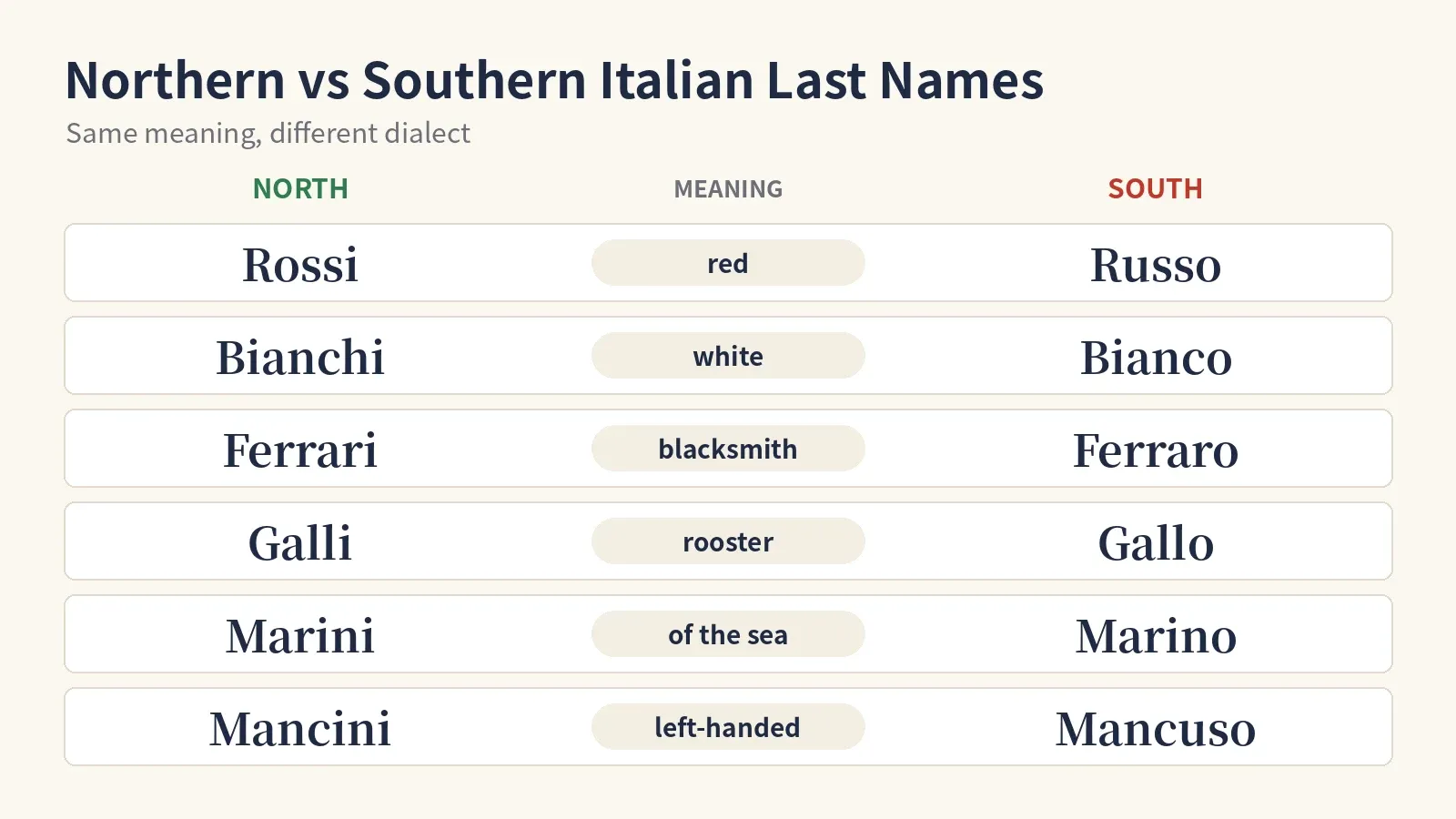
| Northern style | Southern style | Shared meaning |
|---|---|---|
| Rossi | Russo | Red |
| Bianchi | Bianco | White |
| Ferrari | Ferraro | Blacksmith |
| Galli | Gallo | Rooster |
| Marini | Marino | Sea / Marino |
| Mancini | Mancuso | Left-handed |
Foundling Surnames: The Hidden Story Behind Esposito
Esposito, Italy’s fourth most common surname, was originally given to abandoned babies. It comes from the Latin expositus, meaning “exposed” or “placed outside.”
For centuries, Italian cities ran foundling hospitals. Many had a ruota, a revolving wooden wheel set into the wall. A parent could place a baby inside, turn the wheel and walk away unseen. The nuns on the other side took the child in.
Those children needed surnames. So officials invented them, and the names they chose were often kind, religious or hopeful.
| Surname | Meaning | Where it’s common |
|---|---|---|
| Esposito | Exposed, placed outside | Naples, Campania |
| Proietti | Cast out, thrown away | Rome, Lazio |
| Innocenti | The innocents | Florence, Tuscany |
| Colombo | Dove (sign of the Holy Spirit) | Milan, Lombardy |
| Casadei | House of God | Emilia-Romagna |
| Trovato / Trovati | Found | Sicily, south |
| Diotallevi | May God raise you | Central Italy |
| Diotaiuti | May God help you | Central Italy |
| Benvenuto | Welcome | Nationwide |
| Venturini | Little lucky one | North and center |
| Degli Esposti | Of the exposed ones | Bologna |
| Della Casa | Of the house (the hospital) | Nationwide |
Florence’s famous Ospedale degli Innocenti gave so many children the name Innocenti that it became a common Tuscan surname.
In the 1800s, Italian authorities stopped giving foundlings such obvious labels, since the names carried a lifelong stigma. Officials began inventing neutral surnames instead, which is one reason Italy ended up with so many unique names.
Rare and Unusual Italian Last Names
Rare Italian last names are often whole phrases frozen into a name, like Bevilacqua (“drink water”) or Ingannamorte (“cheat death”). With around 350,000 surnames, Italy has thousands that belong to just a few families.
15 Unusual Italian Surnames With Surprising Meanings
| Surname | Literal meaning | Likely story |
|---|---|---|
| Ingannamorte | Cheat death | A hopeful wish for a child’s survival |
| Nonfarmale | Don’t do harm | A gentle blessing |
| Gustapane | Enjoy bread | A baker or a bread lover |
| Buttacavoli | Throw cabbages | A produce seller |
| Passacantando | Passes by singing | A wandering street vendor |
| Cantarutti | Little singer | Friulian nickname |
| Cantacessi | Sings for the dead | Mourners at funerals |
| Mezzasalma | Half a corpse | Probably a small land measure in Sicily |
| Testagrossa | Big head | A large head, or a big brain |
| Zappacosta | Hoe the coast | Coastal farmers in Abruzzo |
| Scaramuccia | Skirmish | A boastful stage soldier in Naples |
| Bonadonna | Good woman | A noble soul |
| Piscione | Big fish | A fisherman |
| Chiappa | To seize | Hunters or trap makers |
| Mastronzo | Master Oronzo | A skilled craftsman |
Source: Daily Italian Words.
More Rare Italian Last Names Built From Phrases
Italians love compound surnames. They read like tiny sentences.
| Surname | Meaning |
|---|---|
| Bevilacqua | Drink water |
| Mangiapane | Eat bread |
| Mangiafico | Eat figs |
| Tagliaferro | Iron cutter |
| Squarcialupi | Wolf tearer |
| Scannapieco | Sheep slaughterer |
| Bentivoglio | I wish you well |
| Malatesta | Bad head (stubborn) |
| Mezzanotte | Midnight |
| Acquaviva | Living water |
| Quarantotto | Forty-eight |
| Bonfiglio | Good son |
| Bongiovanni | Good Giovanni |
| Buonocore | Good heart |
| Malaspina | Bad thorn |
Why Some Italian Surnames Are So Rare
Three forces created Italy’s long tail of rare names:
- Isolation. Mountain villages and islands kept local names from spreading.
- Invented foundling names. After the 1800s, officials created unique neutral surnames for abandoned children.
- Emigration. Millions of Italians left between the 1880s and 1920s. Some surnames became more common in New York or Buenos Aires than in Italy itself.
Unique, Cool and Noble Italian Last Names
Cool Italian last names tend to borrow from animals, weapons, nature or famous dynasties. Every name below is a real surname, so you can use it with confidence.
Cool Italian Last Names With Strong Meanings
| Surname | Meaning | Vibe |
|---|---|---|
| Lupo | Wolf | Fierce |
| Falco | Falcon | Sharp |
| Corvo | Raven | Dark |
| Orso | Bear | Powerful |
| Forte | Strong | Bold |
| Valente | Brave, capable | Heroic |
| Ferro | Iron | Tough |
| Guerra | War | Intense |
| Martello | Hammer | Tough |
| Spada | Sword | Warrior |
| Tempesta | Storm | Dramatic |
| Santangelo | Holy angel | Mystical |
| Romeo | Pilgrim to Rome | Romantic |
| Amato | Beloved | Warm |
| Fortunato | Lucky | Upbeat |
| Bellavia | Beautiful road | Elegant |
| Valentino | Healthy, strong | Stylish |
| D’Alessandro | Son of Alessandro (defender) | Classic |
Unique Italian Last Names That Sound Beautiful
Some names are simply a pleasure to say. These tend to be less common but very recognizable.
| Surname | Meaning |
|---|---|
| Belcastro | Beautiful castle |
| Bellafiore | Beautiful flower |
| Buonamici | Good friends |
| Fiorello | Little flower |
| Primavera | Spring (the season) |
| Serafini | Seraphs, angels |
| Paradiso | Paradise |
| Stella | Star |
| Marchesi | Marquises |
| Viola | Violet |
Noble Italian Last Names From Famous Dynasties
These families ruled cities, produced popes and funded the Renaissance. Many of their surnames still exist today, carried by descendants and unrelated families alike.
| Surname | Meaning | Famous for |
|---|---|---|
| Medici | Doctors | Rulers of Florence; patrons of Michelangelo |
| Sforza | Force, strength | Dukes of Milan; patrons of Leonardo |
| Visconti | Viscounts | Lords of Milan before the Sforza |
| Este | From Este (a town) | Dukes of Ferrara and Modena |
| Gonzaga | From Gonzaga (a town) | Rulers of Mantua for nearly 400 years |
| Farnese | From Farnese (a town) | Dukes of Parma; Pope Paul III |
| Orsini | Little bears | Roman nobility; three popes |
| Colonna | Column | Roman nobility; Pope Martin V |
| Borghese | Of the borough, townsman | Roman family; Villa Borghese |
| Doria | Of Oria (an ancestor’s name) | Admirals of Genoa |
| Savoia | Savoy | Italy’s royal family, 1861–1946 |
| Barberini | From Barberino | Pope Urban VIII |
| Pallavicini | From an ancestor named Pallavicino | Northern Italian nobility |
Italian-American Last Names: From Ellis Island to Today
Italian-American last names are mostly southern Italian names, like Russo, Esposito and Romano. That’s because roughly four out of five Italian immigrants to the US came from the south and Sicily, especially between 1880 and 1920.
According to an analysis of US Census data published by We The Italians, Russo is the most common Italian surname in America. Notice it’s the southern “red” name, not the northern Rossi that leads in Italy.
Common Italian-American Last Names
| Surname | Meaning | Typical roots |
|---|---|---|
| Russo | Red-haired | South, Sicily |
| Esposito | Foundling | Naples |
| Romano | From Rome | South |
| Marino | Of the sea | South |
| Greco | Greek | South |
| Bruno | Brown-haired | South |
| Rizzo | Curly | Sicily |
| Caruso | Boy, apprentice | Sicily, Campania |
| Gallo | Rooster | South |
| Ferrara | From Ferrara | South |
| Amato | Beloved | South |
| Santoro | All Saints | South |
| Vitale | Full of life | South |
| DeLuca | Son of Luca | South, center |
| Castellano | Castle keeper, from a castle town | South |
| Palumbo | Wood pigeon | South |
| Rinaldi | Of Rinaldo | North |
| Pellegrino | Pilgrim | South |
The Ellis Island Name-Change Myth
You’ve probably heard a family story like this: “Our name was changed at Ellis Island.” It’s one of the most repeated myths in American genealogy.
Here’s the reality. Ship passenger lists were written up in Europe, when the ticket was sold. Ellis Island inspectors only checked names against those lists. According to US Citizenship and Immigration Services, inspectors were not supposed to change a name unless the immigrant asked or the original record was wrong.
So what actually happened? Names changed later and gradually, through:
- Teachers, employers and landlords who spelled names by ear.
- Naturalization papers, where immigrants chose a new spelling.
- Families who simplified names themselves to fit in or avoid prejudice.
How Italian Surnames Were Americanized
The most common changes followed a few patterns:
| Pattern | Italian original | American version |
|---|---|---|
| Dropping the final vowel | Martino | Martin |
| Joining the prefix | De Luca, Di Maggio | DeLuca, DiMaggio |
| Capitalizing the particle | di Pietro | DiPietro |
| Simplifying hard spellings | Giacomo (first name) | Jack |
| Translating the meaning | Bianco | White (in some families) |
That’s why an American DeLuca may find De Luca in Italian records. Always search both forms.
When comparing immigrant-family spellings, Irish last names and German last names offer separate examples to investigate. French last names also show why a familiar-looking form may have a different linguistic background.
Italian Mafia Names in Movies and TV (And What They Really Mean)
Most “mafia names” in pop culture are ordinary Italian surnames or real Sicilian place names. Corleone, for example, is a small town near Palermo. The meaning behind these names is almost always harmless.
Hollywood has leaned on Italian surnames for gangster stories for decades. That’s worth knowing, because millions of law-abiding Italian Americans share these names, and many find the stereotype tiresome.
Famous Fictional Crime-Family Names
| Surname | Source | Real meaning |
|---|---|---|
| Corleone | The Godfather | A real town in Sicily’s Palermo province |
| Soprano | The Sopranos | A high singing voice; from sopra (“above”) |
| Moltisanti | The Sopranos | “Many saints” |
| Clemenza | The Godfather | Mercy, clemency |
| Tattaglia | The Godfather | A rare surname; its meaning is unclear |
| Barzini | The Godfather | A northern-style name ending in -ini (“little”) |
Surnames Linked to New York’s Historic “Five Families”
The five crime families of 20th-century New York are named after historical figures. Their surnames, though, carry everyday meanings.
| Surname | Meaning |
|---|---|
| Gambino | Little leg |
| Genovese | From Genoa |
| Lucchese | From Lucca |
| Bonanno | Good year |
| Colombo | Dove |
Our take: If you’re naming a character, these surnames will instantly signal “mob story” to an American audience. If you want an Italian-American character without that baggage, pick a name from our common or cool lists instead.
The History of Italian Last Names: From Ancient Rome to Today
Italians had hereditary surnames in ancient Rome, lost them in the Middle Ages, and adopted them again from the 1400s onward. The Catholic Church then made them permanent.
| Period | What happened |
|---|---|
| Ancient Rome | Citizens used three names (tria nomina), including a family name (nomen), as in Gaius Julius Caesar |
| Early Middle Ages | The Roman system fades; most people use a single given name |
| 1100s–1300s | Growing cities need to tell people apart; nicknames and “son of” names spread, starting with nobles and merchants |
| Around 1450 | Most ordinary Italians now have a hereditary surname |
| 1563 | The Council of Trent requires parishes to record baptisms and marriages, locking surnames into written records |
| 1800s | Napoleonic civil registration brings state birth, marriage and death records |
| 1861 | Italy unifies; regional names start mixing |
| 1880–1920 | Mass emigration spreads Italian surnames to the Americas |
| 1975 | Family law reform: married women keep their own surname and may add the husband’s |
| 2022 | Constitutional Court ends the automatic father’s-surname rule for children |
Why Surnames Took Hold in Medieval Italy
Picture a medieval town with ten men named Giovanni. How do you tell them apart? You add a detail: Giovanni the blacksmith (Ferrari), Giovanni the redhead (Rossi), Giovanni from Genoa (Genovese), Giovanni son of Luca (De Luca).
At first, these details changed with each generation. Over time, they stuck to families and became hereditary. Tax records, notaries and property deeds sped the process up.
The Council of Trent: The Moment Surnames Became Permanent
In 1563, the Council of Trent ordered every parish to keep registers of baptisms and marriages. One practical goal was to stop people from marrying close relatives by accident. Recording a stable surname for every family made that possible.
That’s great news for you if you’re tracing ancestors. Italian parish records often reach back to the late 1500s, far earlier than most civil records in other countries.
How Italian Last Names Work Today
Knowing what your surname means is only half the picture. Here’s how Italian surnames are used, passed on and pronounced now.
Do Italian Women Change Their Last Name After Marriage?
No. Under Italian law, a married woman keeps her own surname for all legal purposes. Since the 1975 family law reform, she may add her husband’s surname after her own in social settings, but her official documents stay in her birth name.
So if you meet “Giulia Bianchi” married to “Marco Rossi,” her passport still says Bianchi.
Which Last Name Do Italian Children Get?
For generations, children automatically took the father’s surname. That changed in April 2022, when Italy’s Constitutional Court ruled the automatic rule discriminatory (NPR).
Now, by default, a child receives both parents’ surnames, in the order the parents agree on. Parents can still choose to give just one surname if they both agree. Some practical details still depend on follow-up rules from Italian lawmakers, so check current guidance if this affects your family. Either way, expect to see many more double surnames in Italy.
How to Pronounce Italian Last Names Correctly
Italian spelling is very regular. Learn these five rules and you’ll pronounce most surnames correctly.
| Rule | Example | Say it like |
|---|---|---|
| Every vowel is pronounced, including the last one | Esposito | es-POH-zee-toh |
| “ch” sounds like “k” | Chiappa, Bianchi | KYAHP-pah, BYAHN-kee |
| “c” or “g” before e/i is soft | Ricci, Gentile | REET-chee, jen-TEE-leh |
| “gli” sounds like “lyee” | Pagliaro | pahl-YAH-roh |
| Double consonants are held longer | Galli vs Gali | GAHL-lee (hold the L) |
The mistake English speakers make most: turning Ricci into “RICK-ee.” In Italian, it’s “REET-chee.”
De Luca or DeLuca? Spelling Prefixes in Italy vs the US
In Italy, prefixes usually stay separate: De Luca, Di Maggio, Lo Bianco. In the US, many families joined them: DeLuca, DiMaggio, LoBianco.
Neither is wrong. However, if you’re searching records, try every version: with a space, without a space and with a lowercase prefix (di Maggio).
Expert Insights and Real-World Examples
Lists explain what names mean. These examples show how you can actually use that knowledge.
Case Study: Tracing an Italian-American Surname in 5 Steps
Let’s follow a typical search. Say your great-grandfather was “Joseph DeLuca” of Brooklyn.
- Find the Italian spelling. US naturalization papers or a ship manifest will likely show Giuseppe De Luca. Joseph is simply the English form of Giuseppe.
- Find the hometown. Passenger lists from the 1890s onward usually record the last place of residence, for example a town in Campania.
- Use the surname as a map. De Luca is a patronymic common in the south and center, which fits a Campanian origin.
- Search Italian records. The Italian State Archives’ free Antenati portal holds millions of digitized birth, marriage and death records, searchable by town.
- Go back to the parish. Before the 1800s, look for church records. Thanks to the Council of Trent, many parishes kept them from the late 1500s.
Real Examples: What Famous Surnames Reveal
- Ferrari: Enzo Ferrari’s supercar empire carries a name that means “blacksmith.” An iron-working ancestor, fittingly.
- Esposito: Actor Giancarlo Esposito carries one of Italy’s most common foundling names, a quiet reminder of Naples’ foundling-wheel history.
- Coppola: Francis Ford Coppola’s surname means “flat cap” in southern dialect, the classic coppola worn by Sicilian farmers.
- Rossini: Gioachino Rossini, composer of The Barber of Seville, was literally “little red one.”
- Medici: Florence’s rulers bore a name meaning “doctors,” possibly hinting at an apothecary past. Their coat of arms even shows round balls, which some say represent pills.
Common Mistakes People Make With Italian Surnames
| Mistake | Why it’s a problem | Do this instead |
|---|---|---|
| Believing Ellis Island changed your name | It’s a myth; changes came later | Check naturalization and census records |
| Searching only one spelling | Records use De Luca, DeLuca and Di Luca | Search every variant |
| Assuming Rossi and Russo are unrelated | They’re the same name in two dialects | Consider both when researching |
| Looking for a woman under her married name | Italian records use birth surnames | Search her maiden name |
| Saying “RICK-ee” for Ricci | “cci” is pronounced “tchee” | Say “REET-chee” |
How to Choose an Italian Last Name for Characters, Games and Pen Names
The best Italian surname for a character matches their region, era and personality. A Sicilian fisherman named Visconti will feel off to any Italian reader. A Milanese banker named Visconti won’t.
A 5-Step Italian Surname Checklist
- Pick a region first. Northern characters suit -i endings (Bianchi, Galli). Southern and Sicilian characters suit -o endings (Russo, Caruso).
- Match the social class. Nobles fit dynastic names (Sforza, Orsini). Working families fit job or nickname names (Ferraro, Longo).
- Let the meaning do some work. A fierce character named Lupo (“wolf”) or a gentle one named Amato (“beloved”) adds a subtle layer.
- Avoid accidental stereotypes. Corleone or Soprano will read as “mob story” instantly.
- Say it with the first name. “Luca Valente” flows. Check the rhythm out loud.
28 Real Italian Surnames That Make Great Character Names
| Surname | Meaning | Surname | Meaning |
|---|---|---|---|
| Albanese | From Albania | Neri | Black, dark |
| Bellucci | Little beautiful one | Nobile | Noble |
| Cardinale | Cardinal | Orlandi | Of Orlando |
| Castelli | Castles | Palladino | Paladin, knight |
| Cortese | Courteous | Parisi | From Paris |
| De Angelis | Of the angels | Rosati | Rosy |
| Donati | Gifted | Sabatini | Born on the Sabbath |
| Fiore | Flower | Salvatore | Savior |
| Galante | Gallant | Silvestri | Of the woods |
| Leonardi | Of Leonardo (brave lion) | Tedesco | German |
| Marchese | Marquis | Valenti | Brave |
| Mazza | Club, mace | Vento | Wind |
| Morelli | Little dark one | Zanetti | Little Gianni (Venetian) |
| Negri | Black-haired | Zeno | Of Zeno (Venetian) |
Find Your Perfect Name With Our Italian Last Name Generator
Still deciding? Use the Italian Last Name Generator at the top of this page. Filter by region (north, south, Sicily, Sardinia), origin type (nickname, job, place, patronymic) and vibe (classic, cool, noble). Each result shows the meaning and a one-click copy button.
Exploring more heritage names? See our guides to Japanese last names, Spanish last names, Irish last names and Italian names, or browse the full last names hub.
For a complete Italian character or baby-name combination, start with Italian given names. If your project also includes a Japanese family, use Japanese last names as a separate cultural reference instead of transferring Italian surname patterns.
FAQs About Italian Last Names
What is the most common Italian last name?
Rossi is the most common last name in Italy, followed by Russo, Ferrari, Esposito and Bianchi. In the United States, Russo is the most common Italian surname, because most Italian immigrants came from the south.
How many surnames are there in Italy?
Italy has an estimated 350,000 surnames, the greatest variety of any country in Europe. Many are local names shared by only a few families.
What do most Italian last names mean?
Most describe an ancestor’s appearance (Rossi, “red”), job (Ferrari, “blacksmith”), father (De Luca, “son of Luca”) or hometown (Lombardi, “from Lombardy”).
Why do Italian last names end in -i or -o?
Names ending in -i are usually plural forms from northern and central Italy, meaning “of the family of.” Names ending in -o usually come from the south, where the singular form became standard.
What are some rare Italian last names?
Rare examples include Ingannamorte (“cheat death”), Nonfarmale (“don’t do harm”), Gustapane (“enjoy bread”), Zappacosta (“hoe the coast”) and Quarantotto (“forty-eight”).
What are the most common Sicilian last names?
Common Sicilian surnames include Russo, Messina, Caruso, Lombardo, Marino, Rizzo, Greco and Ferraro. Sicilian names also show Greek, Arab, Norman and Spanish influences.
What does Esposito mean?
Esposito comes from the Latin expositus, meaning “exposed.” It was given to abandoned babies, especially in the Naples area.
What are some cool Italian last names?
Popular choices include Lupo (wolf), Falco (falcon), Corvo (raven), Spada (sword), Tempesta (storm) and Santangelo (holy angel).
Were Italian names changed at Ellis Island?
No. Ellis Island inspectors worked from passenger lists written in Europe and weren’t supposed to change names. Most changes happened later, through schools, jobs, naturalization or the family’s own choice.
Do Italian women take their husband’s last name?
No. Italian women legally keep their own surname after marriage. They may add the husband’s surname socially, but official documents use their birth name.
What are Italian last names that mean strong?
Forte (strong), Valente and Valenti (brave), Ferro (iron), Leone (lion) and Sforza (force) all carry a sense of strength.
Is DeLuca or De Luca correct?
Both are correct. In Italy, the prefix is usually written separately (De Luca). Many Italian-American families joined it (DeLuca).
The Bottom Line
- Most Italian last names describe a person: their looks, trade, father or hometown.
- The ending is a regional clue: -i leans north, -o leans south, and endings like -iello or -u point to specific regions.
- Family stories can mislead: Ellis Island didn’t change names, and Esposito hides a foundling past.
Ready to find a name? Try the Italian Last Name Generator at the top of this page.
Sources: Italian name (Wikipedia) · 50 most common Italian last names (Daily Italian Words) · 15 unusual Italian last names (Daily Italian Words) · 100 most common Italian last names (LearnItalianPod) · Sicilian surnames (Sicilian Food Culture) · Italian last names in America (We The Italians) · Immigrant name changes (USCIS) · Italian court ruling on children’s surnames (NPR) · History behind Italian last names (My Italian Family)
Looking for more? Explore name origins and meanings across all eight categories.