Name generator
French Last Name Generator
Explore 167 distinct French surnames from this guide. Start with rare and uncommon picks, or explore every category. Choose a category or letter to narrow your results, then copy or save your favorites.
Showing 15 of 167 matching French surnames.
Results use different initials when available. Counts reflect the names in this guide; some letters and categories naturally have fewer matches. Letters without matches are hidden. “Rare” and “uncommon” follow the guide’s descriptions, not a worldwide frequency ranking.
- BoileauGuide: rare
Drink water
- DeslauriersGuide: rare
Of the laurels
- Cinq-MarsGuide: rare
From Cinq-Mars (a town)
- GrosjeanGuide: rare
Big John
- TroisfontainesGuide: rare
Three springs
- SansregretGuide: rare
Without regret
- MangematinGuide: rare
Eat in the morning
- VaillancourtGuide: rare
Brave court
- BoivinGuide: rare
Drink wine
- ChantepieGuide: rare
Singing magpie
- VivierGuide: rare
Fish pond
- BonenfantGuide: rare
Good child
- Martin
Of Mars (god of war)
- Etcheverry
- Guillemet
These are surnames from the guide, not invented combinations. Follow the guide for meanings, regional context, and spelling variants. View your shortlist
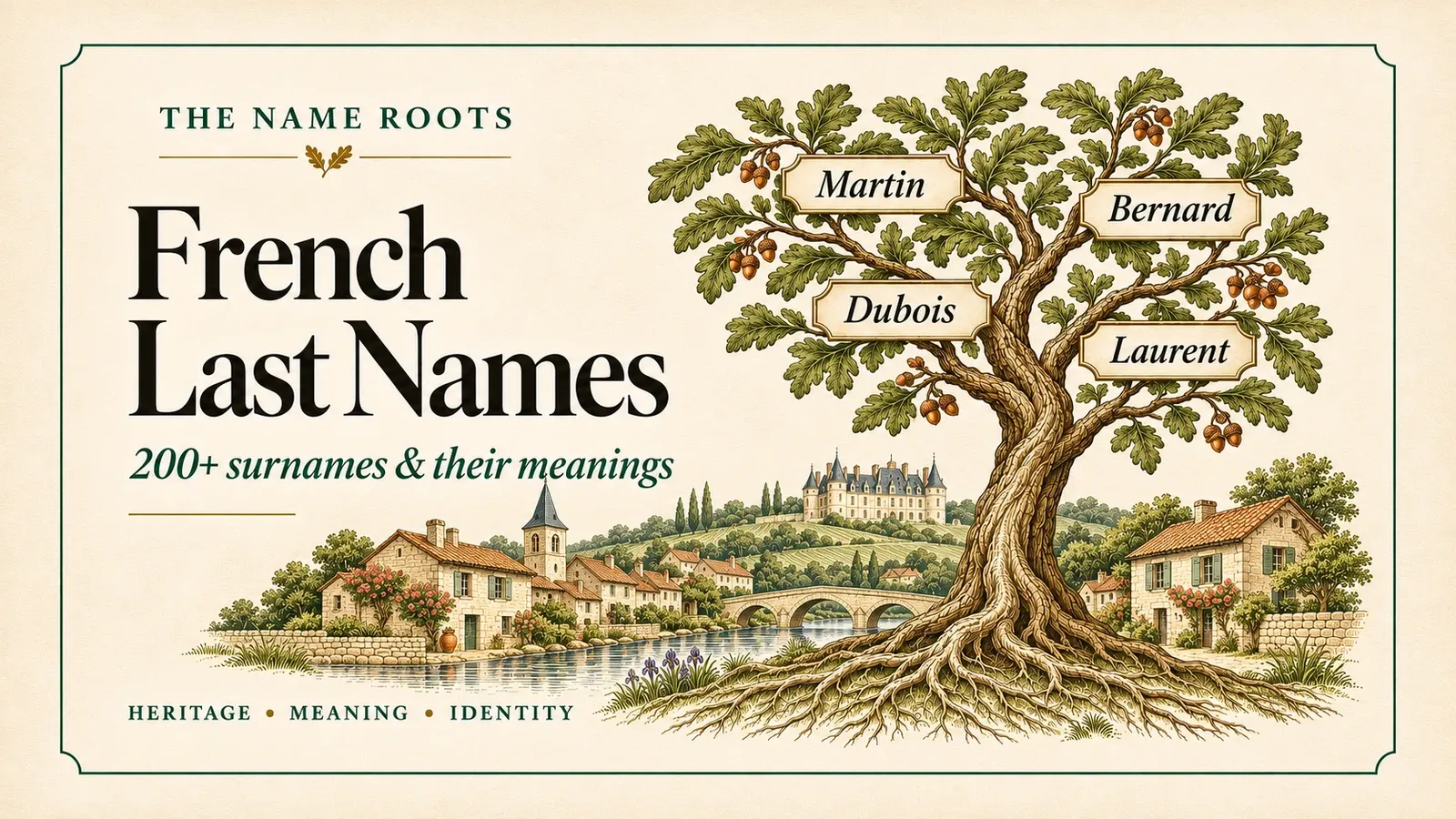
France’s most common surname isn’t Dupont or Lefebvre. It’s Martin, a name borrowed from Mars, the Roman god of war.
French last names usually come from a father’s first name, a job, a place or a nickname. Once you know those four patterns, most French surnames translate themselves. Durand means “enduring.” Dubois means “from the woods.” Lefebvre means “the smith.”
In this guide, you’ll find more than 200 French surnames with meanings, plus the truth about the “noble” particle de, the story behind Cajun names like Boudreaux, and how French-Canadian families ended up sharing just a handful of surnames.
French Last Names at a Glance (Quick Facts)
| Fact | Answer |
|---|---|
| Most common French last name | Martin, followed by Bernard, Thomas, Petit and Robert |
| Number of French surnames | More than 1.3 million were registered for births between 1891 and 1990 |
| Most common origin | A father’s first name (Martin, Bernard, Thomas, Robert) |
| Does “de” mean noble? | Not necessarily. Many commoners have it too |
| Do French women change their name at marriage? | Not legally. They keep their birth name and may use their husband’s |
| Can children take the mother’s surname? | Yes, since 2005, or both names joined |
| Most common surname in Québec | Tremblay |
How to Read the Tables in This Guide
Each surname comes with a meaning and an origin type:
| Origin type | What it tells you | Example |
|---|---|---|
| Patronymic | Named after a father (or ancestor) | Martin, Bernard, Thomas |
| Occupation | What an ancestor did | Lefebvre (smith), Boulanger (baker) |
| Place | Where an ancestor lived | Dubois (woods), Dupont (bridge) |
| Nickname | How an ancestor looked or acted | Petit (small), Moreau (dark) |
The 50 Most Common French Last Names and Their Meanings
The most common French last names are Martin, Bernard, Thomas, Petit and Robert. Four of those five are simply old first names, which tells you how French surnames were born.
The ranking below follows French birth records from 1891 to 1990, as summarized on Wikipedia. Meanings come from standard surname dictionaries.
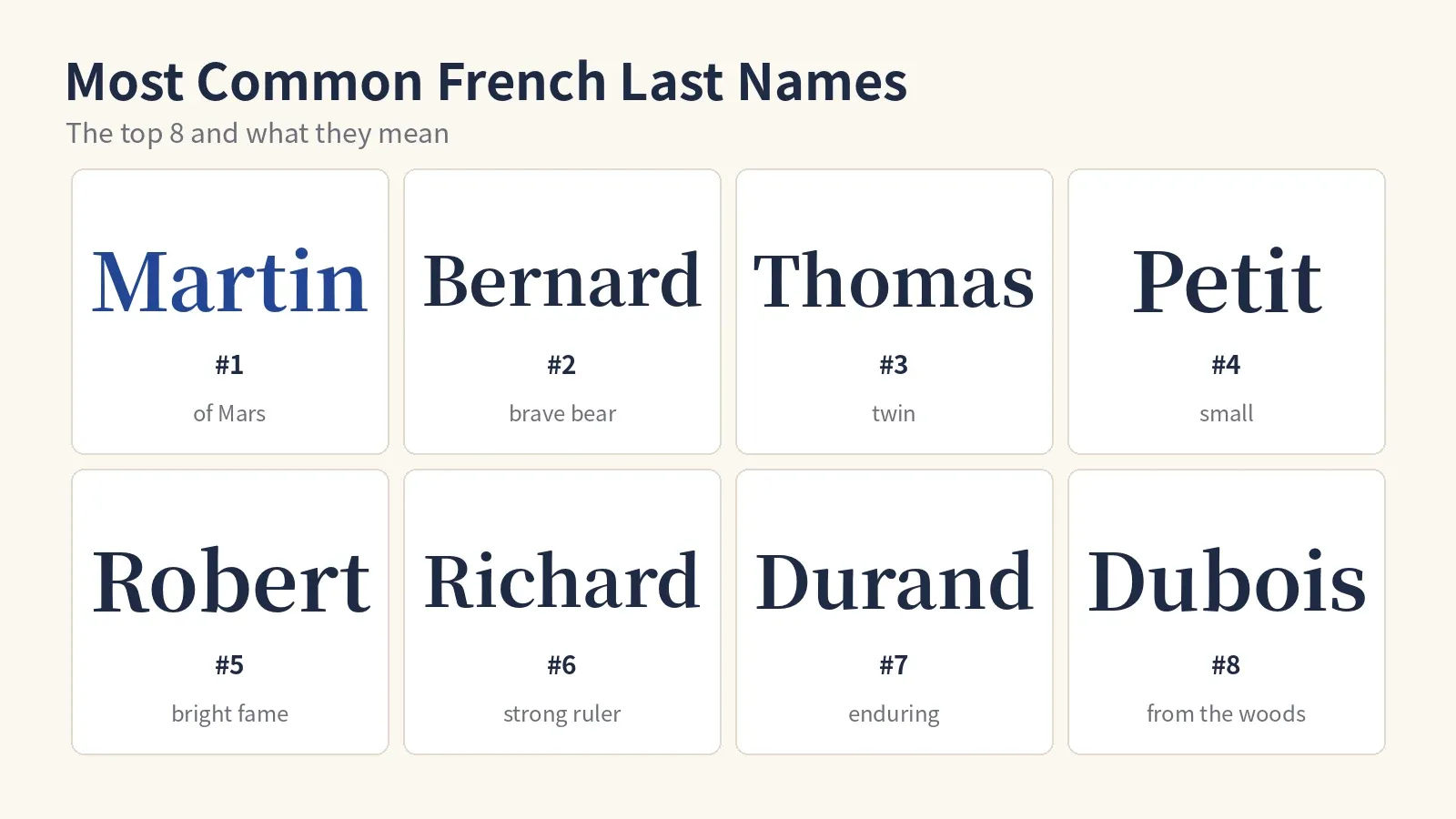
| Rank | Surname | Meaning | Origin type |
|---|---|---|---|
| 1 | Martin | Of Mars (god of war) | Patronymic |
| 2 | Bernard | Brave bear | Patronymic |
| 3 | Thomas | Twin | Patronymic |
| 4 | Petit | Small | Nickname |
| 5 | Robert | Bright fame | Patronymic |
| 6 | Richard | Strong ruler | Patronymic |
| 7 | Durand | Enduring, steadfast | Nickname |
| 8 | Dubois | From the woods | Place |
| 9 | Moreau | Dark-skinned, dark-haired | Nickname |
| 10 | Laurent | Laurel (victory) | Patronymic |
| 11 | Simon | He has heard | Patronymic |
| 12 | Michel | Who is like God? | Patronymic |
| 13 | Lefebvre | The smith | Occupation |
| 14 | Leroy | The king | Nickname |
| 15 | Roux | Red-haired | Nickname |
| 16 | David | Beloved | Patronymic |
| 17 | Bertrand | Bright raven | Patronymic |
| 18 | Morel | Little dark one | Nickname |
| 19 | Fournier | Baker, oven keeper | Occupation |
| 20 | Girard | Brave spear | Patronymic |
| 21 | Bonnet | Hat, bonnet maker | Occupation |
| 22 | Dupont | From the bridge | Place |
| 23 | Lambert | Bright land | Patronymic |
| 24 | Fontaine | Spring, fountain | Place |
| 25 | Rousseau | Little red-haired one | Nickname |
| 26 | Vincent | Conquering | Patronymic |
| 27 | Muller | Miller (Alsatian) | Occupation |
| 28 | Lefèvre | The smith | Occupation |
| 29 | Faure | Smith (southern form) | Occupation |
| 30 | André | Manly, brave | Patronymic |
| 31 | Mercier | Merchant, cloth seller | Occupation |
| 32 | Blanc | White, fair | Nickname |
| 33 | Guérin | Guard, protector | Patronymic |
| 34 | Boyer | Cowherd | Occupation |
| 35 | Garnier | Protecting army | Patronymic |
| 36 | Chevalier | Knight, horseman | Occupation |
| 37 | François | Frenchman | Patronymic |
| 38 | Legrand | The tall one | Nickname |
| 39 | Gauthier | Army ruler | Patronymic |
| 40 | Garcia | Bear (Spanish/Basque) | Patronymic |
| 41 | Perrin | Little Pierre | Patronymic |
| 42 | Robin | Little Robert | Patronymic |
| 43 | Clément | Merciful | Patronymic |
| 44 | Morin | Dark one | Nickname |
| 45 | Nicolas | Victory of the people | Patronymic |
| 46 | Henry | Home ruler | Patronymic |
| 47 | Roussel | Little redhead | Nickname |
| 48 | Mathieu | Gift of God | Patronymic |
| 49 | Gautier | Army ruler | Patronymic |
| 50 | Masson | Stonemason | Occupation |
The Top 10 Popular French Last Names Explained
- Martin: Saint Martin of Tours was one of France’s most loved saints. Thousands of boys got his name, and it became a family name.
- Bernard: A Germanic name meaning “brave as a bear,” brought in by the Franks.
- Thomas: From the apostle, Aramaic for “twin.”
- Petit: “Small.” Often the youngest child, or a short man. French humor strikes again: sometimes it was a joke for a very tall one.
- Robert and Richard: Frankish warrior names that the Normans later carried to England.
- Durand: From Latin durans, “lasting.” A stubborn or tough ancestor, perhaps.
- Dubois: “Of the woods,” for someone living near a forest.
- Moreau: Dark hair or skin, from the same root as “Moor.”
- Laurent: From laurus, the laurel wreath of victory.
Why Are So Many French Surnames First Names?
Here’s the key insight. In medieval France, a man was first known as “Jean, son of Martin,” then simply “Jean Martin.” Unlike English (Johnson) or Russian (Ivanov), French usually added no suffix at all. The father’s name just became the surname.
That’s why a French person can be named Thomas Robert or Martin Bernard, and both halves look like first names.
For another way to recognize an occupational surname, compare the trade-based examples in German last names. The endings discussed in Greek last names provide a different clue: family-name structure rather than a French word alone.
How to Decode Any French Last Name
Look for three clues: an article (Le, La), a particle (de, du, des) or a small suffix (-et, -ot, -eau). Each one changes the meaning in a predictable way.
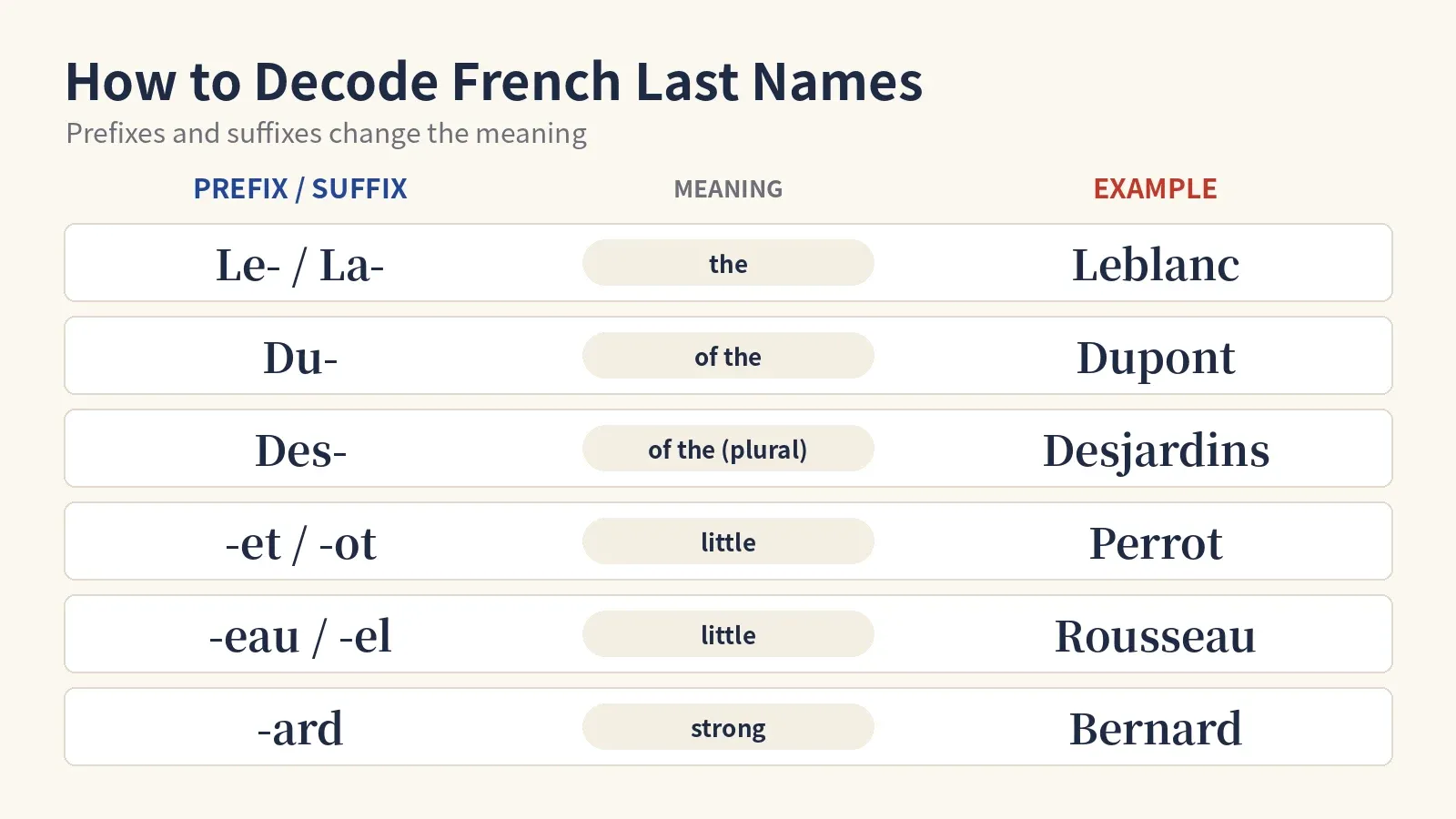
French Prefixes: Le, La, De, Du and Des
| Prefix | Meaning | Examples |
|---|---|---|
| Le / La | The | Leblanc (the white), Lebrun (the brown), Lenoir (the black), Lefort (the strong) |
| De / D’ | Of, from | Deschamps (from the fields), D’Amour (of love) |
| Du | Of the (masc.) | Dupont (of the bridge), Dumont (of the mountain), Dufour (of the oven) |
| Des | Of the (plural) | Desjardins (of the gardens), Desrosiers (of the rose bushes) |
| La | The (feminine) | Lacroix (the cross), Lafontaine (the spring) |
French Suffixes: -et, -ot, -on, -eau and -ard
| Suffix | Meaning | Examples |
|---|---|---|
| -et, -ette | Little | Guillemet (little William), Pinet (little pine) |
| -ot, -otte | Little | Perrot (little Pierre), Guyot (little Guy) |
| -in, -on | Little | Perrin, Robin, Marion |
| -eau, -el | Little | Moreau, Rousseau, Morel |
| -ard | Strong, sometimes mocking | Richard, Bernard, Renard (fox) |
Occupational French Surnames
| Surname | Occupation |
|---|---|
| Boulanger | Baker |
| Boucher | Butcher |
| Charpentier | Carpenter |
| Meunier | Miller |
| Pelletier | Fur trader |
| Tessier | Weaver |
| Berger | Shepherd |
| Pasteur | Pastor, shepherd |
| Marchand | Merchant |
| Couturier | Tailor |
| Barbier | Barber |
| Tanneur | Tanner |
| Carpentier | Carpenter (northern form) |
| Vasseur | Vassal |
French Last Names by Region
Many “French” surnames aren’t French in origin at all. France absorbed regions with their own languages: Breton, Alsatian German, Basque, Occitan and Corsican. Their names still stand out.
| Region | What names look like | Examples |
|---|---|---|
| Brittany | Celtic Breton, often Le + noun | Le Gall (the foreigner), Le Goff (the smith), Le Bihan (the small), Tanguy, Kerguelen |
| Alsace and Lorraine | German spelling | Meyer, Schmitt, Muller, Klein, Weber |
| Basque Country | Basque place names | Etcheverry (new house), Harriague, Iribarne |
| Provence and the south | Occitan forms, Spanish names | Faure, Fabre, Garcia, Martinez |
| Corsica | Italian-style endings | Santoni, Luciani, Mattei |
| Normandy | Norse roots | Anquetil, Toutain, Osmont |
French-Canadian Last Names: Québec’s Surname Puzzle
Tremblay is the most common surname in Québec, and nearly every Tremblay descends from one man. Pierre Tremblay emigrated from France in the 1600s. His large family, like many early settlers, left descendants across the province.
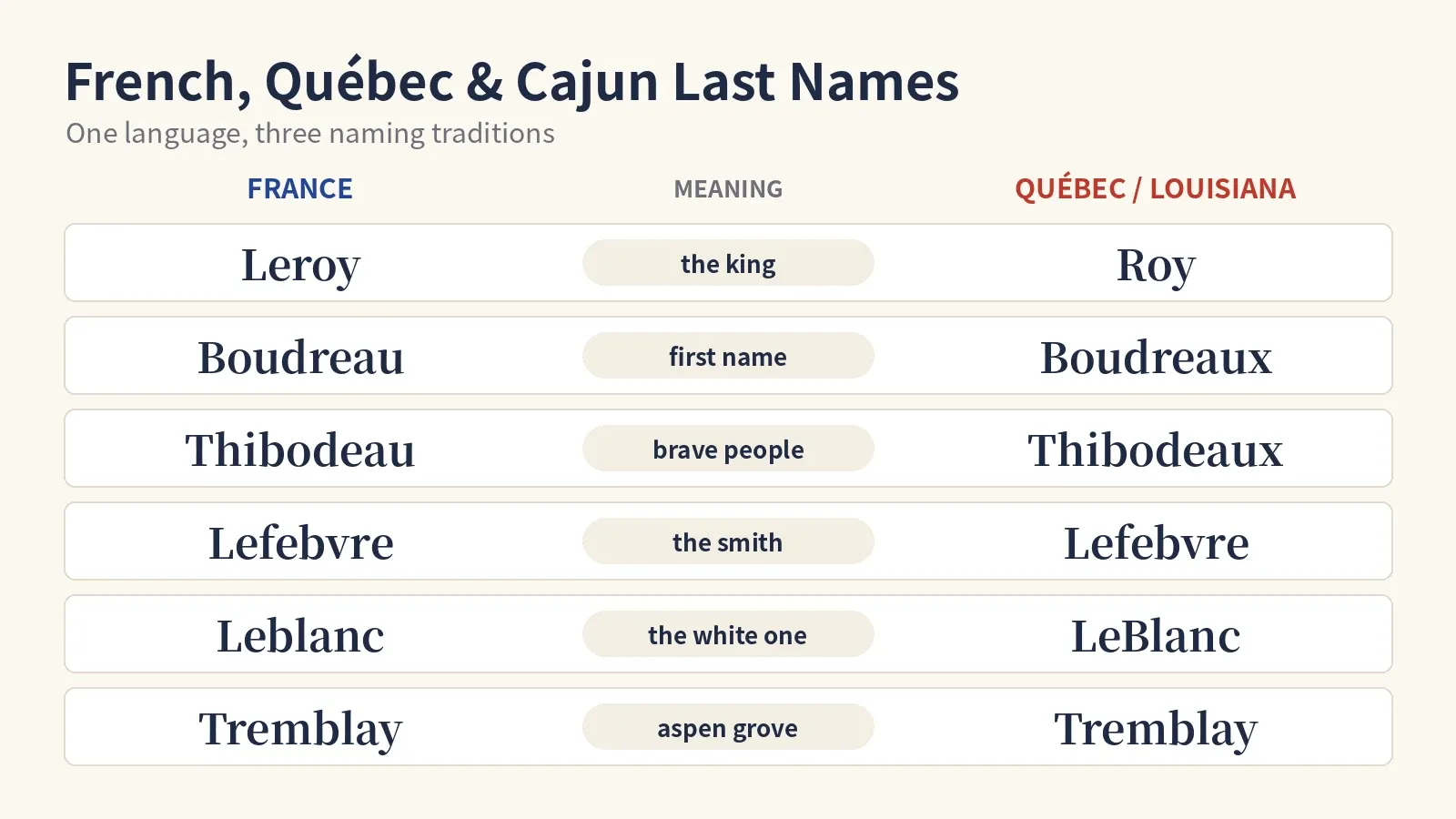
That’s the Québec surname puzzle. Only a few thousand French settlers arrived before 1760, so their surnames multiplied among millions of descendants.
| Surname | Meaning | Note |
|---|---|---|
| Tremblay | Aspen grove | Most common in Québec |
| Gagnon | Guard dog, or a farmer’s name | Very common in Québec |
| Roy | King | Québec spelling of Leroy |
| Côté | Hillside | Common in Québec |
| Bouchard | Big mouth | Common in Saguenay |
| Gauthier | Army ruler | Widespread |
| Morin | Dark one | Widespread |
| Lavoie | The way | Québec |
| Fortin | Little strong one | Québec |
| Gagné | Earned, won | Québec |
| Ouellet | Little Ouel | Québec |
| Pelletier | Fur trader | Fitting for New France |
Dit Names: Why French-Canadian Families Had Two Surnames
Here’s a detail that confuses many family historians. In New France, families often added a dit name (“called”) to tell branches apart. A soldier might be Jean Bernard dit Lafleur.
Over time, some branches kept the original surname and others kept only the dit name. So your Lafleur ancestors might appear as Bernard in older records. Always search both.
Cajun Last Names: The Acadian Story in Louisiana
In 1755, British authorities began expelling French-speaking Acadians from Nova Scotia. Many eventually rebuilt their lives in Louisiana, where “Acadian” became “Cajun.”
Their surnames survived, often with a distinctive Louisiana spelling ending in -eaux.
| Surname | Meaning |
|---|---|
| Boudreaux | From a medieval first name |
| Thibodeaux | Brave people (from Thibaud) |
| Hebert | Bright army |
| LeBlanc | The white one |
| Landry | Land ruler |
| Broussard | Brush, thicket dweller |
| Guidry | From a Germanic first name |
| Arceneaux | From Arsenault |
| Robichaux | Little Robert |
| Melancon | Name of an Acadian founding family |
Royal and Noble French Last Names
The particle de does not prove nobility. Plenty of commoners have it simply because it meant “from” a place. However, some surnames really do belong to famous royal and noble houses.
| Surname | Meaning | Famous for |
|---|---|---|
| Capet | Cape, cloak | Hugh Capet, founder of the Capetian dynasty (987) |
| Valois | From the Valois region | Royal house, 1328–1589 |
| Bourbon | From Bourbon-l’Archambault | Kings of France, Spain and Naples |
| d’Orléans | From Orléans | Royal branch; King Louis-Philippe |
| de Montmorency | From Montmorency | Ancient noble family |
| de La Rochefoucauld | Of the rock of Foucauld | Dukes; the writer of the Maxims |
| de Rohan | From Rohan, Brittany | Princely Breton family |
| de Noailles | From Noailles | Dukes and marshals |
| de Polignac | From Polignac | Noble family close to Marie Antoinette |
| de Lafayette | From La Fayette | The Marquis who fought in the American Revolution |
| de Guise | From Guise | Powerful ducal family |
| Bonaparte | Good part | Napoleon’s family (Corsican origin) |
Unique and Beautiful French Last Names
These surnames sound elegant in English and carry lovely meanings. They’re popular choices for characters, pen names and brands.
| Surname | Meaning |
|---|---|
| Beaumont | Beautiful mountain |
| Bellerose | Beautiful rose |
| Belmont | Beautiful hill |
| Delacroix | Of the cross |
| Delaunay | Of the alder grove |
| Desrosiers | Of the rose bushes |
| Dumas | Of the farmhouse |
| Fleury | Flowered |
| Lachance | Luck |
| Lamour | Love |
| Lafleur | The flower |
| Lumière | Light |
| Clairmont | Clear mountain |
| Montagne | Mountain |
| Rivière | River |
| Soleil | Sun |
| Beauchamp | Beautiful field |
| Beaulieu | Beautiful place |
| Bonheur | Happiness |
| Chevrier | Goatherd |
French Last Names for Girls (That Sound Elegant)
French surnames, like all French surnames, belong to both genders. However, some sound soft and romantic, which is why people search for “French last names for girls.” These work beautifully for a female character:
| Surname | Meaning |
|---|---|
| Bellerose | Beautiful rose |
| Lafleur | The flower |
| Fleury | Flowered |
| Delaunay | Of the alder grove |
| Rosier | Rose bush |
| Delacour | Of the court |
| Beaulieu | Beautiful place |
| Lamour | Love |
| Laroche | The rock |
| Duval | Of the valley |
Rare and Unusual French Last Names
With more than a million surnames recorded, France has a long tail of rare names. Some are delightfully literal.
| Surname | Meaning |
|---|---|
| Boileau | Drink water |
| Boivin | Drink wine |
| Mangematin | Eat in the morning |
| Chantepie | Singing magpie |
| Vivier | Fish pond |
| Grosjean | Big John |
| Bonenfant | Good child |
| Troisfontaines | Three springs |
| Deslauriers | Of the laurels |
| Cinq-Mars | From Cinq-Mars (a town) |
| Sansregret | Without regret |
| Vaillancourt | Brave court |
The History of French Last Names
French surnames formed between about 1000 and 1500, as growing towns needed a way to tell people apart. Kings then locked them in with a series of laws.
| Year | What happened |
|---|---|
| Around 1000–1200 | Bynames spread: “Jean the baker,” “Pierre from the bridge” |
| 1474 | King Louis XI restricts changing one’s name without royal permission |
| 1539 | The Ordinance of Villers-Cotterêts requires parish priests to record baptisms, in French |
| 1792 | Civil registration moves from the Church to the state |
| 1803 | A law limits first names to saints’ names and figures from history |
| 1966 | Rules on first names are relaxed |
| 1993 | Parents may choose almost any first name |
| 2005 | Children may take the father’s name, the mother’s name or both |
| 2022 | Adults may switch to (or add) their other parent’s surname by simple request |
French Surnames and Marriage Today
French women keep their birth surname for all legal purposes. Many use their husband’s surname as a nom d’usage (usage name) in daily life. Official documents, however, stay in the birth name.
Since 2005, parents can also choose which surname their child receives: the father’s, the mother’s, or both joined with a space.
How to Pronounce French Last Names
French spelling hides a lot of silent letters. These rules will save you most mistakes:
| Rule | Example | Say it like |
|---|---|---|
| Final consonants are usually silent | Petit, Durand | puh-TEE, dew-RAHN |
| “-eau” and “-eaux” sound like “oh” | Moreau, Boudreaux | moh-ROH, boo-DROH |
| “-ier” sounds like “yay” | Mercier, Pelletier | mehr-SYAY, pel-TYAY |
| “ch” sounds like “sh” | Chevalier | shuh-vah-LYAY |
| “-ault” sounds like “oh” | Arsenault, Thibault | ar-suh-NOH, tee-BOH |
The classic American twist: In Louisiana and New England, many families now pronounce their names the English way. Both are “correct” for that family.
Expert Insights and Real-World Examples
Case Study: Tracing a French-Canadian Family in 4 Steps
Say your grandmother was a “Lafleur” from Maine.
- Check for a dit name. Search Québec records for “dit Lafleur.” The original surname could be Bernard, Poirier or several others.
- Use Québec’s parish records. Catholic registers in Québec are unusually complete, often reaching back to the 1600s.
- Find the immigrant ancestor. Many French-Canadian lines trace back to one settler who arrived before 1760.
- Cross to France. Once you know the settler’s home parish, French departmental archives often have digitized registers online.
Real Examples: Famous Surnames That Tell a Story
- Lefebvre / Lefèvre: “The smith.” Same name, two spellings; the “b” was an old scribal habit.
- Rousseau: Philosopher Jean-Jacques Rousseau was, literally, “little redhead.”
- Chevalier: “Knight.” Fitting for actor and singer Maurice Chevalier’s charm.
- Lafayette: A place name that became a hero’s name in the United States, where dozens of towns now carry it.
- Dupont: “Of the bridge.” The Du Pont family founded one of America’s biggest chemical companies.
Common Mistakes With French Surnames
| Mistake | Why it’s wrong | Do this instead |
|---|---|---|
| Assuming “de” means noble | It often just means “from” | Check the family’s history |
| Pronouncing every letter | Final letters are often silent | Drop final t, d and s |
| Searching one spelling | Lefebvre, Lefèvre, Lefeuvre are one name | Search all variants |
| Ignoring dit names | Québec branches split names | Search “dit” + surname |
| Treating Muller or Garcia as “not French” | Regional and immigrant names are French too | Consider the region |
How to Choose a French Last Name for a Character
- Pick the setting. A Parisian? Try Martin, Laurent or Moreau. A Breton fisherman? Le Goff or Le Gall.
- Pick the class. Aristocrats suit de La Rochefoucauld or de Montmorency. Everyday characters suit Petit or Fournier.
- Use the meaning. A cunning character named Renard (“fox”) adds a wink for readers who know French.
- Say it out loud. “Camille Delaunay” flows. Test yours.
Find Your Perfect Name With Our French Last Name Generator
Use the French Last Name Generator at the top of this page. Filter by origin type, region and vibe (classic, noble, elegant), then copy your favorite with one click.
Exploring other cultures? See our guides to Italian last names, Spanish last names, German last names and French names.
For a family or character with an international background, distinguish Irish last names from the broader scope of Hispanic last names. Our Mexican last names guide also explains why a two-surname system needs more context than a single surname list.
FAQs About French Last Names
What is the most common French last name?
Martin is the most common French last name, followed by Bernard, Thomas, Petit and Robert.
What do most French last names mean?
Most come from a father’s first name (Martin, Bernard), a job (Lefebvre, “smith”), a place (Dubois, “of the woods”) or a nickname (Petit, “small”).
Does “de” in a French surname mean nobility?
Not necessarily. “De” means “of” or “from,” and many ordinary families have it. Some noble families use it, but it’s not proof of a title.
What are common French-Canadian last names?
Tremblay, Gagnon, Roy, Côté, Bouchard, Gauthier, Morin, Lavoie, Fortin and Gagné are among the most common in Québec.
What are Cajun last names?
Common Cajun surnames include Boudreaux, Thibodeaux, Hebert, LeBlanc, Landry, Broussard and Guidry. They come from Acadians who settled in Louisiana after 1755.
What are some French last names for girls?
Surnames aren’t gendered in France, but elegant-sounding choices include Bellerose, Lafleur, Fleury, Delaunay, Beaulieu and Duval.
What are royal French last names?
Famous royal houses include Capet, Valois, Bourbon and Orléans. Noble families include de Montmorency, de La Rochefoucauld and de Rohan.
Do French women take their husband’s last name?
Not legally. They keep their birth surname and may use their husband’s as a usage name in daily life.
Why do Cajun names end in -eaux?
It’s largely a Louisiana spelling habit. In France, the same names are usually spelled -eau, as in Boudreau or Thibodeau.
How many surnames are there in France?
More than 1.3 million surnames were recorded for births between 1891 and 1990, though many are rare or have disappeared.
The Bottom Line
- Most French last names began as first names, jobs, places or nicknames.
- “De” means “from,” not automatically “noble.”
- French-Canadian and Cajun names tell a story of emigration, and dit names can hide your family’s original surname.
Try the French Last Name Generator at the top of this page to find your favorite.
Looking for more? Explore name origins and meanings across all eight categories.