Name generator
Greek Last Name Generator
Explore 88 distinct Greek surnames from this guide. Start with rare and uncommon picks, or explore every category. Choose a category or letter to narrow your results, then copy or save your favorites.
Showing 15 of 88 matching Greek surnames.
Results use different initials when available. Counts reflect the names in this guide; some letters and categories naturally have fewer matches. Letters without matches are hidden. “Rare” and “uncommon” follow the guide’s descriptions, not a worldwide frequency ranking.
- Papadopoulos
Son of the priest
- Xanthos
Blond
- Mylonas
Miller
- Ioannidis
Son of John
- Oikonomou
Of the steward (church administrator)
- Bakalis
Grocer (Turkish root)
- Kapetanakos
- Ftochos
Poor man
- Georgiou
Of George (farmer)
- Raptis
Tailor
- Aristidou
Son of the best
- Dimitriou
Of Dimitrios (of Demeter)
- Sideris
Ironworker
- Triantafyllou
Rose (literally “thirty petals”)
- Vasileiou
Of Vasileios (royal)
These are surnames from the guide, not invented combinations. Follow the guide for meanings, regional context, and spelling variants. View your shortlist
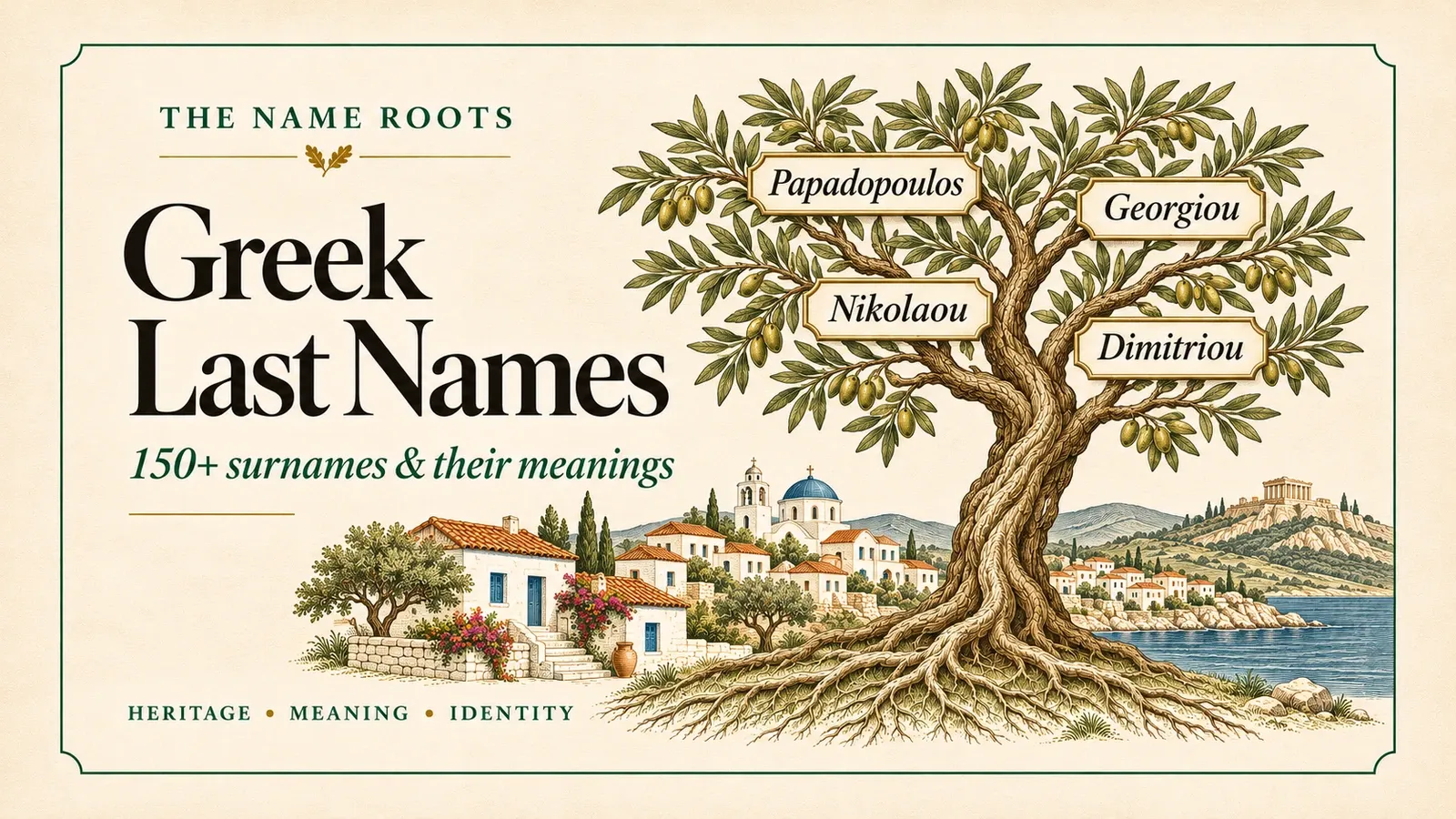
Greece’s most common surname, Papadopoulos, means “son of the priest.” That’s not a scandal. Greek Orthodox priests can marry, and their families have been passing on “Papa-” names for centuries.
Greek last names usually tell you two things: an ancestor’s name or trait, and the region the family came from. The ending is the regional clue. A name ending in -poulos points to the Peloponnese, -akis to Crete, and -idis to the Black Sea coast or Asia Minor.
In this guide, you’ll find more than 150 Greek surnames with meanings, the regional ending map, male and female forms, and the surprising truth about “ancient Greek last names.”
Greek Last Names at a Glance (Quick Facts)
| Fact | Answer |
|---|---|
| Most common Greek last name | Papadopoulos (“son of the priest”) |
| Most common origin | A father’s or ancestor’s first name |
| What “Papa-” means | Priest (Greek Orthodox priests can marry) |
| Regional endings | -poulos (Peloponnese), -akis (Crete), -idis (Pontus/Asia Minor), -atos (Ionian Islands) |
| Female surnames | Usually a genitive form: Papadopoulos → Papadopoulou |
| When surnames spread | Elites in the Byzantine era; most people in the 1800s |
| Did ancient Greeks have surnames? | No. They used a father’s name or hometown instead |
How to Read the Tables in This Guide
Each surname shows the male form, the female form and the meaning. Greek women traditionally use a genitive (“of”) form of the family name, so the ending changes.
The Most Common Greek Last Names and Their Meanings
The most common Greek last names include Papadopoulos, Papageorgiou, Oikonomou, Papadimitriou and Georgiou. Several of the top names carry the priestly “Papa-” prefix.
Papadopoulos is the clear #1, with more than 150,000 bearers worldwide according to Wikipedia. The names below are among the most frequent in Greece and Cyprus.
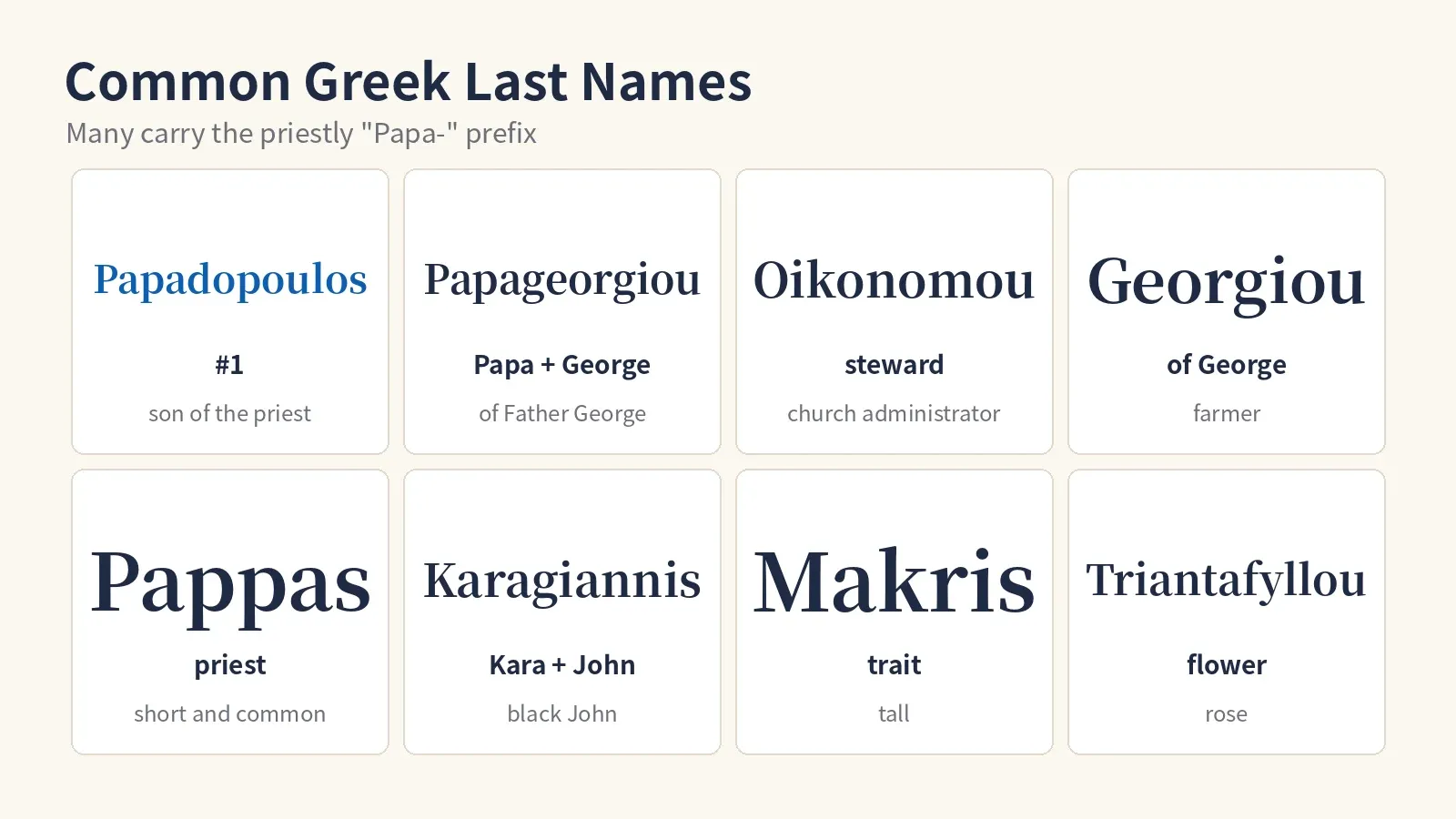
| Male form | Female form | Meaning |
|---|---|---|
| Papadopoulos | Papadopoulou | Son of the priest |
| Papageorgiou | Papageorgiou | Of the priest George |
| Oikonomou | Oikonomou | Of the steward (church administrator) |
| Papadimitriou | Papadimitriou | Of the priest Dimitrios |
| Georgiou | Georgiou | Of George (farmer) |
| Papaioannou | Papaioannou | Of the priest John |
| Pappas | Pappa | Priest |
| Vasileiou | Vasileiou | Of Vasileios (royal) |
| Nikolaou | Nikolaou | Of Nikolaos (victory of the people) |
| Karagiannis | Karagianni | Black John (from Turkish kara) |
| Vlachos | Vlachou | A Vlach; shepherd |
| Antoniou | Antoniou | Of Antonios |
| Makris | Makri | Tall, long |
| Papanikolaou | Papanikolaou | Of the priest Nikolaos |
| Dimitriou | Dimitriou | Of Dimitrios (of Demeter) |
| Ioannidis | Ioannidou | Son of John |
| Georgiadis | Georgiadou | Son of George |
| Triantafyllou | Triantafyllou | Rose (literally “thirty petals”) |
| Konstantinou | Konstantinou | Of Konstantinos (steadfast) |
| Christodoulou | Christodoulou | Servant of Christ |
| Athanasiou | Athanasiou | Of Athanasios (immortal) |
| Theodorou | Theodorou | Of Theodoros (gift of God) |
| Angelopoulos | Angelopoulou | Son of Angelos (messenger, angel) |
| Nikolaidis | Nikolaidou | Son of Nikolaos |
| Alexiou | Alexiou | Of Alexios (defender) |
| Pavlidis | Pavlidou | Son of Pavlos (Paul) |
| Michailidis | Michailidou | Son of Michael |
| Stavrou | Stavrou | Of the cross |
| Economou | Economou | Of the steward (alternate spelling) |
| Papadakis | Papadaki | Little son of the priest (Cretan) |
Why Are So Many Greek Surnames “Papa-”?
Here’s the insight many lists miss. In the Greek Orthodox Church, parish priests are usually married. A priest’s son was often identified through his father’s role: “the priest’s son.” Over time that became a fixed surname: Papadopoulos, Papadakis, Papageorgiou.
The Papa- prefix can also combine with the priest’s own first name: Papa + Georgiou = Papageorgiou, “of Father George.”
What Greek Surname Endings Reveal: A Regional Guide
The ending of a Greek surname is often a strong hint about where the family came from. Many endings mean “son of” or “little,” but each region preferred its own form.
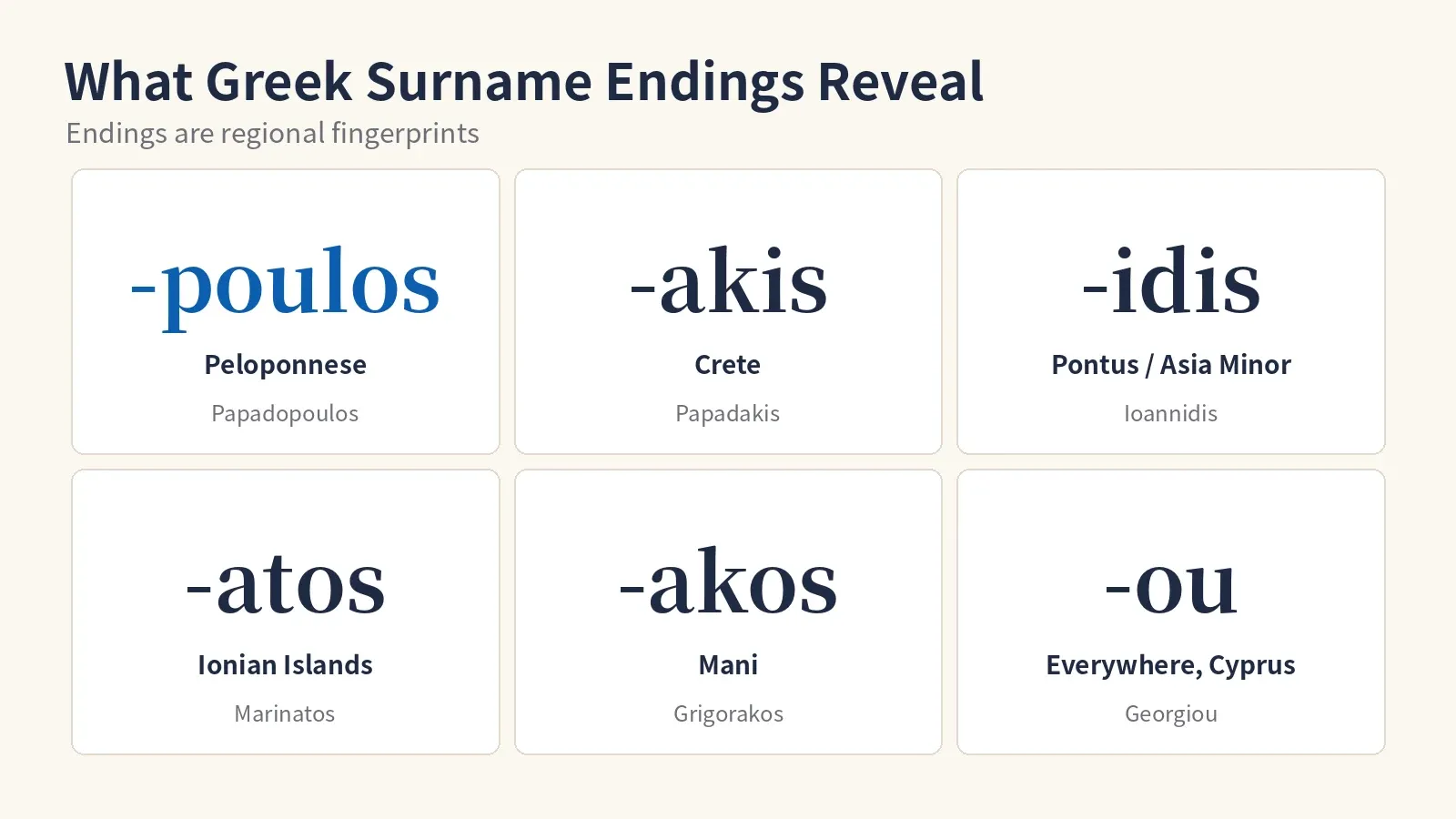
| Ending | Meaning | Region | Examples |
|---|---|---|---|
| -poulos | Son of, young of (from Latin pullus, “chick”) | Peloponnese | Papadopoulos, Angelopoulos, Stephanopoulos |
| -akis | Little, son of | Crete | Papadakis, Galifianakis, Dukakis |
| -idis, -iadis | Son of (ancient -ides) | Pontus, Asia Minor, northern Greece | Ioannidis, Georgiadis, Savvidis |
| -atos | Belonging to (Venetian influence) | Kefalonia, Ionian Islands | Marinatos, Andreatos, Kosmatos |
| -eas, -akos | Son of | Mani (southern Peloponnese) | Grigorakos, Kapetanakos |
| -ou | Of (genitive) | Everywhere, very common in Cyprus | Georgiou, Nikolaou |
| -as, -is, -os | Plain nominative forms | Everywhere | Pappas, Makris, Vlachos |
| -oglou | Son of (Turkish oğlu) | Asia Minor, Anatolia | Hatzioglou, Karaoglou |
| -elis, -lis | From a place or trade (Turkish -li) | Asia Minor | Karamanlis |
Cretan Last Names (-akis)
| Male form | Meaning |
|---|---|
| Papadakis | Little son of the priest |
| Galanakis | Little son of the blue-eyed one |
| Manolakis | Little son of Manolis (Emmanuel) |
| Markakis | Little son of Markos |
| Kazantzakis | Little son of the cauldron maker |
| Theodorakis | Little son of Theodoros |
| Nikolakis | Little son of Nikolaos |
| Spanakis | Little son of the beardless one |
| Tzanakis | Little son of Tzanis (John) |
| Stavrakakis | Little son of Stavros |
Peloponnesian Last Names (-poulos)
| Male form | Meaning |
|---|---|
| Papadopoulos | Son of the priest |
| Angelopoulos | Son of Angelos |
| Stephanopoulos | Son of Stephanos (crown) |
| Kalogeropoulos | Son of the monk |
| Panagopoulos | Son of Panagis |
| Christopoulos | Son of Christos |
| Georgopoulos | Son of Georgios |
| Dimopoulos | Son of Dimos |
| Konstantopoulos | Son of Konstantinos |
| Vasilopoulos | Son of Vasilis |
The gendered forms in Russian last names offer a useful comparison with Greek surname forms. The occupational examples in German last names help show why an ending and a literal word can provide different kinds of clues.
Male and Female Greek Last Names
Greek surnames change form for women. Traditionally, a woman uses the genitive (“of the family”) form of her father’s surname.
| Male ending | Female ending | Male example | Female example |
|---|---|---|---|
| -os | -ou | Papadopoulos | Papadopoulou |
| -is | -i | Galanakis | Galanaki |
| -as | -a | Pappas | Pappa |
| -idis | -idou | Ioannidis | Ioannidou |
| -ou | -ou (no change) | Georgiou | Georgiou |
Marriage: Since a 1983 family law reform, Greek women legally keep their own surname after marriage. They may use their husband’s name socially, but it doesn’t replace their legal surname.
Greek Last Names From Jobs, Looks and Places
Occupational Greek Surnames
| Surname | Occupation |
|---|---|
| Oikonomou | Steward, church treasurer |
| Kalogeropoulos | Monk’s son |
| Psaras | Fisherman |
| Ftochos | Poor man |
| Mylonas | Miller |
| Raftis / Raptis | Tailor |
| Chalkias | Coppersmith |
| Sideris | Ironworker |
| Kazantzis | Cauldron maker (Turkish root) |
| Bakalis | Grocer (Turkish root) |
Surnames From Looks and Traits
| Surname | Meaning |
|---|---|
| Makris | Tall |
| Mavros | Black, dark |
| Mavromatis | Black-eyed |
| Xanthos | Blond |
| Kokkinos | Red-haired |
| Galanis | Blue-eyed, fair |
| Kontos | Short |
| Chondros | Fat |
| Asproulis | Little white one |
| Karamanlis | From Karaman (a place in Anatolia) |
Surnames With Turkish Prefixes (Ottoman Era)
Four centuries of Ottoman rule left their mark on Greek surnames:
| Prefix | Meaning | Examples |
|---|---|---|
| Kara- | Black | Karagiannis, Karamanlis |
| Hatzi- / Chatzi- | Pilgrim (one who visited Jerusalem) | Hatzidakis, Chatzigeorgiou |
| Deli- | Brave, crazy | Deligiannis |
| Topal- | Lame | Topalidis |
The Hatzi- prefix is especially interesting. It comes from the Arabic hajji but was used by Greek Christians who made a pilgrimage to the Holy Sepulchre in Jerusalem.
Ancient Greek Last Names: Did They Exist?
Ancient Greeks did not have hereditary last names. A person was identified by their given name plus their father’s name or hometown. Pericles was “Pericles, son of Xanthippus.” In Athens, citizens also used a deme (district) name.
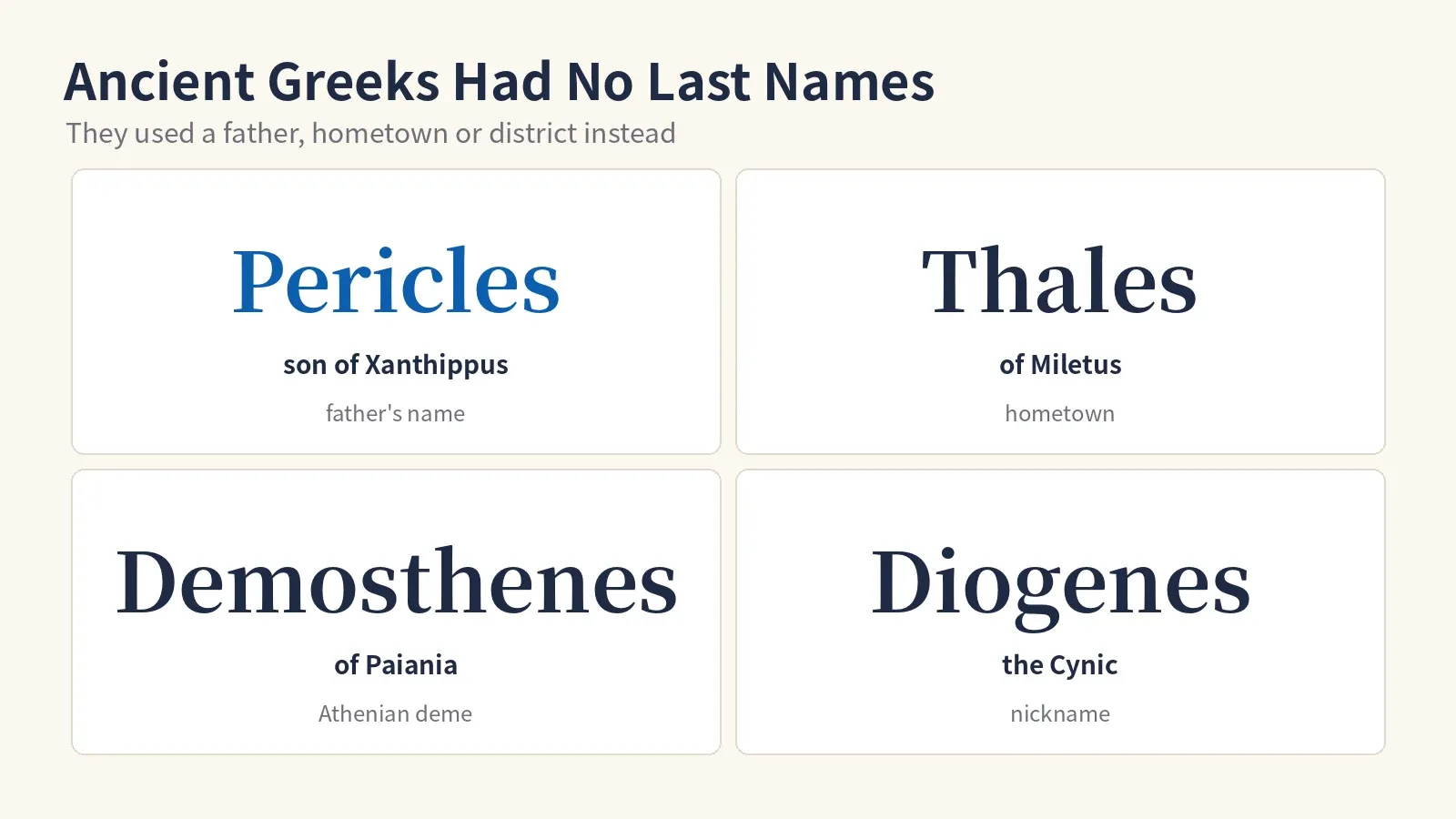
| How ancient Greeks were named | Example |
|---|---|
| Given name + father’s name | Pericles, son of Xanthippus |
| Given name + hometown | Thales of Miletus |
| Given name + deme (Athens) | Demosthenes of Paiania |
| Given name + nickname | Diogenes the Cynic |
So when people search for “ancient Greek last names,” they usually want modern surnames with ancient roots. Many modern Greek surnames come from classical given names or gods:
| Modern surname | Ancient root | Meaning |
|---|---|---|
| Dimitriou | Demeter (goddess of harvest) | Of Dimitrios |
| Athanasiou | athanatos | Immortal |
| Alexiou | alexein | To defend |
| Periklis / Perikleous | Pericles | Surrounded by glory |
| Sokratous | Socrates | Whole power |
| Achilleos | Achilles | Name of the hero |
| Apostolou | apostolos | Messenger, apostle |
| Xenakis | xenos | Stranger, guest |
| Theodorou | theos + doron | Gift of God |
| Stefanou | stephanos | Crown, wreath |
| Filippou | Philip | Lover of horses |
| Aristidou | Aristides | Son of the best |
Greek Last Names in America
Greek Americans often shortened or anglicized long surnames. A few patterns:
| Greek original | American form (examples) |
|---|---|
| Papadopoulos | Pappas, Poulos |
| Anastassakis | Aniston (Jennifer Aniston’s father’s family) |
| Georgakopoulos | George, Georgas |
| Theodorakopoulos | Theodore |
| Karageorgiou | Karas |
Famous Greek-American surnames: Stephanopoulos (George, the journalist), Dukakis (Michael, 1988 presidential candidate), Galifianakis (Zach, the actor) and Sampras (Pete, the tennis champion).
For a cross-cultural character or family tree, check French last names, Spanish last names and Irish last names in their own guides. Choose a surname that fits the family’s background rather than treating European names as interchangeable.
The History of Greek Last Names
| Period | What happened |
|---|---|
| Ancient Greece | No hereditary surnames; father’s name or hometown used |
| 800s–1100s | Byzantine elite families adopt family names |
| 1453–1800s | Ottoman rule; Turkish prefixes and suffixes enter Greek names |
| 1800s | Patronymic surnames become common for most Greeks |
| 1830s onward | Modern Greek state records names officially |
| 1983 | Women keep their own surname after marriage |
Expert Insights and Real-World Examples
Case Study: Reading a Family’s Journey From Its Surname
Take the surname Georgiadis. The -iadis ending suggests roots among Pontic Greeks from the Black Sea coast or Greeks from Asia Minor. Many of these families arrived in northern Greece after the 1923 population exchange between Greece and Turkey.
Compare Georgakis (Crete) and Georgopoulos (Peloponnese). All three mean “son of George,” but each tells a different regional story.
Common Mistakes With Greek Surnames
| Mistake | Why it’s wrong | Do this instead |
|---|---|---|
| Using the male form for a woman | Female forms differ (-ou, -i) | Use Papadopoulou, not Papadopoulos |
| Assuming “Papa-” means pope | It means a parish priest | Think “Father George” |
| Expecting ancient Greek surnames | Ancient Greeks had none | Use father’s name or hometown |
| Ignoring the ending | It’s a strong regional clue | Match -akis to Crete, -poulos to the Peloponnese |
| Searching one spelling | Greek transliterates many ways | Try Georgiou, Yeorgiou, Giorgiou |
How to Choose a Greek Last Name for a Character
- Pick a region. A Cretan character suits -akis; a Peloponnesian one suits -poulos.
- Use the right gender form. A female character should be Papadopoulou or Galanaki.
- Use meaning. A dark, brooding character named Mavros (“black”) or a bright one named Xanthos (“blond”) adds depth.
- For ancient settings, skip the surname and use “son of” or a hometown.
Find Your Perfect Name With Our Greek Last Name Generator
Use the Greek Last Name Generator at the top of this page. Filter by region, male or female form and meaning theme, then copy your favorite.
Exploring more? See our guides to Italian last names, Russian last names, rare last names and Greek names.
FAQs About Greek Last Names
What is the most common Greek last name?
Papadopoulos is the most common Greek last name. It means “son of the priest.”
What does -poulos mean in Greek surnames?
It means “son of” or “young of,” from the Latin pullus, “chick.” It’s typical of the Peloponnese.
What does -akis mean in Greek surnames?
It’s a diminutive meaning “little” or “son of,” and it’s typical of Crete.
Why do Greek female surnames end differently?
Women traditionally use the genitive (“of the family”) form, so Papadopoulos becomes Papadopoulou.
Did ancient Greeks have last names?
No. They used their father’s name, hometown or district instead, such as “Thales of Miletus.”
What does “Papa” mean in Greek last names?
It means “priest.” Greek Orthodox priests can marry, so many families descend from priests.
What are common Greek last names and meanings?
Papadopoulos (son of the priest), Georgiou (of George), Oikonomou (steward), Makris (tall) and Triantafyllou (rose).
Do Greek women change their last name when they marry?
Since 1983, Greek women legally keep their own surname after marriage.
What does -idis mean in a Greek surname?
It means “son of,” from the ancient -ides ending. It’s common among Pontic and Asia Minor Greek families.
What are Greek last names that mean something cool?
Mavros (black), Triantafyllou (rose), Athanasiou (immortal), Xanthos (blond) and Stefanou (crown).
The Bottom Line
- Greek surnames carry regional fingerprints: -poulos, -akis, -idis and -atos.
- “Papa-” means priest, and Papadopoulos is the most common name in Greece.
- Ancient Greeks had no surnames, but many modern surnames keep ancient roots alive.
Try the Greek Last Name Generator at the top of this page to find yours.
Looking for more? Explore name origins and meanings across all eight categories.