Name generator
German Last Name Generator
Explore 140 distinct German surnames from this guide. Start with rare and uncommon picks, or explore every category. Choose a category or letter to narrow your results, then copy or save your favorites.
Showing 15 of 140 matching German surnames.
Results use different initials when available. Counts reflect the names in this guide; some letters and categories naturally have fewer matches. Letters without matches are hidden. “Rare” and “uncommon” follow the guide’s descriptions, not a worldwide frequency ranking.
- MorgensternGuide: uncommon
Morning star
- FrohlichGuide: uncommon
Cheerful
- SauerbierGuide: uncommon
Sour beer
- NachtigallGuide: uncommon
Nightingale
- HimmelreichGuide: uncommon
Kingdom of heaven
- DonnerstagGuide: uncommon
Thursday
- LiebknechtGuide: uncommon
Dear servant
- AdlerGuide: uncommon
Eagle
- WunderlichGuide: uncommon
Odd, peculiar
- GrünewaldGuide: uncommon
Green forest
- RosenthalGuide: uncommon
Rose valley
- KirschbaumGuide: uncommon
Cherry tree
- EisenhauerGuide: uncommon
Iron hewer (miner)
- FalkenrathGuide: uncommon
Falcon counsel
- SonnenscheinGuide: uncommon
Sunshine
These are surnames from the guide, not invented combinations. Follow the guide for meanings, regional context, and spelling variants. View your shortlist
If you live in the United States, there’s a good chance your neighbor has a German surname and doesn’t know it. Miller is often the American form of Müller. Myers is often Meyer. Snyder can be Schneider.
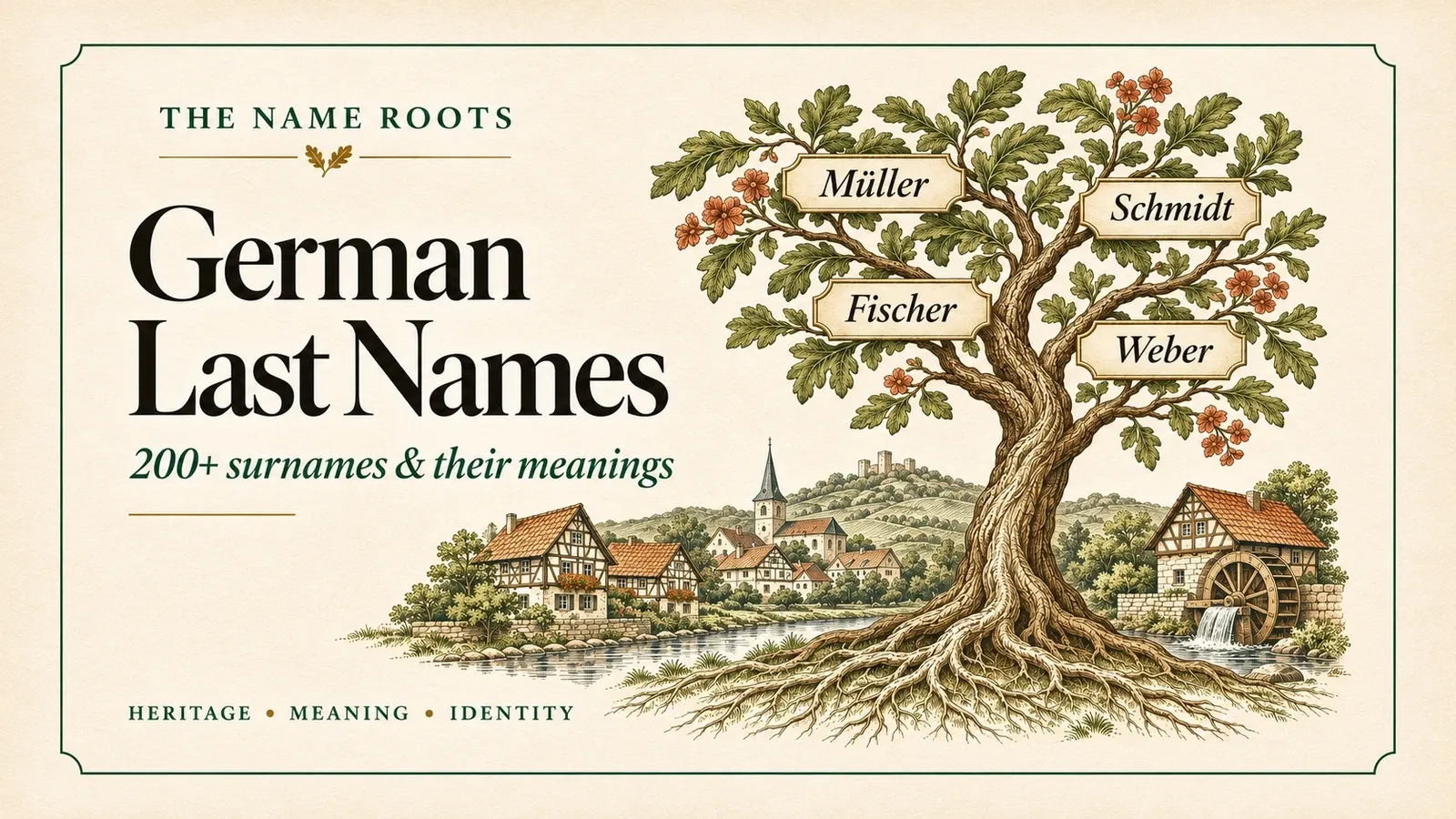
German last names are mostly job titles. Schmidt was the smith, Müller the miller, Schneider the tailor and Fischer the fisherman. Learn a few German trade words and you can translate half of Germany’s phone book.
In this guide, you’ll find more than 200 German surnames with meanings, plus the truth about “von,” the regional clues hidden in name endings, and how German names quietly became some of America’s most common.
German Last Names at a Glance (Quick Facts)
| Fact | Answer |
|---|---|
| Most common German last name | Müller or Schmidt (the order depends on how spelling variants are counted) |
| Most common origin | Occupations |
| Share with the top name | Schmidt and its variants: about 0.87% of Germans |
| Does “von” mean noble? | Historically, often. Since 1919 it’s just part of the name |
| Typical northern ending | -sen, -mann (Hansen, Hoffmann) |
| Typical southern ending | -er, -le, -l (Huber, Schäuble, Hansl) |
| Influence in the US | German is one of the largest ancestry groups Americans report |
How to Read the Tables in This Guide
| Origin type | What it tells you | Example |
|---|---|---|
| Occupation | An ancestor’s job | Schmidt (smith), Bauer (farmer) |
| Patronymic | A father’s first name | Werner, Hartmann, Petersen |
| Nickname | A trait or look | Klein (small), Lang (tall), Weiss (white) |
| Place | A town or landscape | Berger (mountain dweller), Bach (brook) |
The 50 Most Common German Last Names and Their Meanings
The most common German last names are Müller, Schmidt, Schneider, Fischer and Weber. Every one of the top ten is either a job or tied to farming life.
The order below follows frequency data summarized on Wikipedia, which ranks Schmidt (with Schmitt and Schmitz) at about 0.87% and Müller at about 0.83%. Counted as single spellings, Müller usually comes first.
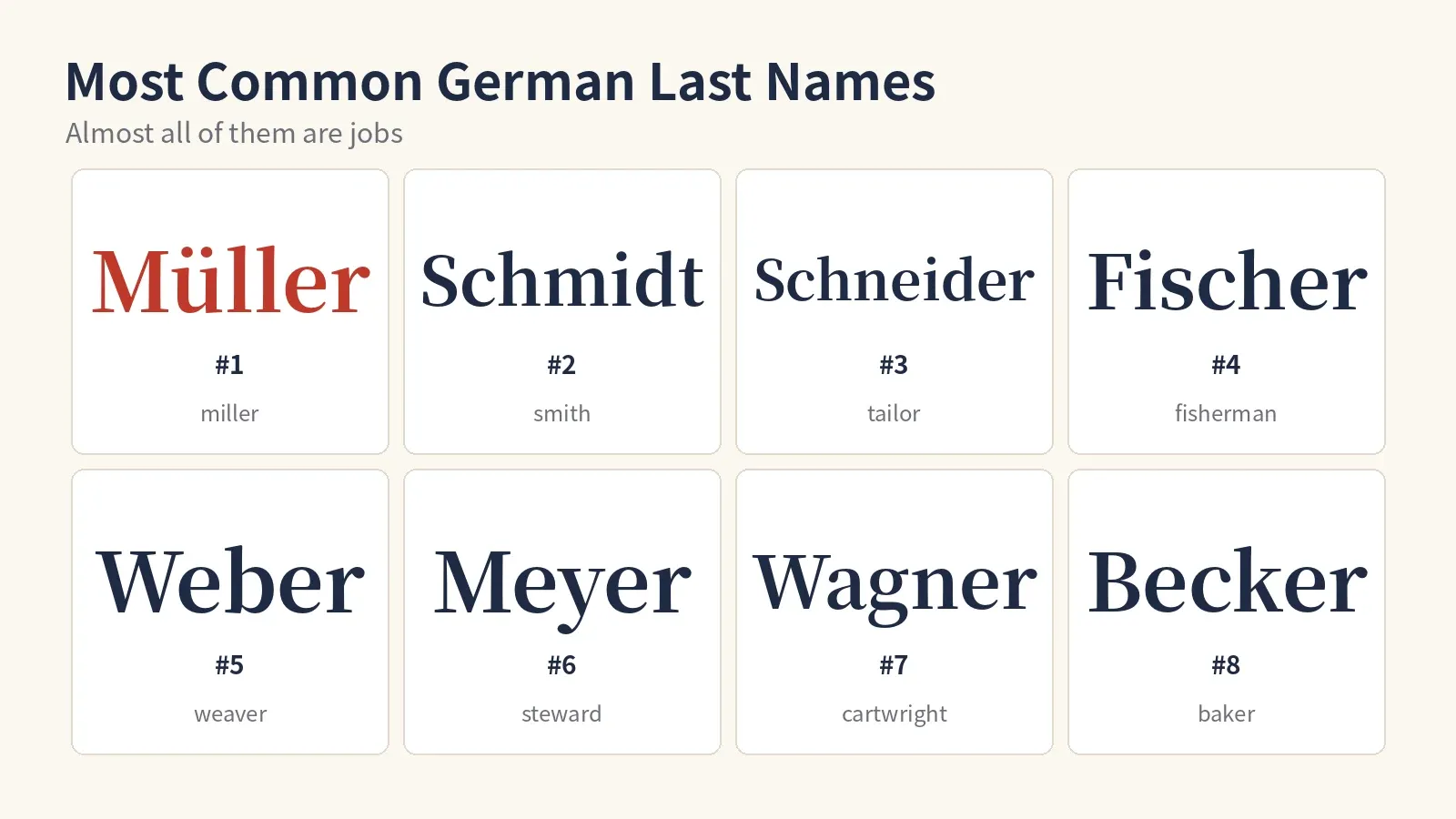
| Rank | Surname | Meaning | Origin type |
|---|---|---|---|
| 1 | Müller | Miller | Occupation |
| 2 | Schmidt | Smith | Occupation |
| 3 | Schneider | Tailor (cutter) | Occupation |
| 4 | Fischer | Fisherman | Occupation |
| 5 | Weber | Weaver | Occupation |
| 6 | Meyer | Steward, tenant farmer | Occupation |
| 7 | Wagner | Cartwright, wagon driver | Occupation |
| 8 | Becker | Baker | Occupation |
| 9 | Schulz | Village headman, constable | Occupation |
| 10 | Hoffmann | Farm steward | Occupation |
| 11 | Schäfer | Shepherd | Occupation |
| 12 | Koch | Cook | Occupation |
| 13 | Bauer | Farmer | Occupation |
| 14 | Richter | Judge | Occupation |
| 15 | Klein | Small | Nickname |
| 16 | Wolf | Wolf | Nickname |
| 17 | Schröder | Tailor (northern) | Occupation |
| 18 | Neumann | New man, newcomer | Nickname |
| 19 | Schwarz | Black, dark-haired | Nickname |
| 20 | Zimmermann | Carpenter | Occupation |
| 21 | Braun | Brown | Nickname |
| 22 | Krüger | Innkeeper, potter | Occupation |
| 23 | Hofmann | Farm steward | Occupation |
| 24 | Hartmann | Strong man | Patronymic |
| 25 | Lange | Tall | Nickname |
| 26 | Schmitt | Smith (western) | Occupation |
| 27 | Werner | Guard of the army | Patronymic |
| 28 | Schmitz | Smith (Rhineland) | Occupation |
| 29 | Krause | Curly-haired | Nickname |
| 30 | Meier | Steward (southern spelling) | Occupation |
| 31 | Lehmann | Feudal tenant | Occupation |
| 32 | Schmid | Smith (southern) | Occupation |
| 33 | Schulze | Village headman | Occupation |
| 34 | Maier | Steward (Bavarian spelling) | Occupation |
| 35 | Köhler | Charcoal burner | Occupation |
| 36 | Herrmann | Army man, warrior | Patronymic |
| 37 | König | King | Nickname |
| 38 | Walter | Army ruler | Patronymic |
| 39 | Mayer | Steward | Occupation |
| 40 | Huber | Farmer of a “Hube” (land unit) | Occupation |
| 41 | Kaiser | Emperor | Nickname |
| 42 | Fuchs | Fox | Nickname |
| 43 | Peters | Son of Peter | Patronymic |
| 44 | Lang | Tall | Nickname |
| 45 | Scholz | Village headman (Silesian) | Occupation |
| 46 | Möller | Miller (northern) | Occupation |
| 47 | Weiß | White, fair | Nickname |
| 48 | Jung | Young | Nickname |
| 49 | Hahn | Rooster | Nickname |
| 50 | Schubert | Shoemaker | Occupation |
The Top 10 Popular German Last Names Explained
- Müller: Every village needed a mill, and the miller was a key figure. Hence one of Europe’s most common names.
- Schmidt: From Schmied, a smith. Schmitt and Schmitz are regional spellings of the same job.
- Schneider: “Cutter,” from schneiden, to cut. A tailor cut cloth.
- Fischer: A fisherman, common near rivers and the coast.
- Weber: From weben, to weave. Linen weaving was a huge rural trade.
- Meyer: A steward who managed a landowner’s farm. It appears as Meier, Maier, Mayer and Meyer.
- Wagner: A cartwright who built wagons, or a carter who drove them.
- Becker: A baker, from backen, to bake.
- Schulz: From Schultheiß, the village official who collected dues and kept order.
- Hoffmann: A man who worked on a Hof (farm or court), often a steward.
Why Are So Many German Surnames Jobs?
Here’s the core insight. When surnames became fixed in German towns, a trade was the easiest way to tell people apart. Three men named Hans? One was the smith, one the miller, one the baker.
And those jobs stayed in the family for generations. A son usually took over his father’s workshop, so the job title naturally became a family name.
If an ancestor’s occupation interests you, compare the word-based explanations in French last names and Italian last names. Treat each language’s spelling and meaning separately rather than translating a surname by appearance.
How to Decode Any German Last Name
Most German surnames are built from a German word you can look up. Spot the root, then check the ending for a regional clue.
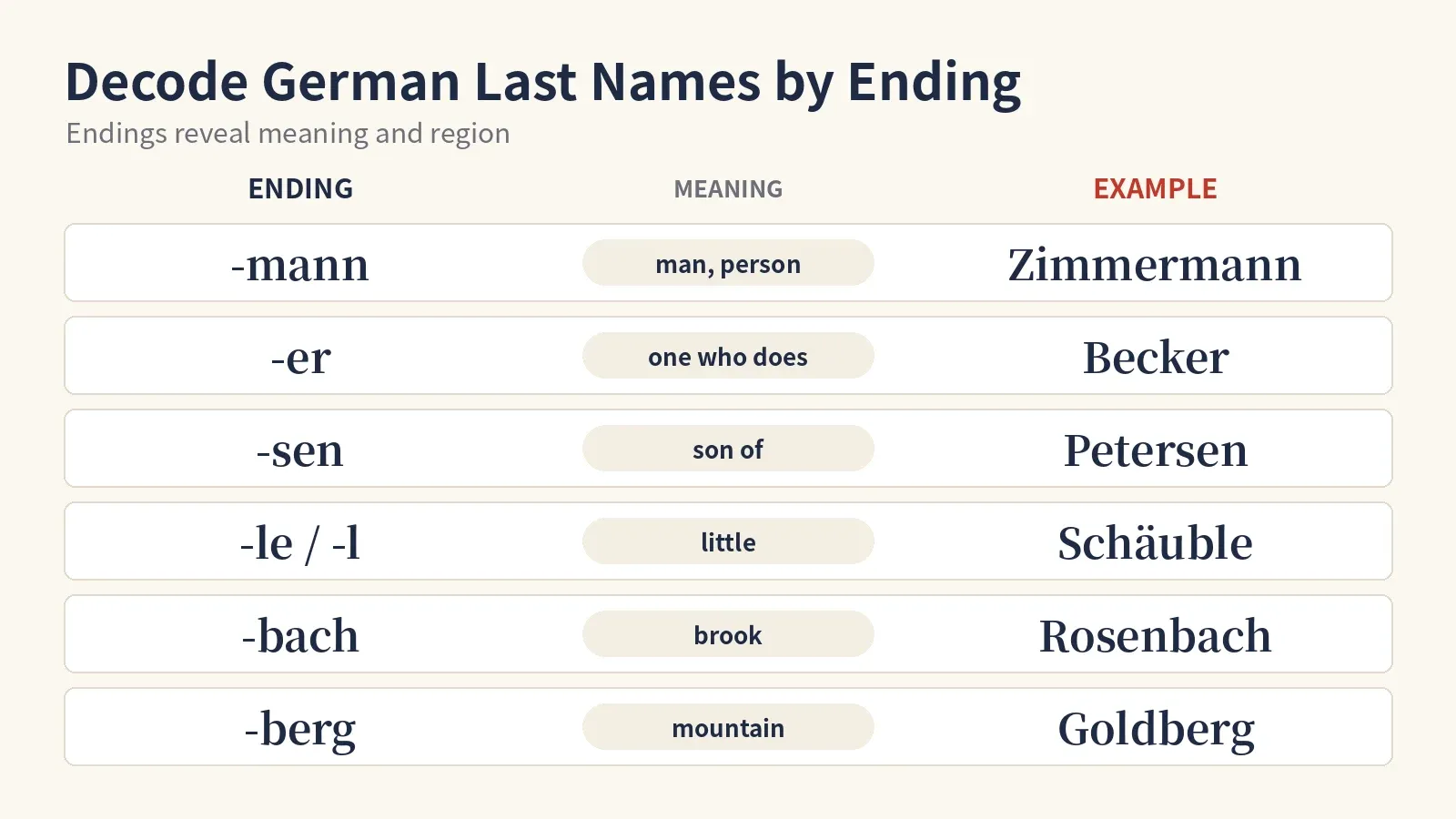
German Surname Endings and What They Mean
| Ending | Meaning | Examples | Region |
|---|---|---|---|
| -mann | Man, person | Hoffmann, Neumann, Zimmermann | Everywhere |
| -er | Person who does / lives at | Becker, Berger, Huber | Everywhere, esp. south |
| -sen | Son of | Petersen, Hansen, Jensen | Far north |
| -s, -z | Son of (short) | Peters, Hinz, Kunz | North and west |
| -ing | Belonging to | Henning, Nölting | North |
| -le, -l, -li | Little | Schäuble, Hansl, Rüedli | South, Switzerland |
| -ke, -ka | Little (Slavic influence) | Lemke, Radtke | East |
| -ow, -itz | Place name (Slavic) | Bülow, Leibnitz | East |
| -bach, -berg, -dorf | Brook, mountain, village | Rosenbach, Goldberg, Altdorf | Everywhere |
Occupational German Surnames
| Surname | Occupation |
|---|---|
| Bäcker / Becker | Baker |
| Brenner | Distiller |
| Fleischer / Metzger | Butcher |
| Gärtner | Gardener |
| Jäger | Hunter |
| Kaufmann | Merchant |
| Keller | Cellar master |
| Kellner | Waiter, steward |
| Maurer | Mason |
| Schuster | Shoemaker |
| Töpfer | Potter |
| Vogler | Bird catcher |
| Wirth | Innkeeper |
| Zimmermann | Carpenter |
| Förster | Forester |
| Schreiber | Scribe |
Nature and Place German Surnames
| Surname | Meaning |
|---|---|
| Bach | Brook |
| Baumann | Tree man, farmer |
| Berg / Berger | Mountain / mountain dweller |
| Busch | Bush |
| Feld | Field |
| Holz | Wood |
| Rosenberg | Rose mountain |
| Stein | Stone |
| Waldmann | Forest man |
| Brunner | Well or spring dweller |
| Lindemann | Man by the linden tree |
| Eichmann | Man by the oak |
Compare family-name structure with Greek last names and Russian last names. Their guides make useful companions when you are checking how endings, family relationships and spelling conventions differ across Europe.
Germanic Last Names: Names From Old Warrior First Names
“Germanic” last names come from ancient Germanic first names, many of them warlike. They’re shared across Germany, the Netherlands, Scandinavia and even England.
| Surname | Old Germanic parts | Meaning |
|---|---|---|
| Albrecht | adal + beraht | Noble and bright |
| Bernhardt | bern + hard | Brave as a bear |
| Friedrich | frid + ric | Peaceful ruler |
| Gerhardt | ger + hard | Brave spear |
| Heinrich | heim + ric | Ruler of the home |
| Konrad | kuoni + rad | Brave counsel |
| Ludwig | hlud + wig | Famous warrior |
| Siegfried | sigu + frid | Victory and peace |
| Wilhelm | wil + helm | Will + helmet |
| Ulrich | uodal + ric | Ruler of the inheritance |
| Dietrich | theud + ric | Ruler of the people |
| Arnold | arn + wald | Eagle power |
Uncommon German Last Names
Here are rarer surnames with vivid meanings. Many are compound words, which German builds easily.
| Surname | Meaning |
|---|---|
| Morgenstern | Morning star |
| Himmelreich | Kingdom of heaven |
| Sonnenschein | Sunshine |
| Rosenthal | Rose valley |
| Silberberg | Silver mountain |
| Adler | Eagle |
| Falkenrath | Falcon counsel |
| Donnerstag | Thursday |
| Winterstein | Winter stone |
| Kirschbaum | Cherry tree |
| Nachtigall | Nightingale |
| Wunderlich | Odd, peculiar |
| Frohlich | Cheerful |
| Liebknecht | Dear servant |
| Grünewald | Green forest |
| Eisenhauer | Iron hewer (miner) |
| Hasenclever | Hare clover |
| Sauerbier | Sour beer |
Noble German Last Names: What “von” Really Means
“Von” means “of” or “from.” Historically, noble families used it with the name of their estate, such as von Bismarck. But not every “von” was noble, and the related Dutch “van” rarely was.
In 1919, the Weimar Republic abolished noble privileges. Titles like “Graf” (count) became simply part of the legal surname, and new “von” names could no longer be granted as honors.
| Surname | Meaning | Famous for |
|---|---|---|
| von Bismarck | Of Bismarck (a town) | Otto von Bismarck, unifier of Germany |
| von Habsburg | Of Habichtsburg (“hawk castle”) | Holy Roman Emperors |
| von Hohenzollern | Of Hohenzollern castle | Kings of Prussia, German emperors |
| von Braun | Of Braun | Wernher von Braun, rocket scientist |
| von Goethe | Of Goethe | Poet Johann Wolfgang von Goethe (ennobled 1782) |
| von Humboldt | Of Humboldt | Explorer Alexander von Humboldt |
| von Richthofen | Of Richthofen (a place) | The “Red Baron” |
| von Trapp | Of Trapp | The Sound of Music family (Austrian) |
| von Stauffenberg | Of Stauffenberg | Leader of the 1944 plot against Hitler |
| von Wittelsbach | Of Wittelsbach | Bavarian royal family |
How German Last Names Became American
Millions of Germans emigrated to the United States in the 1700s and 1800s, and many adapted their surnames to English spelling. Some translated the meaning. Others just spelled the sound the English way.
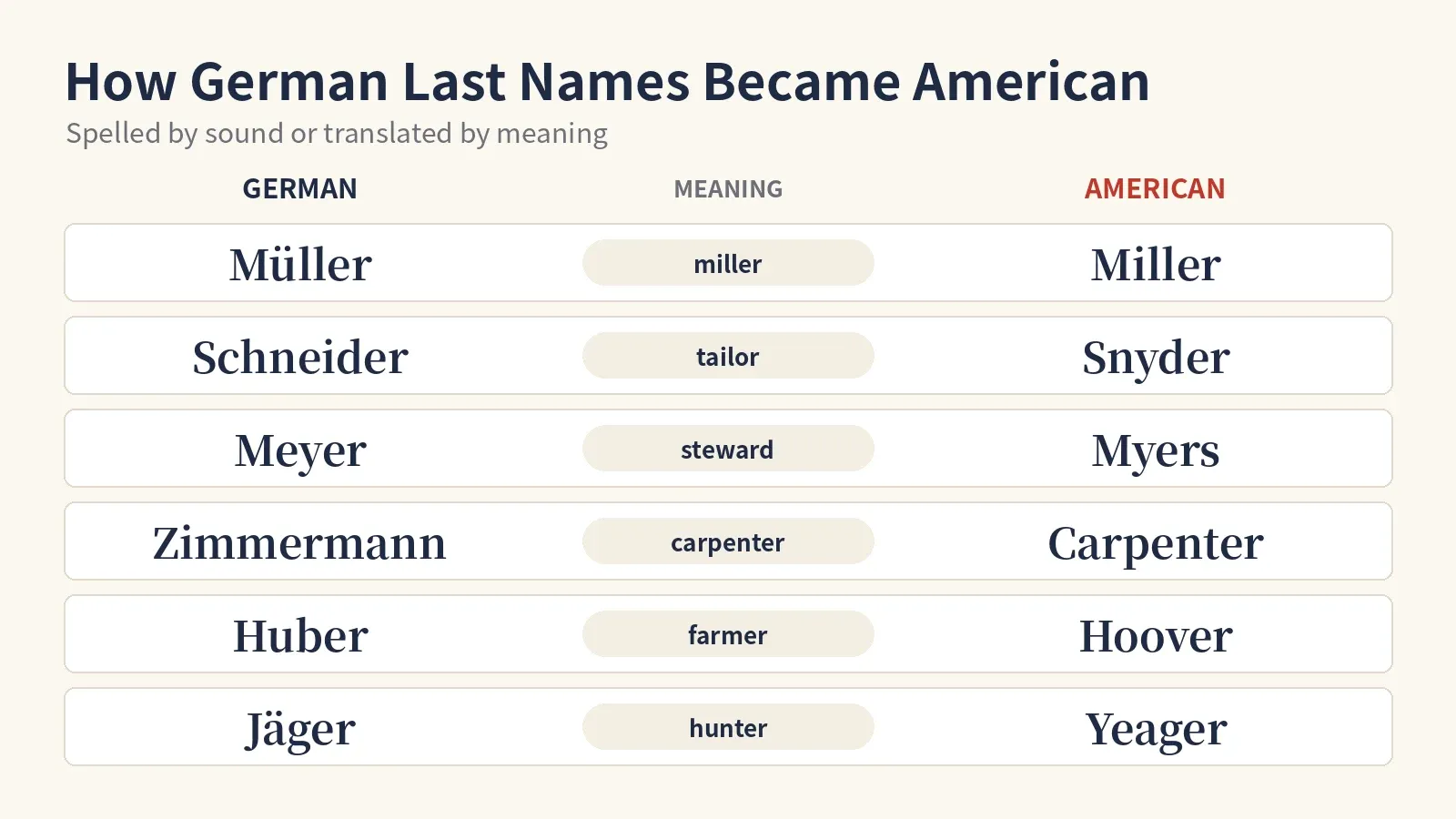
| German original | American form | Meaning |
|---|---|---|
| Müller | Miller | Miller |
| Schneider | Snyder, Snider | Tailor |
| Meyer | Myers | Steward |
| Schmidt | Smith | Smith |
| Zimmermann | Carpenter | Carpenter |
| Koch | Cook | Cook |
| Becker | Baker | Baker |
| Braun | Brown | Brown |
| Weiß | White | White |
| Klein | Kline, Cline | Small |
| Pfeiffer | Piper | Piper |
| Jäger | Yeager | Hunter |
| Huber | Hoover | Farmer |
| Kuntz | Coons | Son of Konrad |
| Rockefeller | Rockefeller | From Rockenfeld (place) |
The Pennsylvania Dutch Connection
“Pennsylvania Dutch” doesn’t mean Dutch. It comes from Deutsch, “German.” These settlers from the Palatinate and Switzerland brought names like Yoder, Stoltzfus, Hershey and Zook. Milton Hershey’s chocolate empire carries one of them.
When following a family across borders, consult Irish last names for another migration-focused comparison. Spanish last names and Hispanic last names add a separate discussion of surname order that should not be assumed to follow German conventions.
The History of German Last Names
| Period | What happened |
|---|---|
| 1100s–1200s | Nobles and city dwellers in the south and west start using bynames |
| 1300s–1400s | Surnames spread in towns; trades and places dominate |
| 1500s–1600s | Church books record baptisms; surnames become hereditary |
| 1700s–1800s | Rural north and east finish adopting fixed surnames |
| 1808–1812 | Jewish families in German states are required to adopt fixed surnames |
| 1875 | Civil registration begins across the German Empire |
| 1919 | Noble privileges abolished; “von” becomes part of the name |
Why Some Jewish German Surnames Sound So Poetic
When German states required Jewish families to take fixed surnames in the early 1800s, many chose (or were assigned) names from nature and beauty: Rosenthal (rose valley), Goldberg (gold mountain), Lilienthal (lily valley), Blumenfeld (flower field). That’s why these ornamental names are so distinctive today.
How to Pronounce German Last Names
| Rule | Example | Say it like |
|---|---|---|
| “ei” sounds like “eye” | Meyer, Klein | MY-er, KLINE |
| “ie” sounds like “ee” | Dietrich | DEE-trikh |
| “w” sounds like “v” | Wagner, Weber | VAHG-ner, VAY-ber |
| “sch” sounds like “sh” | Schmidt | SHMIT |
| “ü” is between “ee” and “oo” | Müller | MEW-ler |
| “ß” is a double s | Weiß | VICE |
Expert Insights and Real-World Examples
Case Study: Finding “Miller” in German Records
Say your great-great-grandfather was “John Miller” from Ohio.
- Check church records in the US first. German-speaking Lutheran or Catholic churches often recorded names in German: “Johannes Müller.”
- Find the town. Immigration papers or tombstones sometimes name the German village.
- Search German church books. Many are digitized, going back to the 1600s.
- Try every spelling. Müller, Mueller, Muller and Möller are all the same name.
Real Examples: Famous German Surnames
- Bach: “Brook.” Johann Sebastian Bach’s family name described a place by a stream.
- Beethoven: Actually Flemish: “from the beet garden.”
- Schwarzenegger: From a place name meaning “black corner” or “black ridge” in Austria.
- Heineken: Dutch, but from the Germanic Heine, a pet form of Heinrich.
Common Mistakes With German Surnames
| Mistake | Why it’s wrong | Do this instead |
|---|---|---|
| Assuming “von” means nobility | Many commoners had it too | Check the family history |
| Searching only “Miller” | Records may say Müller or Molitor | Search every variant |
| Dropping umlauts incorrectly | Müller ≠ Muller in some systems | Use Mueller |
| Mistaking “Dutch” for Dutch | Pennsylvania Dutch are German | Look for German records |
| Ignoring Latin records | Priests wrote in Latin | Learn a few Latin job words |
How to Choose a German Last Name for a Character
- Pick the job. A blacksmith hero named Schmidt is almost too perfect.
- Pick the region. A Bavarian character suits Huber or Maier; a Hamburg sailor suits Petersen.
- Add status. A villain aristocrat suits “von Falkenrath.”
- Use meaning. A clever character named Fuchs (“fox”) gives German speakers a wink.
Find Your Perfect Name With Our German Last Name Generator
Use the German Last Name Generator at the top of this page. Filter by occupation, nature, noble “von” names and rarity, then copy your favorite.
Exploring more? See our guides to French last names, Polish last names, English last names and German names.
FAQs About German Last Names
What is the most common German last name?
Müller is usually counted as the most common German last name. If you combine Schmidt, Schmitt and Schmitz, the Schmidt group comes out slightly ahead.
What do most German last names mean?
Most describe an ancestor’s job, such as Schmidt (smith), Müller (miller), Schneider (tailor) and Fischer (fisherman).
What does “von” mean in a German name?
“Von” means “of” or “from.” It was traditionally used by nobility with the name of an estate. Since 1919, it’s simply part of the surname.
What are uncommon German last names?
Examples include Morgenstern (morning star), Himmelreich (kingdom of heaven), Sonnenschein (sunshine), Nachtigall (nightingale) and Wunderlich (odd).
What are Germanic last names?
Germanic last names come from old Germanic first names, such as Albrecht, Friedrich, Heinrich, Ludwig and Wilhelm.
Why did German names change in America?
Many immigrants adapted spellings or translated names to fit English, turning Müller into Miller and Zimmermann into Carpenter.
Is Miller a German name?
Often, yes. Many American Millers descend from German Müllers, though Miller is also an English occupational name.
How do you type German names without umlauts?
Replace the umlaut with an “e”: ä becomes ae, ö becomes oe and ü becomes ue.
What are German last names that mean wolf?
Wolf, Wolff and Wölfel all mean wolf. Wolfgang and Wolfram are first names with the same root.
What is the longest common German surname?
Long compound surnames like Hasenclever or Himmelreich exist, but the most common names are short job titles.
The Bottom Line
- Most German last names are jobs: Müller, Schmidt, Schneider, Fischer, Weber.
- Endings reveal regions: -sen in the north, -le and -er in the south, -ow and -itz in the east.
- Many American names are secretly German: Miller, Myers, Snyder and Hoover.
Try the German Last Name Generator at the top of this page to find yours.
Looking for more? Explore name origins and meanings across all eight categories.