Name generator
Spanish Last Name Generator
Explore 108 distinct Spanish surnames from this guide. Start with rare and uncommon picks, or explore every category. Choose a category or letter to narrow your results, then copy or save your favorites.
Showing 15 of 108 matching Spanish surnames.
Results use different initials when available. Counts reflect the names in this guide; some letters and categories naturally have fewer matches. Letters without matches are hidden. “Rare” and “uncommon” follow the guide’s descriptions, not a worldwide frequency ranking.
- AlcázarGuide: uncommon
Fortress, palace (Arabic origin)
- EspinosaGuide: uncommon
Thorny
- VillalobosGuide: uncommon
Town of wolves
- OlivaresGuide: uncommon
Olive groves
- QuiñonesGuide: uncommon
Plots of land
- LuceroGuide: uncommon
Bright star, morning star
- BelmonteGuide: uncommon
Beautiful mountain
- DelacruzGuide: uncommon
Of the cross
- HidalgoGuide: uncommon
Son of something (a nobleman)
- GalindoGuide: uncommon
From a Visigothic name
- SotomayorGuide: uncommon
Larger grove
- MadrigalGuide: uncommon
From a Castilian town
- CalatravaGuide: uncommon
Castle of Rabah (Arabic origin)
- ZuritaGuide: uncommon
Dove (from zurito)
- AlmodóvarGuide: uncommon
The round one (Arabic origin)
These are surnames from the guide, not invented combinations. Follow the guide for meanings, regional context, and spelling variants. View your shortlist
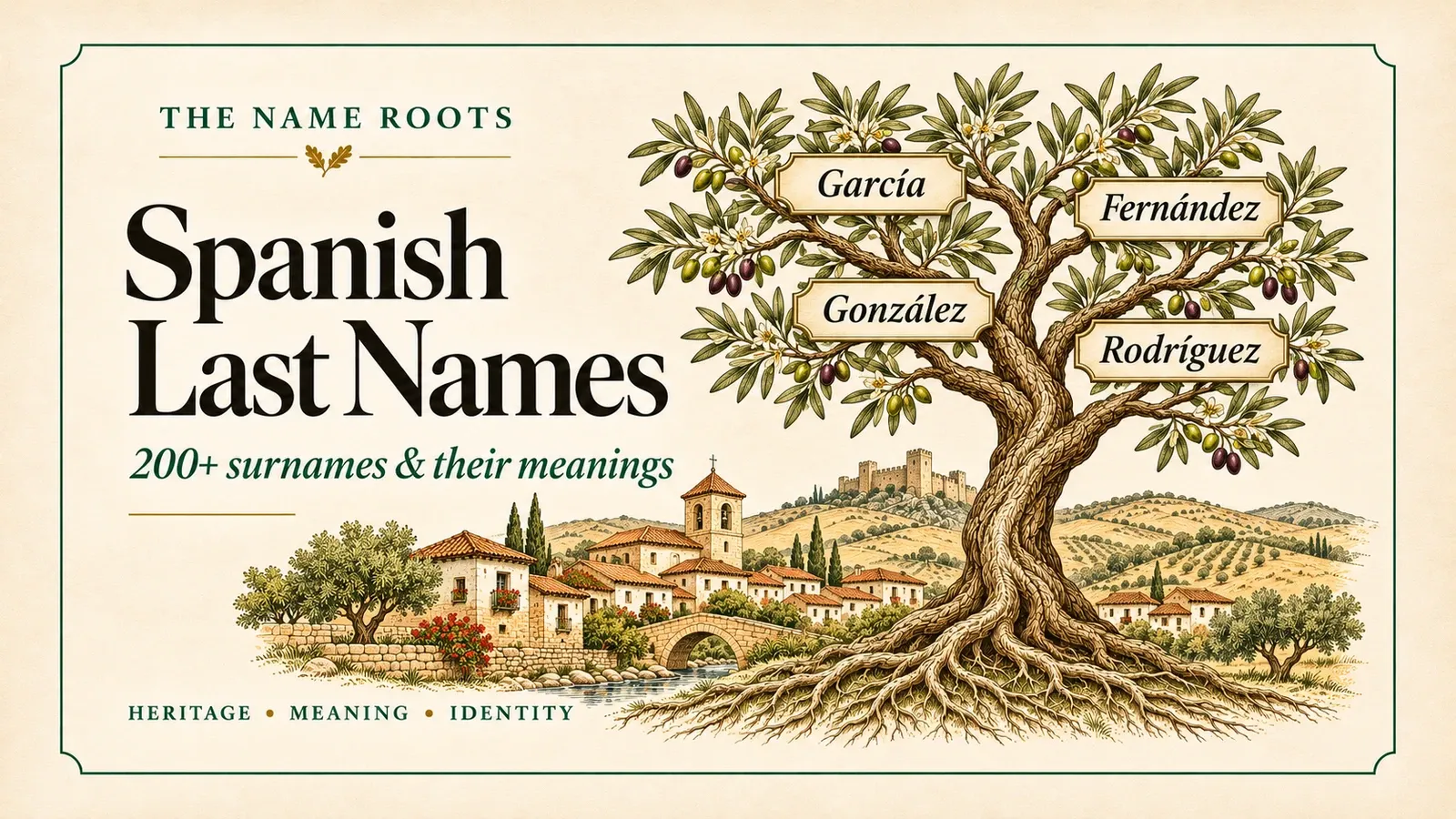
Spain’s most common surname, García, is so old that scholars still argue about what it means. Its closest rivals, Rodríguez, González and Fernández, are easy by comparison: they all mean “son of” someone.
Most Spanish last names are patronymics ending in -ez, meaning “son of.” Others come from places (Torres, Navarro), jobs (Herrero, “blacksmith”) or nicknames (Delgado, “thin”). And every Spaniard carries two surnames, one from each parent.
In this guide, you’ll find more than 200 Spanish surnames with meanings, plus how the two-surname system works, how to decode -ez names, and why a whole country on the other side of the world uses Spanish surnames.
Spanish Last Names at a Glance (Quick Facts)
| Fact | Answer |
|---|---|
| Most common Spanish last name | García, then Rodríguez, González, Fernández and López |
| Top 10 share | The ten most common surnames cover about 20% of Spain |
| How many surnames each person has | Two: father’s first surname + mother’s first surname |
| What “-ez” means | “Son of” (Fernández = son of Fernando) |
| Can parents choose the order? | Yes, since 1999; since 2017 there’s no automatic default |
| Do Spanish women change surnames at marriage? | No. They keep their own surnames for life |
| Regional languages | Basque, Catalan and Galician surnames look very different |
How to Read the Tables in This Guide
| Origin type | What it tells you | Example |
|---|---|---|
| Patronymic | Father’s first name + -ez | Rodríguez, Sánchez |
| Place | A town, region or landscape | Navarro, Torres, Rivera |
| Occupation | An ancestor’s job | Herrero (smith), Molina (mill) |
| Nickname | A trait or look | Moreno (dark), Delgado (thin) |
| Religious | A saint, feast or virtue | Cruz, Santos, Reyes |
The 30 Most Common Spanish Last Names and Their Meanings
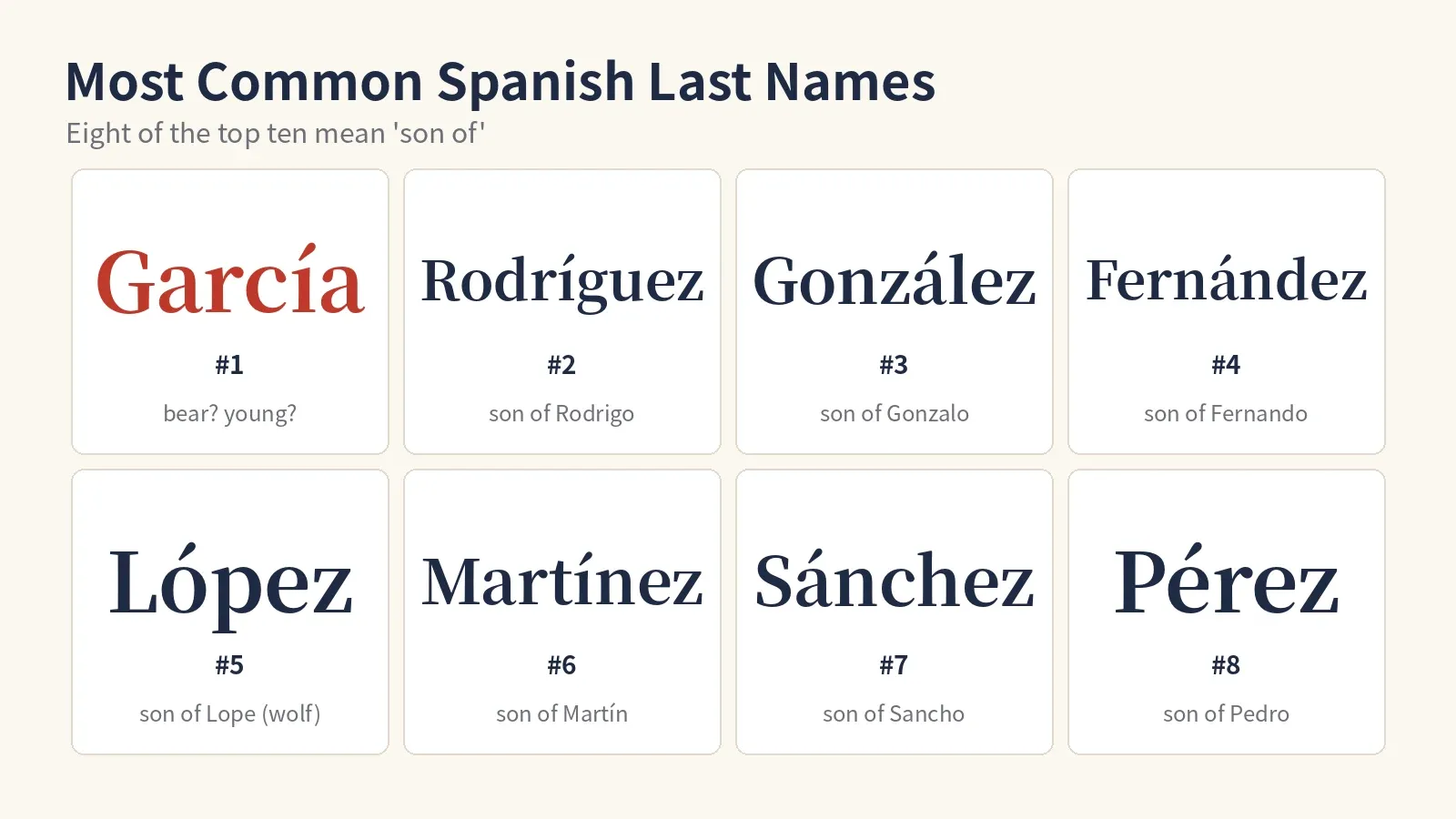
The most common Spanish last names are García, Rodríguez, González, Fernández and López. Eight of the top ten end in -ez.
The ranking below follows data from Spain’s National Statistics Institute (INE), as summarized on Wikipedia.
| Rank | Surname | Meaning | Origin type |
|---|---|---|---|
| 1 | García | Uncertain; possibly “bear” or “young” (Basque) | Pre-Roman / Basque |
| 2 | Rodríguez | Son of Rodrigo (“famous ruler”) | Patronymic |
| 3 | González | Son of Gonzalo (“battle”) | Patronymic |
| 4 | Fernández | Son of Fernando (“bold traveler”) | Patronymic |
| 5 | López | Son of Lope (“wolf”) | Patronymic |
| 6 | Martínez | Son of Martín | Patronymic |
| 7 | Sánchez | Son of Sancho (“holy”) | Patronymic |
| 8 | Pérez | Son of Pedro (“rock”) | Patronymic |
| 9 | Gómez | Son of Gome (“man”) | Patronymic |
| 10 | Martín | Of Mars; from Saint Martin | Patronymic |
| 11 | Jiménez | Son of Jimeno (Simon) | Patronymic |
| 12 | Ruiz | Son of Ruy (Rodrigo) | Patronymic |
| 13 | Hernández | Son of Hernando | Patronymic |
| 14 | Díaz | Son of Diego | Patronymic |
| 15 | Moreno | Dark-haired, dark-skinned | Nickname |
| 16 | Muñoz | Son of Muño | Patronymic |
| 17 | Álvarez | Son of Álvaro (“guardian”) | Patronymic |
| 18 | Romero | Pilgrim to Rome; rosemary | Religious / nickname |
| 19 | Alonso | Noble and ready (Alfonso) | Patronymic |
| 20 | Gutiérrez | Son of Gutierre | Patronymic |
| 21 | Navarro | From Navarre | Place |
| 22 | Torres | Towers | Place |
| 23 | Domínguez | Son of Domingo | Patronymic |
| 24 | Vázquez | Son of Vasco (Basque) | Patronymic |
| 25 | Ramos | Branches (Palm Sunday) | Religious |
| 26 | Gil | Young goat; from Giles | Patronymic |
| 27 | Ramírez | Son of Ramiro | Patronymic |
| 28 | Serrano | Mountain dweller | Place |
| 29 | Blanco | White, fair | Nickname |
| 30 | Molina | Mill | Occupation / place |
The Top 5 Popular Spanish Last Names Explained
- García: The mystery name. It likely comes from a pre-Roman or Basque word, possibly hartz (“bear”) or gaztea (“young”). It was a popular medieval first name before it became a surname.
- Rodríguez: “Son of Rodrigo,” a Visigothic name meaning “famous ruler.”
- González: “Son of Gonzalo,” another Visigothic name, related to “battle.”
- Fernández: “Son of Fernando,” a name made famous by Spanish kings.
- López: “Son of Lope,” from Latin lupus, “wolf.”
For other language-specific approaches to places and occupations, compare Italian last names with French last names. Similar themes can produce different spellings and naming conventions.
What Does -ez Mean in Spanish Last Names?
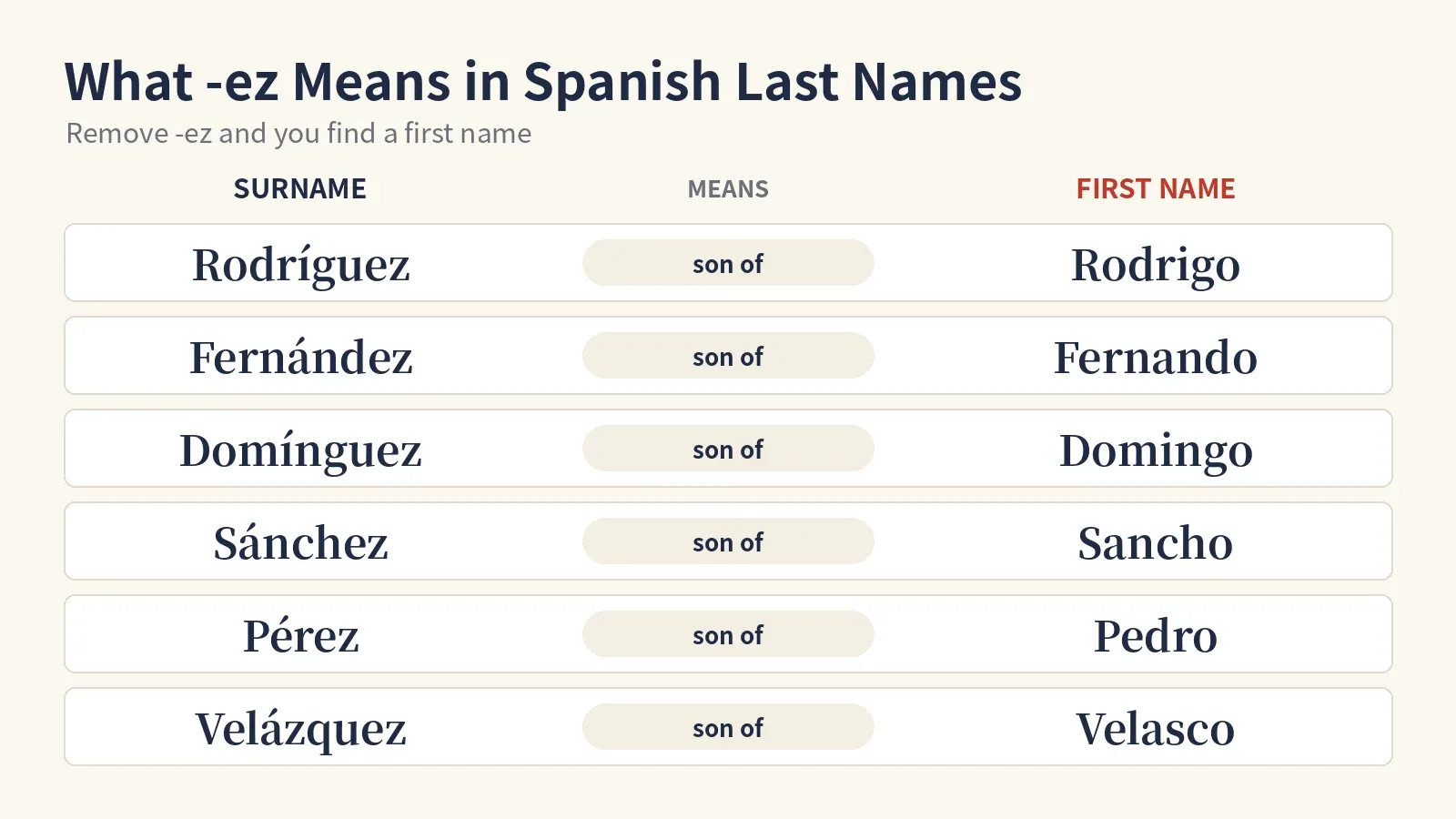
The -ez ending means “son of.” It comes from a Latin genitive ending (-ici) used in medieval Iberia. Remove it and you’ll usually find an old first name.
| Surname | First name | First name’s meaning |
|---|---|---|
| Rodríguez | Rodrigo | Famous ruler |
| Fernández | Fernando | Bold traveler |
| Sánchez | Sancho | Holy |
| Pérez | Pedro | Rock |
| Martínez | Martín | Of Mars |
| Domínguez | Domingo | Of the Lord (Sunday) |
| Benítez | Benito | Blessed |
| Enríquez | Enrique | Home ruler |
| Velázquez | Velasco | Little crow |
| Suárez | Suero | Swineherd (Latin suarius) |
| Márquez | Marcos | Of Mars |
| Estévez | Esteban | Crown |
| Ibáñez | Iván / Juan | God is gracious |
| Yáñez | Juan | God is gracious |
The same idea shows up in Portuguese as -es (Fernandes, Rodrigues, Gonçalves). So a Portuguese Fernandes and a Spanish Fernández are name cousins.
Spanish Last Names Meaning “Domingo”
People often search for a Spanish surname meaning “Domingo.” The answer is Domínguez, “son of Domingo.” Domingo means “of the Lord” (from Latin dominicus) and is also the Spanish word for Sunday. Related surnames include Domingo itself and the Portuguese Domingues.
How the Spanish Two-Surname System Works
Every Spaniard has two surnames: the father’s first surname and the mother’s first surname.
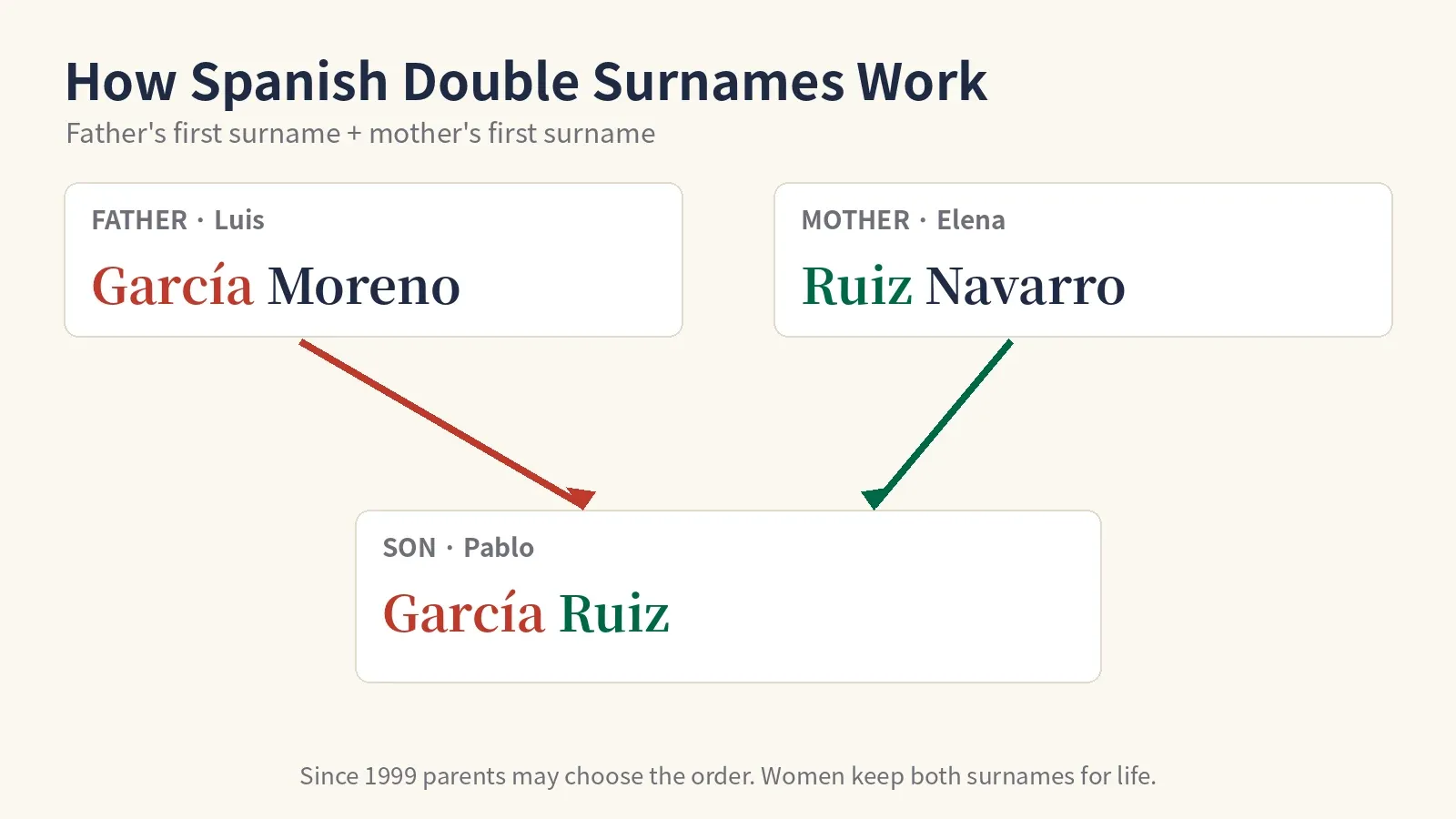
Both are passed on, so each person carries a trace of two family lines.
| Person | First surname | Second surname |
|---|---|---|
| Father: Luis García Moreno | García | Moreno |
| Mother: Elena Ruiz Navarro | Ruiz | Navarro |
| Son: Pablo García Ruiz | García | Ruiz |
What most people don’t know:
- Parents can choose the order. Since 1999, parents can put the mother’s surname first. Since 2017, the law has no automatic default, though the father-first order is still chosen the vast majority of the time.
- Women never change surnames at marriage. A married woman keeps both of her own surnames for life.
- Some people link surnames with “y.” For example, José Ortega y Gasset. The “y” (“and”) helps avoid confusion, especially when a surname could also be a first name.
- Common first surnames get dropped in daily use. Picasso’s full name was Pablo Ruiz Picasso. Because Ruiz is so common, he became known by his mother’s rarer surname.
Family Names in Spanish: Useful Vocabulary
| Spanish | English |
|---|---|
| Apellido | Surname, last name |
| Primer apellido | First (father’s) surname |
| Segundo apellido | Second (mother’s) surname |
| Nombre de pila | Given (baptismal) name |
| Familia | Family |
| Linaje | Lineage |
| ¿Cuál es tu apellido? | What’s your last name? |
Spanish Last Names by Region: Basque, Catalan and Galician
Spain has four major languages, and each shaped its own surnames. A Basque or Catalan surname looks nothing like a Castilian -ez name.
Basque Surnames
Basque surnames usually describe the family’s house or landscape. Many end in -(e)txea (“house”), -aga or -ena (“place of”).
| Surname | Meaning |
|---|---|
| Echeverría / Etxeberria | New house |
| Aguirre | Open field, exposed place |
| Mendoza | Cold mountain |
| Urrutia | Far away |
| Zabala | Wide |
| Goikoetxea | Upper house |
| Arrieta | Stony place |
| Iturriaga | Place of the spring |
| Larrañaga | Place of the threshing floor |
| Ibarra | Valley, meadow |
Catalan Surnames
| Surname | Meaning |
|---|---|
| Puig | Hill |
| Ferrer | Blacksmith |
| Vidal | Life |
| Serra | Mountain range |
| Soler | Sunny place |
| Font | Spring, fountain |
| Roca | Rock |
| Pujol | Small hill |
| Riera | Stream |
| Casals | Farmhouses |
Galician Surnames
| Surname | Meaning |
|---|---|
| Castro | Hill fort |
| Pereira | Pear tree |
| Carballo | Oak tree |
| Outeiro | Hill |
| Seoane | Saint John |
| Figueroa | Fig tree place |
| Varela | Stick, rod |
| Novoa | New |
| Otero | Hill, height |
| Barreiro | Clay pit |
Uncommon and Unique Spanish Last Names
These surnames are real but far less common. Many have striking or poetic meanings.
| Surname | Meaning |
|---|---|
| Alcázar | Fortress, palace (Arabic origin) |
| Almodóvar | The round one (Arabic origin) |
| Belmonte | Beautiful mountain |
| Bustamante | Place of cattle pasture |
| Calatrava | Castle of Rabah (Arabic origin) |
| Cienfuegos | A hundred fires |
| Delacruz | Of the cross |
| Espinosa | Thorny |
| Galindo | From a Visigothic name |
| Lucero | Bright star, morning star |
| Madrigal | From a Castilian town |
| Montalbán | White mountain |
| Olivares | Olive groves |
| Quiñones | Plots of land |
| Salvatierra | Safe land |
| Sotomayor | Larger grove |
| Valdés | Valley |
| Villalobos | Town of wolves |
| Zamora | From Zamora (a city) |
| Zurita | Dove (from zurito) |
| Buenaventura | Good fortune |
| Hidalgo | Son of something (a nobleman) |
| Caballero | Knight, gentleman |
| Cordero | Lamb |
Occupational Spanish Surnames
| Surname | Occupation |
|---|---|
| Herrero | Blacksmith |
| Zapatero | Shoemaker |
| Pastor | Shepherd |
| Molinero | Miller |
| Carpintero | Carpenter |
| Guerrero | Warrior, soldier |
| Escudero | Shield bearer, squire |
| Vaquero | Cowherd |
| Tejedor | Weaver |
| Cabrera | Goat herder |
Why Do Filipinos Have Spanish Last Names?
Most Filipinos have Spanish surnames because of an 1849 decree by Spanish Governor-General Narciso Clavería. He ordered Filipino families to adopt surnames from an official list, the Catálogo alfabético de apellidos.
Before then, many Filipinos didn’t use fixed family names, and many shared the same religious names (like de los Santos or de la Cruz), which made tax and census records chaotic. The catalogue fixed that. Each town received surnames starting with certain letters, which is why whole towns in the Philippines still share names beginning with the same letter.
That’s why a Filipino named Reyes or Santos may have no Spanish ancestry at all. The surname came from a government list, not a family tree. See our guide to Filipino last names for more.
Spanish Last Names Around the World
Spanish surnames spread to 20+ countries across Latin America and beyond. Rankings differ from country to country:
| Country | Most common surname |
|---|---|
| Spain | García |
| Mexico | Hernández |
| Argentina | González |
| Colombia | Rodríguez |
| Chile | González |
| United States (Hispanic) | Garcia |
In the 2010 US Census, Garcia ranked #6 among all American surnames, with Rodriguez (#9) and Martinez (#10) close behind (US Census Bureau).
The History of Spanish Last Names
| Period | What happened |
|---|---|
| 400s–700s | Visigoths bring Germanic first names (Rodrigo, Gonzalo, Fernando) |
| 711–1492 | Arabic influence on place names and some surnames |
| 900s–1100s | “Son of” names ending in -ez spread in northern kingdoms |
| 1400s–1500s | Surnames become hereditary; two-surname custom takes shape |
| 1500s onward | Spanish surnames spread across the Americas and the Philippines |
| 1870 | Spain’s Civil Registry formalizes two surnames |
| 1999 | Parents may put the mother’s surname first |
| 2017 | No automatic order; parents must agree |
When comparing family-name traditions beyond Spain, read German last names, Greek last names and Irish last names. Keep each surname’s documented background separate when choosing a name for a real family or fictional character.
Expert Insights and Real-World Examples
Case Study: Why “Picasso” Isn’t Picasso’s First Surname
Pablo Picasso was born Pablo Ruiz Picasso. Ruiz was his father’s surname, Picasso his mother’s (of Italian origin). Early on he signed “P. Ruiz Picasso,” then dropped Ruiz entirely.
The lesson for researchers: a famous or preferred surname isn’t always the legal first surname. Always check both.
Real Examples: Famous Spanish Surnames
- Velázquez (Diego): “Son of Velasco.” The painter’s full name was Diego Rodríguez de Silva y Velázquez.
- Cervantes (Miguel de): From a place name. The Don Quixote author’s full name was Miguel de Cervantes Saavedra.
- Almodóvar (Pedro): From an Arabic place name, “the round one.”
- Nadal (Rafael): Catalan for “Christmas,” given to children born on Christmas Day.
- Cruz (Penélope): “Cross,” a religious surname.
Common Mistakes With Spanish Surnames
| Mistake | Why it’s wrong | Do this instead |
|---|---|---|
| Treating the second surname as a middle name | It’s the mother’s surname | Keep both surnames |
| Filing under the last surname | The first surname is the main one | Alphabetize by the first surname |
| Expecting women to take the husband’s name | Spanish women keep their surnames | Search by birth surnames |
| Assuming all Spanish surnames are Castilian | Basque, Catalan and Galician names are Spanish too | Consider the region |
| Assuming a Filipino Reyes has Spanish ancestors | Many names came from an 1849 list | Research family records |
How to Choose a Spanish Last Name for a Character
- Use two surnames. “Lucía Navarro Castillo” sounds authentically Spanish.
- Pick a region. A Basque character suits Echeverría; a Barcelona character suits Puig or Ferrer.
- Use meaning. A fierce character named Guerrero (“warrior”) or a gentle one named Cordero (“lamb”) adds a layer.
- Go noble with care. Hidalgo, Caballero or a “de” name signals status.
Find Your Perfect Name With Our Spanish Last Name Generator
Use the Spanish Last Name Generator at the top of this page. Filter by origin type, region (Castilian, Basque, Catalan, Galician) and rarity, then copy your favorite.
Exploring more? See our guides to Mexican last names, Hispanic last names, Filipino last names and Spanish names.
FAQs About Spanish Last Names
What is the most common Spanish last name?
García is the most common last name in Spain, followed by Rodríguez, González, Fernández and López.
Why do Spanish people have two last names?
Each person takes the father’s first surname and the mother’s first surname, so both family lines are recorded.
What does -ez mean in Spanish last names?
It means “son of.” Rodríguez means “son of Rodrigo,” and Fernández means “son of Fernando.”
What Spanish last name means “son of Domingo”?
Domínguez means “son of Domingo.” Domingo means “of the Lord” and is also the Spanish word for Sunday.
Why do Filipinos have Spanish last names?
An 1849 decree by Governor-General Narciso Clavería required Filipino families to choose surnames from an official Spanish catalogue.
What are uncommon Spanish last names?
Examples include Cienfuegos, Villalobos, Salvatierra, Montalbán, Lucero, Zurita and Buenaventura.
Do Spanish women change their last name when they marry?
No. Spanish women keep both of their own surnames for life.
What are Basque last names?
Basque surnames include Echeverría (new house), Aguirre, Mendoza, Urrutia, Zabala and Ibarra.
Are Spanish and Mexican last names the same?
Many are shared, but rankings differ. García leads in Spain, while Hernández leads in Mexico.
What are popular Spanish last names in the US?
Garcia, Rodriguez, Martinez, Hernandez, Lopez and Gonzalez are the most common in the United States.
The Bottom Line
- Most Spanish last names mean “son of” someone, thanks to the -ez ending.
- Every Spaniard has two surnames, one from each parent, and women keep theirs for life.
- Regional and Arabic roots add depth, and an 1849 decree spread Spanish surnames across the Philippines.
Try the Spanish Last Name Generator at the top of this page to find yours.
Looking for more? Explore name origins and meanings across all eight categories.