Name generator
Russian Last Name Generator
Explore 115 distinct Russian surnames from this guide. Start with rare and uncommon picks, or explore every category. Choose a category or letter to narrow your results, then copy or save your favorites.
Showing 15 of 115 matching Russian surnames.
Results use different initials when available. Counts reflect the names in this guide; some letters and categories naturally have fewer matches. Letters without matches are hidden. “Rare” and “uncommon” follow the guide’s descriptions, not a worldwide frequency ranking.
- Smirnov
Son of the quiet, meek one
- Yegorov
Yegor’s (George)
- Goncharov
Potter
- Obolensky
From Obolensk
- Ivanov
Ivan’s (John)
- Fyodorov
Fyodor’s (gift of God)
- Dolgorukov
Long-armed
- Tolstoy
Fat, stout
- Kuznetsov
Blacksmith’s
- Zakharov
Zakhar’s
- Muravyov
Ant
- Uspensky
Of the Dormition
- Popov
Priest’s
- Alekseyev
Aleksey’s (defender)
- Vasilyev
Vasily’s (royal)
These are surnames from the guide, not invented combinations. Follow the guide for meanings, regional context, and spelling variants. View your shortlist
Russia’s most famous vodka brand is named after a family. Smirnoff is just an old Western spelling of Smirnov, which means “son of the quiet one.” It’s also one of Russia’s most common surnames.
Russian last names change with gender. A man is Ivanov, his wife and daughter are Ivanova. The ending tells you who’s who, and the root usually tells you where the family name came from: a father, a job, an animal nickname or a place.
In this guide, you’ll find more than 200 Russian surnames with meanings, both male and female forms, and simple rules to decode almost any Russian name you’ll ever see.
Russian Last Names at a Glance (Quick Facts)
| Fact | Answer |
|---|---|
| Most common Russian last names | Smirnov and Ivanov, followed by Kuznetsov, Popov and Vasilyev |
| Do Russian surnames change by gender? | Yes. Ivanov (male), Ivanova (female) |
| Most common male endings | -ov, -ev, -in, -sky |
| Most common female endings | -ova, -eva, -ina, -skaya |
| Most common origin | A father’s or ancestor’s first name (Ivanov = Ivan’s) |
| When most peasants got surnames | Mostly in the 1800s, especially after serfdom ended in 1861 |
| Why “-off” in English? | An older Western spelling of -ov (Smirnoff, Rachmaninoff) |
How to Read the Tables in This Guide
Every table shows the male form, the female form and the meaning. The origin types are:
| Origin type | What it tells you | Example |
|---|---|---|
| Patronymic | Named after a father or ancestor | Ivanov (Ivan’s), Petrov (Pyotr’s) |
| Occupation | An ancestor’s job | Kuznetsov (smith), Popov (priest’s) |
| Nickname | An animal, trait or quirk | Volkov (wolf’s), Lebedev (swan’s) |
| Place | A town or estate | Dostoevsky (from Dostoevo) |
| Church | Given to priests’ sons in seminaries | Preobrazhensky (Transfiguration) |
The 40 Most Common Russian Last Names and Their Meanings
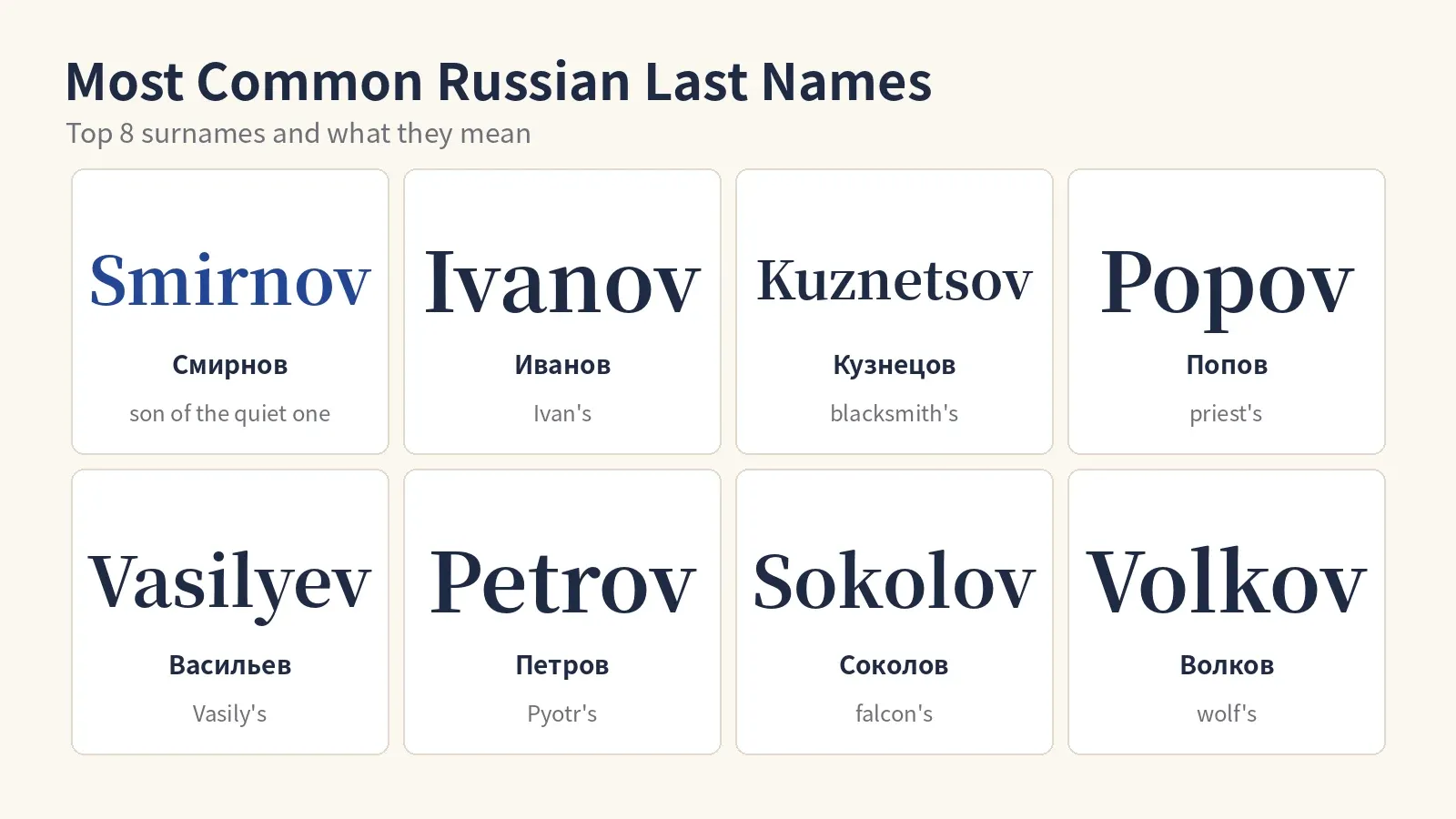
The most common Russian last names are Smirnov, Ivanov, Kuznetsov, Popov and Vasilyev. Different studies swap Smirnov and Ivanov at the top, but the same group of names leads every list.
Russian surname frequency has been studied by academic researchers, most recently Yumaguzin and Vinnik (2019), as summarized on Wikipedia. The list below follows the widely cited order of the most frequent names.
| Male | Female | Meaning | Origin type |
|---|---|---|---|
| Smirnov | Smirnova | Son of the quiet, meek one | Nickname |
| Ivanov | Ivanova | Ivan’s (John) | Patronymic |
| Kuznetsov | Kuznetsova | Blacksmith’s | Occupation |
| Popov | Popova | Priest’s | Occupation |
| Vasilyev | Vasilyeva | Vasily’s (royal) | Patronymic |
| Petrov | Petrova | Pyotr’s (stone) | Patronymic |
| Sokolov | Sokolova | Falcon’s | Nickname |
| Mikhaylov | Mikhaylova | Mikhail’s | Patronymic |
| Novikov | Novikova | Newcomer’s | Nickname |
| Fyodorov | Fyodorova | Fyodor’s (gift of God) | Patronymic |
| Morozov | Morozova | Frost’s | Nickname |
| Volkov | Volkova | Wolf’s | Nickname |
| Alekseyev | Alekseyeva | Aleksey’s (defender) | Patronymic |
| Lebedev | Lebedeva | Swan’s | Nickname |
| Semyonov | Semyonova | Semyon’s | Patronymic |
| Yegorov | Yegorova | Yegor’s (George) | Patronymic |
| Pavlov | Pavlova | Pavel’s (small) | Patronymic |
| Kozlov | Kozlova | Goat’s | Nickname |
| Stepanov | Stepanova | Stepan’s (crown) | Patronymic |
| Nikolayev | Nikolayeva | Nikolay’s | Patronymic |
| Orlov | Orlova | Eagle’s | Nickname |
| Andreyev | Andreyeva | Andrey’s (manly) | Patronymic |
| Makarov | Makarova | Makar’s (blessed) | Patronymic |
| Nikitin | Nikitina | Nikita’s (victor) | Patronymic |
| Zakharov | Zakharova | Zakhar’s | Patronymic |
| Zaytsev | Zaytseva | Hare’s | Nickname |
| Solovyov | Solovyova | Nightingale’s | Nickname |
| Borisov | Borisova | Boris’s | Patronymic |
| Yakovlev | Yakovleva | Yakov’s (Jacob) | Patronymic |
| Grigoryev | Grigoryeva | Grigory’s (watchful) | Patronymic |
| Romanov | Romanova | Roman’s | Patronymic |
| Vorobyov | Vorobyova | Sparrow’s | Nickname |
| Sergeyev | Sergeyeva | Sergey’s | Patronymic |
| Kuzmin | Kuzmina | Kuzma’s | Patronymic |
| Frolov | Frolova | Frol’s (flower) | Patronymic |
| Aleksandrov | Aleksandrova | Aleksandr’s | Patronymic |
| Dmitriyev | Dmitriyeva | Dmitry’s | Patronymic |
| Korolyov | Korolyova | King’s | Nickname |
| Gusev | Guseva | Goose’s | Nickname |
| Belov | Belova | White one’s | Nickname |
The Top 5 Popular Russian Last Names Explained
- Smirnov: From smirny, “quiet, peaceful.” A calm ancestor, or a child who didn’t cry much.
- Ivanov: Ivan was the most common Russian first name for centuries, so “Ivan’s son” became everywhere.
- Kuznetsov: From kuznets, “blacksmith.” It’s Russia’s version of Smith, Schmidt and Ferrari.
- Popov: From pop, a village priest. Orthodox priests could marry, so they had sons who carried the name.
- Vasilyev: From Vasily (Basil), which comes from Greek for “royal.”
Why Do So Many Russian Surnames End in -ov?
Here’s the core idea. The -ov and -ev endings mean “belonging to.” Ivanov literally means “Ivan’s,” as in “Ivan’s son.” It works exactly like the English “-son” or the Irish “Mac.”
Animal names follow the same logic. Volkov doesn’t mean “wolf.” It means “the wolf’s,” the family of a man nicknamed Volk (Wolf).
The word-based examples in German last names and French last names offer a contrast to Russian surname patterns. They are useful references when a family history crosses language boundaries.
Male vs Female Russian Last Names
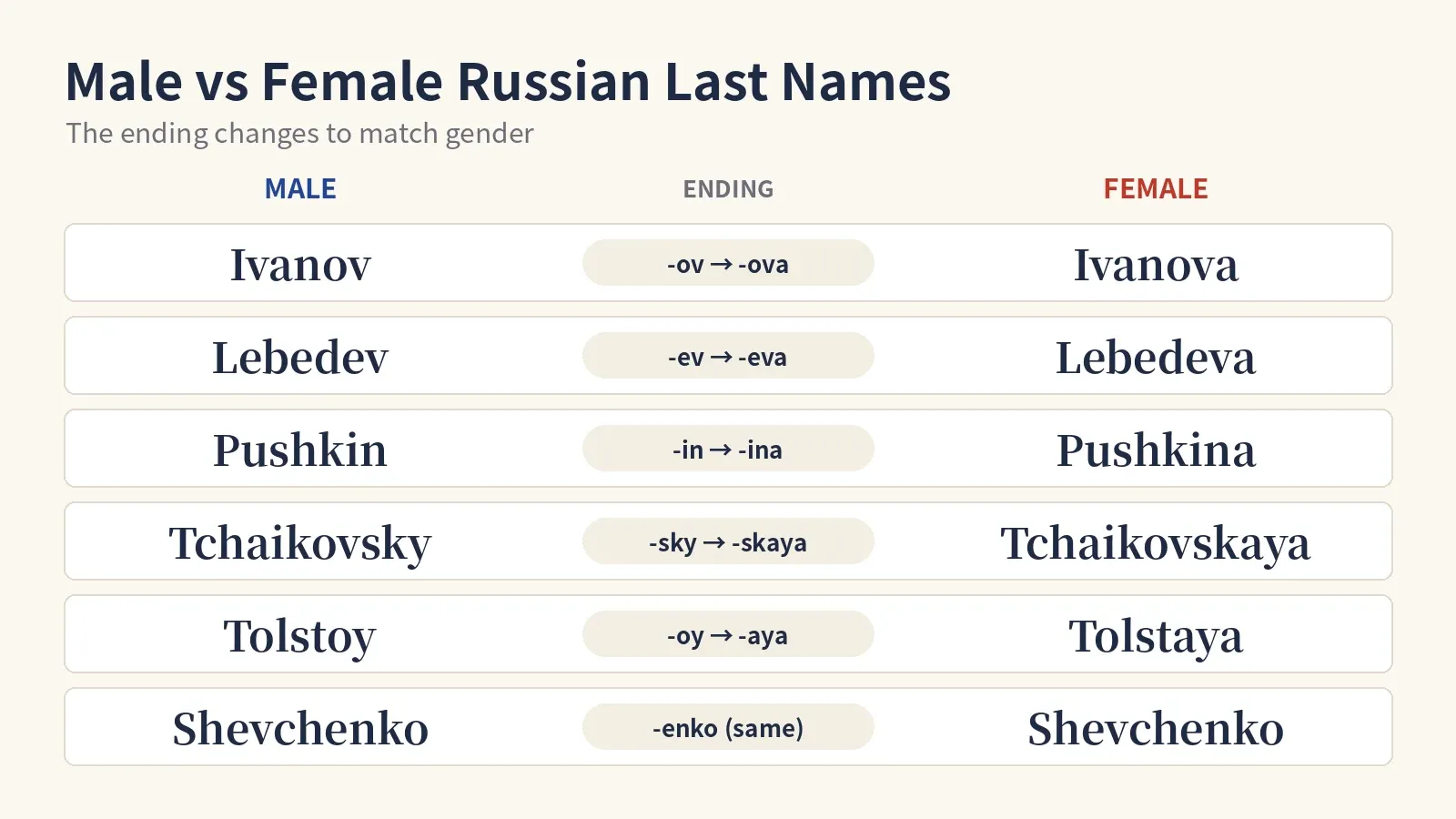
Russian surnames change their ending to match gender. It’s grammar, not choice. A woman in the Petrov family is always Petrova.
| Male ending | Female ending | Male example | Female example |
|---|---|---|---|
| -ov | -ova | Ivanov | Ivanova |
| -ev / -yov | -eva / -yova | Lebedev | Lebedeva |
| -in / -yn | -ina / -yna | Pushkin | Pushkina |
| -sky / -skiy | -skaya | Tchaikovsky | Tchaikovskaya |
| -oy | -aya | Tolstoy | Tolstaya |
| -ich (Belarusian/Serbian style) | -ich (no change) | Abramovich | Abramovich |
| -enko (Ukrainian) | -enko (no change) | Shevchenko | Shevchenko |
| -ko, -uk, -ak | no change | Bondarenko, Kovalchuk | same |
The plural is also different. A whole family is “the Ivanovs” in English, but Ivanovy in Russian.
Russian Last Names for Girls (Female Forms)
People searching “Russian last names for girls” usually want the female forms. Here are 20 that sound especially elegant, with meanings:
| Female surname | Male form | Meaning |
|---|---|---|
| Lebedeva | Lebedev | Swan’s |
| Solovyova | Solovyov | Nightingale’s |
| Orlova | Orlov | Eagle’s |
| Sokolova | Sokolov | Falcon’s |
| Romanova | Romanov | Roman’s (also the royal family) |
| Belova | Belov | White one’s |
| Zvezdina | Zvezdin | Star’s |
| Rozanova | Rozanov | Rose’s |
| Vinogradova | Vinogradov | Vineyard’s |
| Lvova | Lvov | Lion’s |
| Morozova | Morozov | Frost’s |
| Snegireva | Snegirev | Bullfinch’s |
| Tsvetkova | Tsvetkov | Flower’s |
| Lavrova | Lavrov | Laurel’s |
| Zhuravleva | Zhuravlev | Crane’s (the bird) |
| Golubeva | Golubev | Dove’s |
| Voronova | Voronov | Raven’s |
| Karpova | Karpov | Karp’s (fruit) |
| Arkhipova | Arkhipov | Arkhip’s (master horseman) |
| Sharapova | Sharapov | From an old nickname |
Russian Last Names for Boys and Men (Strong-Sounding)
| Male surname | Meaning |
|---|---|
| Volkov | Wolf’s |
| Medvedev | Bear’s |
| Orlov | Eagle’s |
| Sokolov | Falcon’s |
| Kuznetsov | Blacksmith’s |
| Molotov | Hammer’s (a pen name) |
| Voronov | Raven’s |
| Silin | Strength’s |
| Bogatyrev | Warrior hero’s |
| Kremnev | Flint’s |
| Zheleznov | Iron’s |
| Rybakov | Fisherman’s |
| Streltsov | Musketeer’s |
| Bykov | Bull’s |
| Kovalyov | Smith’s (southern form) |
| Kalashnikov | Kalach baker’s |
How to Decode Any Russian Last Name
Strip off the ending and you’re usually left with a first name, a job, an animal or a place. Here’s how to read what remains.
Occupational Russian Surnames
| Surname | Occupation |
|---|---|
| Kuznetsov | Blacksmith |
| Popov | Priest |
| Melnikov | Miller |
| Rybakov | Fisherman |
| Goncharov | Potter |
| Plotnikov | Carpenter |
| Kalashnikov | Kalach (bread) baker |
| Sapozhnikov | Shoemaker |
| Pastukhov | Herdsman |
| Bondarev | Cooper (barrel maker) |
| Kozhevnikov | Tanner |
| Tkachev | Weaver |
| Pechkin | Stove’s (a stove maker or keeper) |
Animal Nickname Surnames
Russians loved animal nicknames. A clever man might be “the fox,” a quiet one “the fish.”
| Surname | Animal |
|---|---|
| Volkov | Wolf |
| Medvedev | Bear |
| Lisitsyn | Fox |
| Zaytsev | Hare |
| Kozlov | Goat |
| Baranov | Ram |
| Gusev | Goose |
| Utkin | Duck |
| Petukhov | Rooster |
| Sorokin | Magpie |
| Voronin | Crow |
| Ershov | Ruffe (a small fish) |
| Komarov | Mosquito |
| Muravyov | Ant |
Seminary Surnames: Why Some Russian Names Sound So Grand
Here’s something most lists miss. In the 1700s and 1800s, many sons of Orthodox priests received new surnames at seminary school. Teachers invented them from church feasts, Latin words or virtues.
| Surname | Meaning |
|---|---|
| Preobrazhensky | Of the Transfiguration |
| Voskresensky | Of the Resurrection |
| Rozhdestvensky | Of the Nativity |
| Uspensky | Of the Dormition |
| Troitsky | Of the Trinity |
| Bogoyavlensky | Of the Epiphany |
| Speransky | Hope (from Latin sperare) |
| Dobrolyubov | Lover of goodness |
| Tikhomirov | Quiet peace |
| Florensky | Flowering |
So if you meet someone named Voskresensky, there’s a good chance a priest sits somewhere in the family tree.
Noble and Royal Russian Last Names
Many Russian noble surnames end in -sky, taken from an estate or town, like an English “of.” Others belong to princely families descended from the medieval Rurik dynasty.
| Surname | Meaning | Famous for |
|---|---|---|
| Romanov | Roman’s | Russia’s ruling dynasty, 1613–1917 |
| Rurikovich | Descendant of Rurik | Russia’s first ruling dynasty |
| Obolensky | From Obolensk | Princely family |
| Trubetskoy | From Trubchevsk | Princely family; Decembrist Sergei Trubetskoy |
| Volkonsky | From the Volkona River | Princes; inspiration for Tolstoy’s War and Peace |
| Golitsyn | From a nickname | Princes and statesmen |
| Dolgorukov | Long-armed | Princes; founder of Moscow, Yuri Dolgoruky |
| Sheremetev | From a nickname | Counts and field marshals |
| Stroganov | From strogat, to plane wood | Merchant nobility; beef stroganoff |
| Yusupov | Yusuf’s | Princes of Tatar origin |
| Orlov | Eagle’s | Counts; Catherine the Great’s favorites |
| Tolstoy | Fat, stout | Counts; Leo Tolstoy |
Ukrainian, Belarusian and Other Surnames in Russia
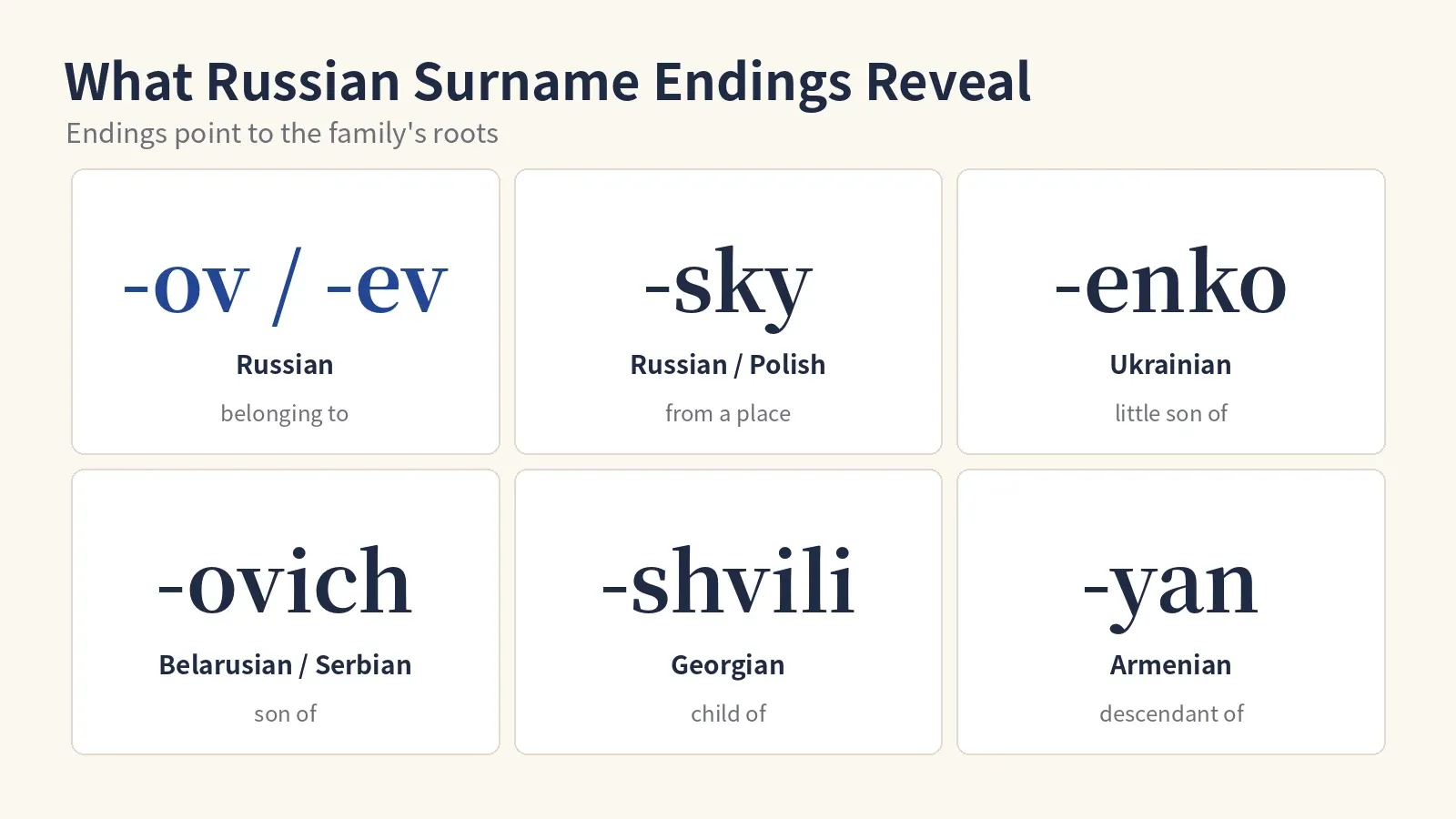
Russia is multinational, so “Russian surnames” include many from neighboring cultures. Their endings give them away.
| Ending | Origin | Examples |
|---|---|---|
| -enko | Ukrainian (“little son of”) | Shevchenko, Bondarenko, Kovalenko |
| -uk, -chuk, -yuk | Ukrainian | Kovalchuk, Martynyuk |
| -ovich, -evich | Belarusian, Serbian | Abramovich, Kovalevich |
| -shvili, -dze | Georgian | Dzhugashvili, Shevardnadze |
| -yan, -ian | Armenian | Mikoyan, Khachaturian |
| -ov + Turkic root | Tatar, Bashkir | Yusupov, Nabiullin |
The History of Russian Last Names
Russian nobles had surnames by the 1400s and 1500s, but most peasants didn’t get official surnames until the 1800s. Before then, people were known by first name and patronymic, such as “Ivan, son of Pyotr.”
| Period | What happened |
|---|---|
| 1400s–1500s | Princely and boyar families adopt hereditary surnames |
| 1600s–1700s | Merchants and townspeople follow |
| 1700s–1800s | Priests’ sons receive invented seminary surnames |
| 1861 | Serfdom ends; millions of peasants need official surnames |
| Late 1800s | Most peasants registered, often under a patronymic-style -ov/-in name |
| 1930s | Soviet internal passports fix surnames in official records |
How Peasants Got Their Surnames
Many former serfs simply turned their father’s or grandfather’s name into a surname: Ivan’s family became the Ivanovs. Others took a nickname, a trade or even the landowner’s surname. That rapid, late process explains why a few patronymic names dominate today.
Patronymics: Russia’s “Middle Name”
Every Russian has a patronymic, based on the father’s first name. It’s not a surname, but it’s a key part of how Russian names work.
| Father’s name | Son’s patronymic | Daughter’s patronymic |
|---|---|---|
| Ivan | Ivanovich | Ivanovna |
| Sergey | Sergeyevich | Sergeyevna |
| Nikolay | Nikolayevich | Nikolayevna |
| Ilya | Ilyich | Ilyinichna |
So the full name Anna Sergeyevna Petrova tells you: first name Anna, father Sergey, family Petrov. Using the first name and patronymic together (“Anna Sergeyevna”) is the polite way to address someone in Russian.
Expert Insights and Real-World Examples
Case Study: Why Your Russian Ancestor Has Four Spellings
Say your great-grandmother arrived in New York as “Olga Lebedeff.” In Russian records, she may appear as Lebedeva. On a later census she might be “Lebedev,” and her son might spell it “Lebedev” or even “Lebedoff.”
That’s because:
- Gender: Russian records use the female form (-ova). US records often used the male form for the whole family.
- Transliteration: Cyrillic “в” was written as v, ff, w or even ow in older Western records.
- Simplification: Many families dropped the female ending completely in the US.
Real Examples: Famous Surnames That Tell a Story
- Tolstoy: “Fat.” A nickname that became one of literature’s greatest names.
- Tchaikovsky: From chayka, “gull,” likely via a place name.
- Pushkin: From pushka, “cannon.” Perhaps an ancestor served with artillery.
- Kalashnikov: “Son of the kalach baker.” A bread-baking family name behind the world’s most famous rifle.
- Gagarin: From a nickname for a loud bird, the gagara (loon). Yuri Gagarin was the first human in space.
- Rachmaninoff: The pianist used the old Western “-off” spelling of Rakhmaninov.
Common Mistakes With Russian Surnames
| Mistake | Why it’s wrong | Do this instead |
|---|---|---|
| Calling a woman “Mrs. Ivanov” in Russian | Female form is Ivanova | Use the -a ending |
| Treating the patronymic as a surname | It changes every generation | Look for the family name |
| Searching only “-ov” | Old records used -off, -ow | Search every spelling |
| Assuming -enko is Russian | It’s Ukrainian | Consider Ukrainian records |
| Assuming -sky means noble | Many commoners have it | Check family history |
How to Choose a Russian Last Name for a Character
- Match gender. A female character needs the female form: Orlova, not Orlov.
- Match class. Aristocrats suit -sky names (Volkonsky, Obolensky). Villagers suit -ov names (Kozlov, Petrov).
- Use meaning. A cunning character named Lisitsyn (“fox”) or a gentle one named Golubeva (“dove”) adds depth.
- Add a patronymic. A full “Dmitri Ivanovich Sokolov” instantly sounds authentic.
Find Your Perfect Name With Our Russian Last Name Generator
Use the Russian Last Name Generator at the top of this page. Pick male or female forms, filter by origin (patronymic, animal, job, noble) and copy your favorite in one click.
Exploring more? See our guides to Polish last names, German last names, Greek last names and Russian names.
For a multinational character or family tree, compare Italian last names, Spanish last names and Irish last names in their own contexts. Do not use a translated meaning as a substitute for a plausible family background.
FAQs About Russian Last Names
What is the most common Russian last name?
Smirnov and Ivanov are the most common Russian last names, followed by Kuznetsov, Popov and Vasilyev.
Why do Russian last names end in -ov or -ova?
The -ov ending means “belonging to,” so Ivanov means “Ivan’s.” Women use the feminine form -ova, as in Ivanova.
What are common Russian last names for females?
Popular female forms include Ivanova, Smirnova, Petrova, Sokolova, Lebedeva, Orlova, Volkova, Morozova and Romanova.
What are common Russian last names for males?
Common male surnames include Smirnov, Ivanov, Kuznetsov, Popov, Vasilyev, Petrov, Sokolov and Volkov.
What does -sky mean in a Russian surname?
It usually means “of” or “from” a place, such as a town or estate. The female form is -skaya.
Are -enko surnames Russian?
Surnames ending in -enko are Ukrainian in origin. They don’t change for gender.
What is a patronymic in Russian?
It’s a name based on your father’s first name, such as Ivanovich (son of Ivan) or Ivanovna (daughter of Ivan). It sits between the first name and the surname.
Why did some Russian names use “-off”?
It’s an older Western transliteration of -ov. Smirnoff, Rachmaninoff and Stroganoff all use it.
What are noble Russian last names?
Famous noble surnames include Romanov, Obolensky, Trubetskoy, Volkonsky, Golitsyn, Sheremetev, Stroganov and Yusupov.
Do Russian women take their husband’s surname?
Many do, in the correct female form, but it’s a choice. Women can also keep their own surname or combine both.
The Bottom Line
- Russian surnames change with gender: -ov for men, -ova for women.
- Most come from a father’s name, a job or an animal nickname.
- Endings reveal origins: -enko is Ukrainian, -shvili Georgian, -yan Armenian, and grand church names hint at priestly ancestors.
Try the Russian Last Name Generator at the top of this page to find yours.
Looking for more? Explore name origins and meanings across all eight categories.