Name generator
Japanese Last Name Generator
Explore 281 distinct Japanese surnames from this guide. Start with rare and uncommon picks, or explore every category. Choose a category or letter to narrow your results, then copy or save your favorites.
Showing 15 of 281 matching Japanese surnames.
Results use different initials when available. Counts reflect the names in this guide; some letters and categories naturally have fewer matches. Letters without matches are hidden. “Rare” and “uncommon” follow the guide’s descriptions, not a worldwide frequency ranking.
- KurosawaGuide: uncommonJapanese writing: 黒澤
Black marsh
- DōmekiGuide: rareJapanese writing: 百目鬼
Hundred-eyed demon
- OnimaruGuide: rareJapanese writing: 鬼丸
Demon circle
- IkariGuide: rareJapanese writing: 五十里
Fifty villages
- HayashidaGuide: uncommonJapanese writing: 林田
Woods rice field
- NosakuGuide: rareJapanese writing: 農作
Farming
- TaueGuide: rareJapanese writing: 田植
Rice planting
- YagamiGuide: uncommonJapanese writing: 八神
Eight gods
- GogatsuGuide: rareJapanese writing: 五月
May
- AmamiyaGuide: uncommonJapanese writing: 雨宮
Rain shrine
- SugiyamaGuide: uncommonJapanese writing: 杉山
Cedar mountain
- UmemuraGuide: uncommonJapanese writing: 梅村
Plum village
- ChiakiGuide: rareJapanese writing: 千秋
A thousand autumns (eternity)
- BusujimaGuide: rareJapanese writing: 毒島
Poison island
- MizukiGuide: uncommonJapanese writing: 水木
Water tree
These are surnames from the guide, not invented combinations. Follow the guide for meanings, regional context, and spelling variants. View your shortlist
Two surnames, Satō and Suzuki, cover close to 4 million people in Japan. Yet the country has somewhere between 100,000 and 300,000 family names, and some of them belong to fewer than ten households.
Japanese last names are family names written in kanji, and most describe a place: a rice field, a mountain, a bridge or a village. Once you know about 20 characters, you can read the meaning of most surnames on sight.
In this guide, you’ll get more than 300 Japanese last names with their kanji, reading and meaning. We’ve tagged each one with a rarity level. We’ve also flagged which “dark” names are real family names and which ones the internet made up. That last part matters more than you’d think.
Japanese Last Names at a Glance (Quick Facts)
Short on time? Here’s what you need to know in 30 seconds.
| Fact | Answer |
|---|---|
| Most common Japanese last name | Satō (佐藤), about 1.9 million people |
| Number of surnames in Japan | Roughly 100,000 to 300,000, depending on how you count kanji variants |
| Name order | Surname first, given name second (Tanaka Hiroshi) |
| Male or female surnames? | Neither. Every Japanese surname is gender-neutral |
| When everyone got one | 1875, when a Meiji-era law made surnames mandatory for all commoners |
| Most common kanji in surnames | 田 (rice field), 山 (mountain), 藤 (wisteria), 木 (tree) |
| Written in | Kanji, with katakana reserved for foreign names |
How to Read This List (Kanji, Reading, Meaning and Rarity)
Every table in this guide uses the same columns, so you can compare names quickly.
- Kanji: the characters used to write the name. Some names have more than one spelling.
- Reading: how you say it, in standard Hepburn romanization.
- Meaning: a literal translation of each kanji.
- Rarity: how many households carry the name.
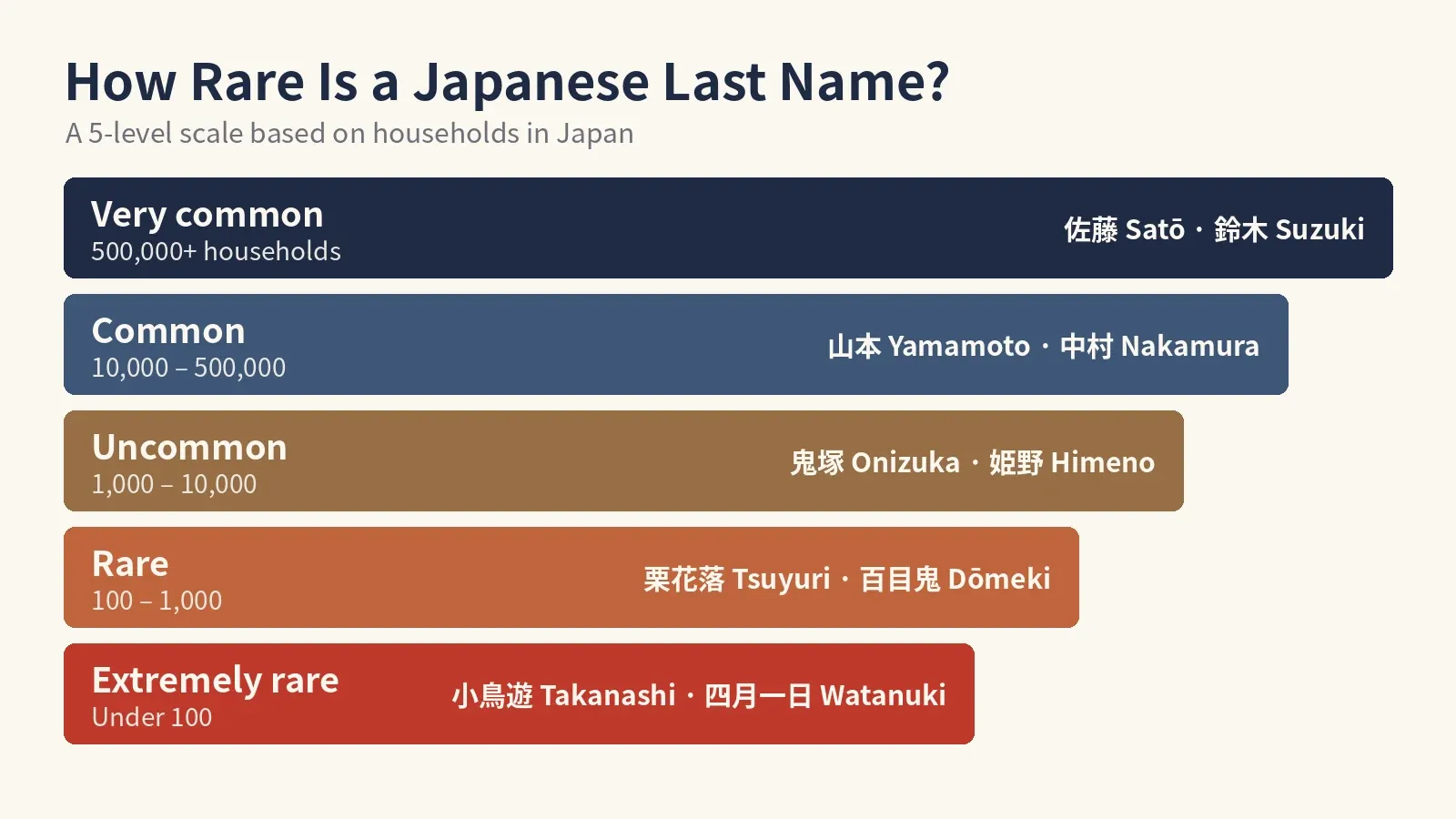
We use this five-level rarity scale throughout. It’s based on estimated household counts, the same unit Japanese surname databases use.
| Rarity level | Households in Japan | Example |
|---|---|---|
| Very common | 500,000+ | Satō, Suzuki |
| Common | 10,000–500,000 | Yamamoto, Nakamura |
| Uncommon | 1,000–10,000 | Onizuka, Himeno |
| Rare | 100–1,000 | Tsuyuri, Dōmeki |
| Extremely rare | Under 100 | Takanashi, Watanuki |
Why this matters: A “rare Japanese last name” on most websites could mean anything. With a scale, you know exactly how unusual a name is before you use it for a character, a pen name or a family history search.
30 Most Common Japanese Last Names and Their Meanings
The most common Japanese last names are Satō, Suzuki, Takahashi, Tanaka and Watanabe. Together, the top 10 surnames cover roughly 1 in 10 people in Japan.
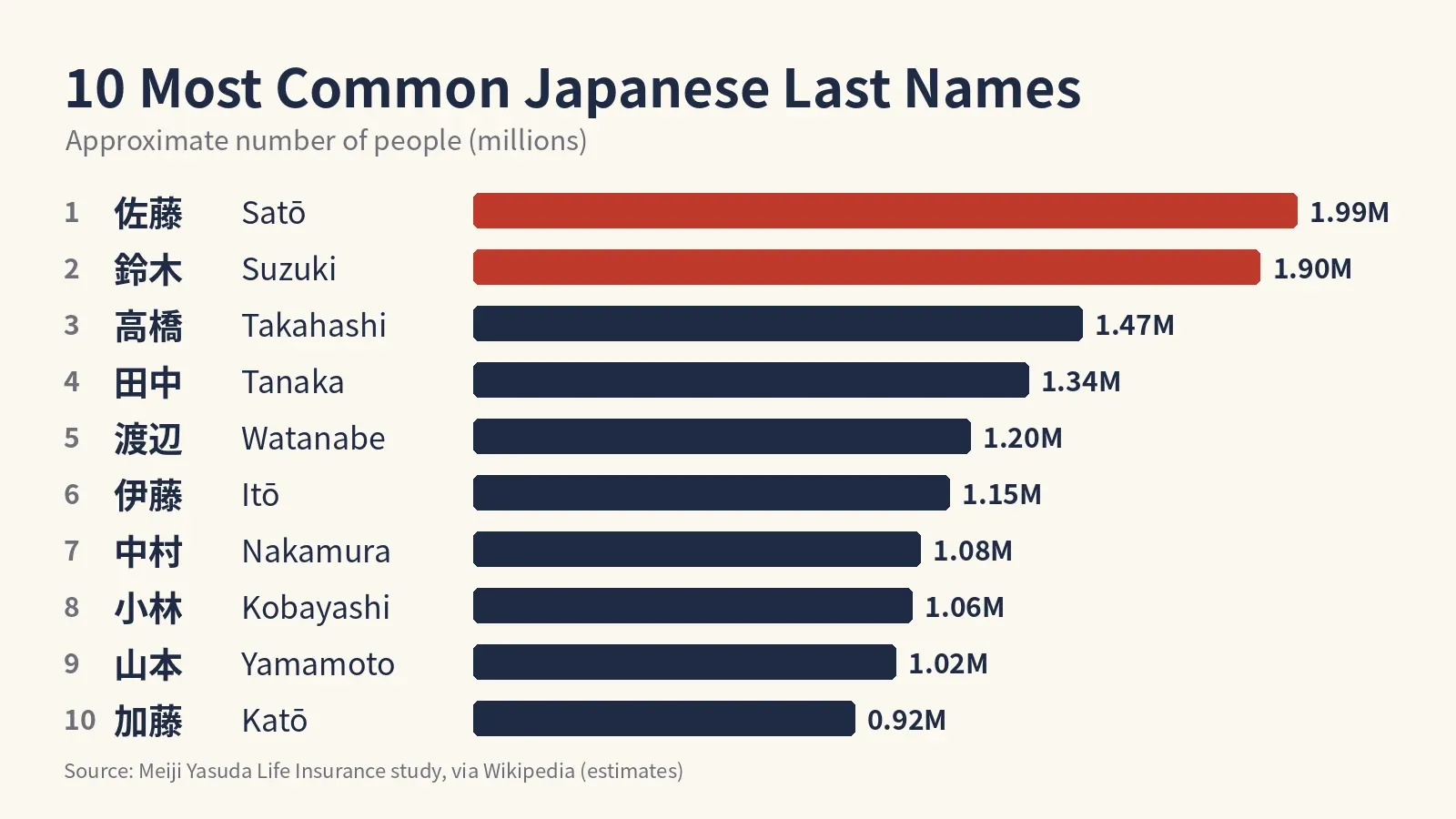
The population figures below come from a large study by Meiji Yasuda Life Insurance, which analyzed about 6.1 million policyholders (source). Treat them as estimates, not census counts. However, the ranking itself has barely moved in decades.
| Rank | Kanji | Reading | Meaning | Approx. people |
|---|---|---|---|---|
| 1 | 佐藤 | Satō | Help + wisteria | 1,990,000 |
| 2 | 鈴木 | Suzuki | Bell + tree | 1,900,000 |
| 3 | 高橋 | Takahashi | High bridge | 1,470,000 |
| 4 | 田中 | Tanaka | Middle of the rice field | 1,340,000 |
| 5 | 渡辺 | Watanabe | Cross + edge (ferry crossing) | 1,200,000 |
| 6 | 伊藤 | Itō | Ise + wisteria | 1,150,000 |
| 7 | 中村 | Nakamura | Middle village | 1,080,000 |
| 8 | 小林 | Kobayashi | Small forest | 1,060,000 |
| 9 | 山本 | Yamamoto | Base of the mountain | 1,020,000 |
| 10 | 加藤 | Katō | Add + wisteria | 920,000 |
| 11 | 吉田 | Yoshida | Lucky rice field | 850,000 |
| 12 | 山田 | Yamada | Mountain rice field | 820,000 |
| 13 | 佐々木 | Sasaki | Help + tree (repeated) | 710,000 |
| 14 | 山口 | Yamaguchi | Mountain entrance | 640,000 |
| 15 | 松本 | Matsumoto | Base of the pine tree | 630,000 |
| 16 | 井上 | Inoue | Above the well | 600,000 |
| 17 | 木村 | Kimura | Tree village | 580,000 |
| 18 | 清水 | Shimizu | Pure water | 560,000 |
| 19 | 林 | Hayashi | Forest | 550,000 |
| 20 | 斉藤 | Saitō | Equal + wisteria (variant of 斎藤) | 530,000 |
| 21 | 斎藤 | Saitō | Religious purification + wisteria | 520,000 |
| 22 | 山崎 | Yamazaki | Mountain cape | 490,000 |
| 23 | 中島 | Nakajima | Middle island | 480,000 |
| 24 | 森 | Mori | Forest | 470,000 |
| 25 | 阿部 | Abe | Corner + section | 470,000 |
| 26 | 池田 | Ikeda | Pond + rice field | 450,000 |
| 27 | 橋本 | Hashimoto | Base of the bridge | 450,000 |
| 28 | 石川 | Ishikawa | Stone river | 440,000 |
| 29 | 山下 | Yamashita | Below the mountain | 410,000 |
| 30 | 小川 | Ogawa | Small river | 410,000 |
Notice something? Two different Saitō spellings made the list. Same sound, different kanji. That’s the first clue that Japanese names are written for the eye as much as the ear.
The Top 10 Japanese Surnames Explained
- Satō (佐藤): Traditionally linked to a Fujiwara-clan official who “assisted” (佐) at court. The name is especially common in northern Japan.
- Suzuki (鈴木): “Bell tree.” One popular theory ties it to rice-harvest rituals, where bundled rice stalks were hung on poles. Suzuki spread widely from the Kii Peninsula.
- Takahashi (高橋): “High bridge.” A family living near a prominent bridge would take the name.
- Tanaka (田中): “In the middle of the rice field.” It’s the textbook example of a farmland surname.
- Watanabe (渡辺): A crossing point on a river. Some families still use the old spelling 渡邊, and dozens of kanji variants exist.
- Itō (伊藤): The Fujiwara of Ise Province. 伊 comes from Ise, and 藤 comes from Fujiwara.
- Nakamura (中村): “Middle village.” A family living in the central settlement of an area.
- Kobayashi (小林): “Small forest.” Simple and descriptive.
- Yamamoto (山本): “At the foot of the mountain.” Very common in western Japan.
- Katō (加藤): The Fujiwara of Kaga Province. 加 comes from Kaga.
The Wisteria Family: Why Satō, Itō, Katō and Saitō All End in 藤
Here’s a detail most lists miss. The kanji 藤 (tō or fuji) means wisteria. It’s also the first character of Fujiwara (藤原), the clan that ran the imperial court for centuries.
As the Fujiwara family branched out, its members often combined 藤 with a place name or job title. So when you meet someone named Satō, Itō, Katō, Saitō, Kondō or Endō, you’re looking at a name that, at least traditionally, points back to one of Japan’s most powerful families.
| Surname | Kanji | First kanji refers to | Meaning |
|---|---|---|---|
| Satō | 佐藤 | 佐 (assistant, an official title) | Fujiwara assistant |
| Itō | 伊藤 | Ise Province | Fujiwara of Ise |
| Katō | 加藤 | Kaga Province | Fujiwara of Kaga |
| Kondō | 近藤 | Ōmi Province (近江) | Fujiwara of Ōmi |
| Endō | 遠藤 | Tōtōmi Province (遠江) | Fujiwara of Tōtōmi |
| Saitō | 斎藤 | 斎 (religious office) | Fujiwara priest official |
| Gotō | 後藤 | 後 (later / rear) | Later Fujiwara |
| Mutō | 武藤 | 武 (military) | Fujiwara military officer |
Of course, not every Satō today descends from the Fujiwara. After 1875, many commoners simply picked a respected name. Still, the pattern explains why so many top surnames share a single character.
More Popular Japanese Last Names
These names fall just outside the top 30. You’ll hear them constantly in Japan, in anime and in Japanese-American communities.
| Kanji | Reading | Meaning |
|---|---|---|
| 山中 | Yamanaka | Inside the mountains |
| 中川 | Nakagawa | Middle river |
| 石井 | Ishii | Stone well |
| 岡田 | Okada | Hill rice field |
| 長谷川 | Hasegawa | Long valley river |
| 藤田 | Fujita | Wisteria rice field |
| 村上 | Murakami | Upper village |
| 青木 | Aoki | Green tree |
| 坂本 | Sakamoto | Base of the slope |
| 福田 | Fukuda | Fortune rice field |
| 太田 | Ōta | Fat (plentiful) rice field |
| 西村 | Nishimura | West village |
| 藤井 | Fujii | Wisteria well |
| 金子 | Kaneko | Child of gold |
| 岡本 | Okamoto | Base of the hill |
| 藤原 | Fujiwara | Wisteria plain |
| 三浦 | Miura | Three bays |
| 中野 | Nakano | Middle field |
| 原田 | Harada | Plain rice field |
| 松田 | Matsuda | Pine rice field |
| 竹内 | Takeuchi | Inside the bamboo |
| 小野 | Ono | Small field |
| 田村 | Tamura | Rice field village |
| 和田 | Wada | Harmony rice field |
| 石田 | Ishida | Stone rice field |
| 上田 | Ueda | Upper rice field |
| 宮本 | Miyamoto | Base of the shrine |
| 山内 | Yamauchi | Inside the mountain |
| 桃井 | Momoi | Peach well |
| 菊地 | Kikuchi | Chrysanthemum land |
Popular Japanese Last Names You Already Know From Famous People
You’ve probably heard more Japanese surnames than you realize. Here’s what a few famous ones actually mean.
| Famous person | Surname | Kanji | Meaning |
|---|---|---|---|
| Shohei Ohtani (baseball) | Ōtani | 大谷 | Big valley |
| Naomi Osaka (tennis) | Ōsaka | 大坂 | Big slope |
| Hayao Miyazaki (Studio Ghibli) | Miyazaki | 宮崎 | Shrine + cape |
| Akira Kurosawa (film director) | Kurosawa | 黒澤 | Black marsh |
| Haruki Murakami (novelist) | Murakami | 村上 | Upper village |
| Shigeru Miyamoto (Nintendo) | Miyamoto | 宮本 | Base of the shrine |
| Yoko Ono (artist) | Ono | 小野 | Small field |
| Ichiro Suzuki (baseball) | Suzuki | 鈴木 | Bell tree |
Take Ōtani. His name literally paints a picture: a wide valley. Most Japanese surnames work exactly like that.
When studying names written with characters, compare Chinese names and Korean names alongside the original writing. Similar-looking romanized syllables are not enough to establish the same name or meaning across languages.
How to Decode Any Japanese Last Name (Kanji Meaning Cheat Sheet)
Most Japanese last names combine two kanji: a landscape feature plus a position or descriptor. Learn the 20 characters below and you can translate the majority of surnames you’ll ever meet.
Think of it like English names such as “Hill,” “Brook” or “Newton” (new town). The difference? Japanese names stack two of these building blocks together.
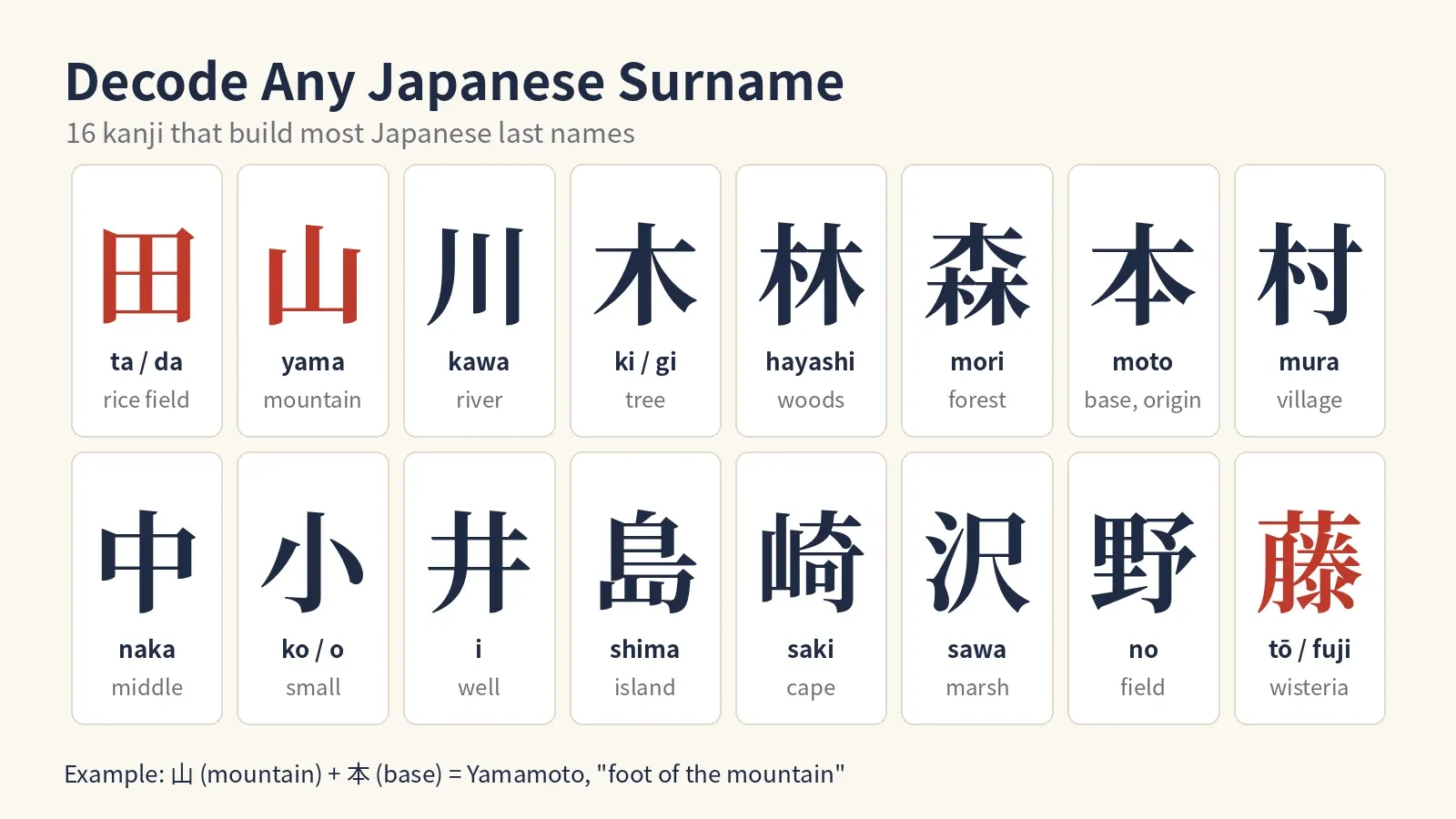
| Kanji | Common readings | Meaning | Example surnames |
|---|---|---|---|
| 田 | ta, da | Rice field | Tanaka, Yamada, Yoshida |
| 山 | yama | Mountain | Yamamoto, Yamaguchi |
| 川 | kawa, gawa | River | Ishikawa, Ogawa |
| 木 | ki, gi | Tree | Suzuki, Aoki, Takagi |
| 林 | hayashi, bayashi | Woods | Hayashi, Kobayashi |
| 森 | mori | Forest | Mori, Morita |
| 本 | moto | Base, origin | Yamamoto, Matsumoto |
| 村 | mura | Village | Nakamura, Kimura |
| 中 | naka | Middle, inside | Tanaka, Nakajima |
| 小 | ko, o | Small | Kobayashi, Ogawa |
| 大 | ō, ōki | Big | Ōtani, Ōtsuka |
| 井 | i | Well | Inoue, Ishii |
| 島 / 嶋 | shima, jima | Island | Nakajima, Kojima |
| 崎 | saki, zaki | Cape, peninsula | Yamazaki, Miyazaki |
| 沢 / 澤 | sawa, zawa | Marsh, swamp | Kurosawa, Fujisawa |
| 野 | no | Field, plain | Ono, Hoshino |
| 原 | hara, wara | Meadow, plain | Fujiwara, Harada |
| 石 | ishi | Stone | Ishikawa, Ishida |
| 松 | matsu | Pine tree | Matsumoto, Matsuda |
| 藤 | tō, fuji | Wisteria (Fujiwara link) | Satō, Fujita |
What Do -moto, -mura, -da, -shima and -zaki Mean?
The ending of a surname usually tells you where the family lived. Here’s a quick reference.
| Ending | Kanji | Meaning | Think of it as |
|---|---|---|---|
| -moto | 本 | Base, origin | “at the foot of” |
| -mura | 村 | Village | “-ton” in English |
| -ta / -da | 田 | Rice field | “-field” |
| -kawa / -gawa | 川 | River | “-brook” |
| -shima / -jima | 島 | Island | “-isle” |
| -saki / -zaki | 崎 | Cape | “-point” |
| -hara / -wara | 原 | Plain, meadow | “-lea” |
| -no | 野 | Field | “-field” (wilder, not farmed) |
| -uchi | 内 | Inside | “within” |
| -shita | 下 | Below | “under” |
Why do some endings flip from “ta” to “da” or “kawa” to “gawa”? It’s a sound change called rendaku. When two words join, the second one often softens. That’s why 山 + 田 becomes Yamada, not Yamata.
Try It Yourself: Decoding Three Real Surnames
Let’s put the cheat sheet to work.
- Yamamoto (山本): 山 (mountain) + 本 (base). The family lived at the foot of a mountain.
- Ishikawa (石川): 石 (stone) + 川 (river). Picture a rocky riverbed.
- Matsushita (松下): 松 (pine) + 下 (below). Someone who lived under a pine tree. Fun fact: it’s the founding family name behind Panasonic.
See the pattern? Each surname is basically a tiny map of where an ancestor lived.
Why So Many Japanese Surnames Contain 田 (Rice Field)
Rice wasn’t just food in old Japan. It was money. Feudal lords measured wealth in koku, a unit of rice, and taxes were paid in rice too.
So when commoners had to register surnames in the 1870s, many simply described their land. “Middle of the field” (Tanaka), “mountain field” (Yamada) and “lucky field” (Yoshida) all make perfect sense for farming families.
The other big category is forests and mountains. That’s no accident either. Forests cover roughly two-thirds of Japan, and mountains dominate most of the landscape.
Japanese Last Names With Meanings Inspired by Nature
Nature-inspired surnames are the heart of Japanese naming. Unlike English names, which often come from jobs (Smith, Baker, Carter), Japanese names overwhelmingly describe the landscape.
We’ve split them into three groups so you can find the “feel” you want.
Mountain, Forest and Tree Surnames
| Kanji | Reading | Meaning | Rarity |
|---|---|---|---|
| 青山 | Aoyama | Green mountain | Common |
| 高山 | Takayama | Tall mountain | Common |
| 横山 | Yokoyama | Beside the mountain | Common |
| 丸山 | Maruyama | Round mountain | Common |
| 森田 | Morita | Forest rice field | Common |
| 大森 | Ōmori | Big forest | Common |
| 林田 | Hayashida | Woods rice field | Uncommon |
| 竹下 | Takeshita | Below the bamboo | Common |
| 栗原 | Kurihara | Chestnut plain | Common |
| 柏木 | Kashiwagi | Oak tree | Uncommon |
| 杉山 | Sugiyama | Cedar mountain | Uncommon |
| 月山 | Tsukiyama | Moon mountain | Rare |
River, Sea and Water Surnames
| Kanji | Reading | Meaning | Rarity |
|---|---|---|---|
| 川口 | Kawaguchi | River mouth | Common |
| 川崎 | Kawasaki | River cape | Common |
| 浜田 | Hamada | Beach rice field | Common |
| 浜崎 | Hamasaki | Beach cape | Common |
| 水野 | Mizuno | Water field | Common |
| 水木 | Mizuki | Water tree | Uncommon |
| 浜辺 | Hamabe | Beach side | Uncommon |
| 河野 | Kōno | River field | Common |
| 海老沢 | Ebisawa | Shrimp marsh | Uncommon |
| 小沢 | Ozawa | Small marsh | Common |
| 滝沢 | Takizawa | Waterfall marsh | Uncommon |
| 雨宮 | Amamiya | Rain shrine | Uncommon |
Flower, Moon and Sky Surnames
These are the names people usually mean when they search for “beautiful” or “poetic” Japanese surnames.
| Kanji | Reading | Meaning | Rarity |
|---|---|---|---|
| 桜井 | Sakurai | Cherry blossom well | Common |
| 桜木 | Sakuragi | Cherry blossom tree | Uncommon |
| 花沢 | Hanazawa | Flower marsh | Uncommon |
| 花村 | Hanamura | Flower village | Uncommon |
| 花園 | Hanazono | Flower garden | Rare |
| 梅村 | Umemura | Plum village | Uncommon |
| 菊池 | Kikuchi | Chrysanthemum pond | Common |
| 星野 | Hoshino | Star field | Common |
| 月野 | Tsukino | Moon field | Rare |
| 朝日 | Asahi | Morning sun | Uncommon |
| 日向 | Hinata | Facing the sun, sunny place | Uncommon |
| 雪村 | Yukimura | Snow village | Rare |
Rare and Uncommon Japanese Last Names
Rare Japanese last names are surnames carried by fewer than 1,000 households, and some by fewer than 10. Many come from tiny villages, old court titles or clever word puzzles.
This is where Japanese naming gets fun.
Puzzle Surnames: Takanashi, Yamanashi and Other Riddle Readings
Some surnames aren’t read by sound at all. Instead, you read them by meaning, a technique called gikun (義訓). Each one is a little riddle.
| Kanji | Literal meaning | Reading | The riddle |
|---|---|---|---|
| 小鳥遊 | Little birds play | Takanashi | Birds play freely only when there are no hawks. Taka (hawk) + nashi (none). |
| 月見里 | Moon-viewing village | Yamanashi | You can see the moon clearly only when there’s no mountain. Yama (mountain) + nashi (none). |
| 栗花落 | Chestnut flowers fall | Tsuyuri | Chestnut blossoms drop when the rainy season (tsuyu) begins. |
| 九十九 | Ninety-nine | Tsukumo | An old word for 99, also linked to long life. |
| 五十嵐 | Fifty storms | Igarashi | Not a puzzle, but a famous “unreadable” name from Niigata. |
Takanashi is extremely rare. According to Japanese surname databases, only a handful of households carry it (source). Yet anime fans know it well, thanks to Rikka Takanashi in Love, Chunibyo & Other Delusions.
Calendar Surnames: Watanuki (April 1st) and Hozumi (August 1st)
A few surnames are literally dates. They record old seasonal customs.
| Kanji | Literal meaning | Reading | Why |
|---|---|---|---|
| 四月一日 | April 1st | Watanuki | April 1st was the day people pulled the cotton padding (wata) out of winter clothes. |
| 八月一日 | August 1st | Hozumi | The day farmers picked the first ears of rice (ho) as an offering. |
| 八月朔日 | First of August | Hozumi | Same custom, different spelling. |
| 五月七日 | May 7th | Tsuyuri | Linked to the start of the rainy season in the old calendar. |
The Longest and Shortest Japanese Surnames
Most surnames use two kanji. A few break the rule in both directions.
The longest surnames:
| Kanji | Reading | Length | Background |
|---|---|---|---|
| 勘解由小路 | Kadenokōji | 5 kanji | A noble family of the Heian-era Kyoto court |
| 左衛門三郎 | Saemonsaburō | 5 kanji | Court title (Left Gate Guard) + “third son” |
| 小比類巻 | Kohiruimaki | 4 kanji | Found mainly in Aomori Prefecture |
| 東四柳 | Higashiyotsuyanagi | 3 kanji | “East four willows,” one of the longest readings |
The shortest surnames use a single kanji:
| Kanji | Reading | Meaning |
|---|---|---|
| 東 | Higashi / Azuma | East |
| 辻 | Tsuji | Crossroads (a kanji invented in Japan) |
| 百 | Momo | Hundred |
| 丁 | Yoboro | Block, ward (extremely rare) |
The Most Unusual Surnames in Japan (Dango, Mikan, Hime)
A study by the surname database Myoji Yurai Net ranked Japan’s most unusual family names using government statistics and phone books (source). Here are 20 highlights.
| Kanji | Reading | Meaning |
|---|---|---|
| 蜜柑 | Mikan | Mandarin orange |
| 日ノ出 | Hinode | Sunrise |
| 団子 | Dango | Rice dumpling |
| 家神 | Iekami | House god |
| 日傘 | Higasa | Parasol |
| 姫 | Hime | Princess |
| 五月 | Gogatsu | May |
| 鍛冶屋敷 | Kajiyashiki | Blacksmith’s mansion |
| 農作 | Nosaku | Farming |
| 時計 | Tokei | Clock |
| 和室 | Wamuro | Japanese-style room |
| 百百 | Momo | Hundred hundred |
| 京都 | Kyōto | Kyoto |
| 水車 | Suisha | Water wheel |
| 御菩薩池 | Mizoroge | Pond of the Bodhisattva |
| 田植 | Taue | Rice planting |
| 牡丹 | Botan | Peony |
| 赤祖父 | Akasofu | Red grandfather |
| 神社 | Jinja | Shinto shrine |
| 茗荷 | Myōga | Japanese ginger |
Imagine introducing yourself as “Mr. Dumpling” or “Ms. Clock.” According to the study, only about 10 people share the surname Mikan.
More Rare Japanese Last Names With Lucky Meanings
| Kanji | Reading | Meaning |
|---|---|---|
| 五百蔵 | Ioroi | Five hundred storehouses (great wealth) |
| 金持 | Kanemochi | Rich person |
| 宝 | Takara | Treasure |
| 千秋 | Chiaki | A thousand autumns (eternity) |
| 鳳 | Ōtori | Phoenix |
| 五十里 | Ikari | Fifty villages |
| 御手洗 | Mitarai | Honorable hand-washing (a shrine purification basin) |
Why Rare Japanese Surnames Are Disappearing
Here’s a counter-intuitive fact: Japan’s rarest names are shrinking, not growing.
Three forces drive this:
- A falling birth rate. A family with no children ends its surname line.
- The shared-surname law. Japanese law requires married couples to use one surname, and the vast majority choose the husband’s. So a rare name carried by an only daughter usually disappears at marriage.
- Everyday friction. Rare kanji often don’t appear in computer input systems, and custom personal seals (hanko) cost more.
Some families fight back through mukoyōshi, where a husband is adopted into the wife’s family to keep her surname alive. Meanwhile, the debate over allowing separate surnames for married couples (fūfu bessei) continues in Japan’s parliament.
Unique and Cool Japanese Last Names
Cool Japanese last names usually carry history: a samurai clan, a noble court family or a striking single kanji. These are real surnames, so you can use them with confidence.
Cool Japanese Last Names With Samurai and Warrior Roots
Each of these belonged to a famous warrior family. Today, ordinary people carry them too.
| Kanji | Reading | Meaning | Famous connection |
|---|---|---|---|
| 織田 | Oda | Weaving rice field | Oda Nobunaga, the warlord who began unifying Japan |
| 武田 | Takeda | Warrior rice field | Takeda Shingen, feared cavalry commander |
| 上杉 | Uesugi | Upper cedar | Uesugi Kenshin, “the Dragon of Echigo” |
| 伊達 | Date | From a place name in Fukushima | Date Masamune, the “One-Eyed Dragon” |
| 真田 | Sanada | True rice field | Sanada Yukimura, a legendary last stand |
| 島津 | Shimazu | Island harbor | Rulers of Satsuma in southern Kyushu |
| 服部 | Hattori | Clothing division | Hattori Hanzō, the famous ninja leader |
| 本多 | Honda | Main + many | Honda Tadakatsu, a Tokugawa general |
| 毛利 | Mōri | Hair + profit | Mōri Motonari; lords of Chōshū Domain |
| 坂本 | Sakamoto | Base of the slope | Sakamoto Ryōma, a hero of the Meiji Restoration |
| 宮本 | Miyamoto | Base of the shrine | Miyamoto Musashi, the swordsman |
| 井伊 | Ii | Well + that (from a place name) | Ii Naomasa and his red-armored “Red Devils” |
Noble Japanese Surnames From Clans and Court Families
Four great clans shaped early Japanese history, often called Gen-Pei-Tō-Kitsu: the Minamoto, Taira, Fujiwara and Tachibana. Later, five court families (the go-sekke) held the top government posts for centuries.
| Kanji | Reading | Meaning | Historical role |
|---|---|---|---|
| 源 | Minamoto | Source, origin | Founded the first shogunate (1185) |
| 平 | Taira | Flat, peaceful | Rivals of the Minamoto in the Genpei War |
| 藤原 | Fujiwara | Wisteria plain | Dominated the imperial court |
| 橘 | Tachibana | Mandarin orange tree | One of the four great clans |
| 徳川 | Tokugawa | Virtuous river | Ruled Japan as shoguns for 265 years |
| 足利 | Ashikaga | Foot + profit | The second line of shoguns |
| 北条 | Hōjō | North strip | Regents behind the Kamakura shogunate |
| 近衛 | Konoe | Imperial guard | One of the five regent houses |
| 九条 | Kujō | Ninth avenue | One of the five regent houses |
| 一条 | Ichijō | First avenue | One of the five regent houses |
| 鷹司 | Takatsukasa | Falconry office | One of the five regent houses |
| 西園寺 | Saionji | West garden temple | Court family; produced a prime minister |
Unique Japanese Last Names Made From Just One Kanji
Single-kanji surnames feel clean and bold. They’re also easy for non-Japanese speakers to remember.
| Kanji | Reading | Meaning |
|---|---|---|
| 堀 | Hori | Moat |
| 泉 | Izumi | Spring (water) |
| 原 | Hara | Plain, field |
| 西 | Nishi | West |
| 南 | Minami | South |
| 北 | Kita | North |
| 関 | Seki | Barrier, checkpoint |
| 岡 | Oka | Hill |
| 滝 | Taki | Waterfall |
| 菅 | Suga | Sedge grass |
| 堤 | Tsutsumi | Embankment |
| 横 | Yoko | Side |
Japanese Last Names With Dark Meanings
Real Japanese last names with dark meanings do exist, such as Onizuka (demon mound), Busujima (poison island) and Dōmeki (hundred-eyed demon). However, many “dark Japanese surnames” you’ll find online are invented. Below, we separate the two clearly.
The Dark Kanji Behind Ominous Surnames
If a surname sounds dark, it almost always contains one of these characters.
| Kanji | Reading | Meaning | Used in real surnames? |
|---|---|---|---|
| 鬼 | oni | Demon, ogre | Yes, fairly often |
| 黒 | kuro | Black | Yes, very often |
| 影 | kage | Shadow | Yes |
| 毒 | busu / doku | Poison | Rarely |
| 塚 | tsuka / zuka | Burial mound | Yes, often |
| 闇 | yami | Darkness | Almost never |
| 血 | chi | Blood | Almost never |
| 冥 | mei | Underworld | Almost never |
| 死 | shi | Death | No |
That last column is the key insight. Kanji like 死 (death) and 血 (blood) were considered unlucky, so families avoided them. If you see a “real Japanese surname” built on them, be skeptical.
Verified Dark Surnames: Real Families, Real Records
Every name below is a registered Japanese surname.
| Kanji | Reading | Meaning | Rarity | Note |
|---|---|---|---|---|
| 鬼塚 | Onizuka | Demon mound | Uncommon | Ellison Onizuka, the first Asian American in space |
| 鬼頭 | Kitō | Demon head | Uncommon | Common in the Chūbu region |
| 鬼沢 | Onizawa | Demon marsh | Rare | |
| 鬼木 | Oniki | Demon tree | Rare | Found mainly in Kyushu |
| 鬼丸 | Onimaru | Demon circle | Rare | |
| 百目鬼 | Dōmeki | Hundred-eyed demon | Rare | Named after a legend in Tochigi |
| 毒島 | Busujima | Poison island | Rare | A place name in Gunma |
| 黒塚 | Kurozuka | Black mound | Rare | Linked to a famous demon-hag legend |
| 黒澤 | Kurosawa | Black marsh | Uncommon | Director Akira Kurosawa |
| 黒崎 | Kurosaki | Black cape | Uncommon | Also Ichigo Kurosaki in Bleach |
| 黒木 | Kuroki | Black tree | Common | |
| 黒田 | Kuroda | Black rice field | Common | A powerful samurai clan |
| 影山 | Kageyama | Shadow mountain | Uncommon | Also Tobio Kageyama in Haikyu!! |
| 八神 | Yagami | Eight gods | Uncommon | Death Note used a darker spelling (see below) |
Fictional Dark Names You’ll See Online (And Why They Aren’t Real)
These appear on many name lists, but you won’t find them in Japan’s family registers.
| Name | Kanji | Meaning | Status |
|---|---|---|---|
| Jigoku | 地獄 | Hell | Fictional. No family would register this. |
| Yami | 闇 | Darkness | Fictional as a surname |
| Yagami (Death Note) | 夜神 | Night god | Fictional spelling; the real surname is 八神 (eight gods) |
| Shinigami | 死神 | Death god | Fictional |
| Uchiha (Naruto) | うちは | From uchiwa (a paper fan) | Fictional; not a registered surname |
Why does this matter? If you’re naming a character set in real-world Japan, a fictional name breaks immersion for anyone who knows the language. For fantasy settings, invented names are perfectly fine. Just choose knowingly.
Where “Dark” Surnames Actually Come From
Here’s the twist. Most dark-sounding surnames aren’t dark at all in origin.
- Busujima (毒島) is simply a place name in Gunma.
- Onizuka (鬼塚) refers to an old burial mound, often tied to local legends.
- Kurosawa (黒澤) described dark, muddy wetland.
In Japanese folklore, oni (demons) could also be protectors. So a family named “demon head” wasn’t cursed. More likely, they lived near a place with a local legend attached.
Japanese Last Names for Girls and Boys: Is There a Difference?
No. Japanese last names are gender-neutral. A brother and sister share the same surname, and no surname is “for girls” or “for boys.” Only given names change by gender.
So why do so many people search for Japanese last names for girls or boys? Usually, they want a surname that feels soft or strong, often for a character. That’s something we can help with. The feel comes from the kanji, not from any gender rule.
Cute Japanese Last Names for Girls (Soft and Poetic Sounds)
These surnames use gentle imagery: flowers, bells, seasons, stars and water. They pair beautifully with a female character’s given name.
| Kanji | Reading | Meaning | Vibe |
|---|---|---|---|
| 鈴村 | Suzumura | Bell village | Sweet |
| 鈴原 | Suzuhara | Bell plain | Sweet |
| 白鳥 | Shiratori | White bird, swan | Elegant |
| 姫野 | Himeno | Princess field | Cute |
| 桃田 | Momota | Peach field | Cute |
| 朝比奈 | Asahina | Morning + compare + Nara | Elegant |
| 綾瀬 | Ayase | Patterned silk + rapids | Elegant |
| 花岡 | Hanaoka | Flower hill | Soft |
| 花田 | Hanada | Flower field | Soft |
| 春野 | Haruno | Spring field | Fresh |
| 夏目 | Natsume | Summer eye | Literary |
| 秋山 | Akiyama | Autumn mountain | Calm |
| 美山 | Miyama | Beautiful mountain | Soft |
| 星川 | Hoshikawa | Star river | Dreamy |
| 月島 | Tsukishima | Moon island | Dreamy |
| 雪野 | Yukino | Snow field | Gentle |
| 白石 | Shiraishi | White stone | Clean |
| 藤宮 | Fujimiya | Wisteria shrine | Graceful |
| 天野 | Amano | Heaven field | Dreamy |
| 宮園 | Miyazono | Shrine garden | Graceful |
Strong Japanese Last Names for Boys
These surnames use powerful imagery: dragons, hawks, stone, swords and thunder. They’re a favorite for action heroes and rivals.
| Kanji | Reading | Meaning | Vibe |
|---|---|---|---|
| 竜崎 | Ryūzaki | Dragon cape | Mysterious |
| 辰巳 | Tatsumi | Dragon + snake (a compass direction) | Sharp |
| 熊谷 | Kumagai | Bear valley | Tough |
| 鷹野 | Takano | Hawk field | Fierce |
| 鷲尾 | Washio | Eagle tail | Fierce |
| 岩崎 | Iwasaki | Rock cape | Solid |
| 石原 | Ishihara | Stone plain | Solid |
| 桐生 | Kiryū | Paulownia + life | Cool |
| 剣持 | Kenmochi | Sword holder | Warrior |
| 矢吹 | Yabuki | Arrow + blow | Warrior |
| 弓削 | Yuge | Bow maker | Warrior |
| 轟 | Todoroki | Roar, rumble | Loud and bold |
| 不破 | Fuwa | Unbreakable | Unshakable |
| 真壁 | Makabe | True wall | Unshakable |
| 神崎 | Kanzaki | God cape | Mystical |
| 大門 | Daimon | Great gate | Commanding |
| 荒木 | Araki | Wild tree | Rugged |
| 武井 | Takei | Warrior well | Warrior |
| 高城 | Takashiro | Tall castle | Commanding |
| 力石 | Chikaraishi | Strength stone | Tough |
How Japanese Given Names Differ: -ko, -mi and -ka vs -rō, -ta and -ichi
Gender shows up in the given name, not the surname. Here are the classic patterns.
| Typically female endings | Meaning | Typically male endings | Meaning |
|---|---|---|---|
| -ko (子) | Child | -rō (郎) | Son |
| -mi (美) | Beauty | -ta (太) | Thick, great |
| -ka (花 / 香) | Flower, fragrance | -ichi (一) | First (son) |
| -na (奈 / 菜) | Apple tree, greens | -suke (介) | Helper |
| -e (恵) | Blessing | -hiko (彦) | Prince, lad |
So a full name like Himeno Aiko reads as clearly female, while Takano Kentarō reads as clearly male. The surname stays neutral in both.
Japanese Surnames by Region: From Hokkaido to Okinawa
Your surname can hint at where your ancestors came from. Satō dominates the north, Suzuki the central Pacific coast, Tanaka the west, and Higa the island of Okinawa.
The table below shows the surname most associated with each region, plus a few “signature” names you’ll meet there often. Rankings vary prefecture by prefecture, so treat this as a map of tendencies rather than hard rules.
| Region | Leading surname | Signature surnames |
|---|---|---|
| Hokkaido | Satō | Sasaki, Kudō (工藤), Chiba (千葉) |
| Tohoku (north) | Satō | Sugawara (菅原), Konno (今野), Abe |
| Kanto (Tokyo area) | Suzuki | Arai (新井), Sekine (関根), Saitō |
| Chubu / Tokai (Shizuoka, Aichi) | Suzuki | Katō, Mochizuki (望月), Kondō |
| Kansai (Osaka, Kyoto) | Tanaka | Yamamoto, Nishimura, Ōnishi (大西) |
| Chugoku and Shikoku | Tanaka / Yamamoto | Ochi (越智), Fujii, Okada |
| Northern Kyushu (Fukuoka) | Tanaka | Koga (古賀), Matsuo (松尾), Nakashima |
| Nagasaki | Yamaguchi | Matsuo, Kawaguchi |
| Kagoshima | Nakamura | Hamada, Arimura (有村) |
| Okinawa | Higa | See the table below |
Why Okinawan Last Names Sound So Different
Okinawa was the independent Ryukyu Kingdom for more than 400 years. It had its own language, religion and naming customs. So when Okinawans registered surnames after Japan annexed the islands in 1879, the names looked nothing like mainland ones.
One telltale sign is the kanji 城 (castle). It refers to gusuku, the stone fortresses scattered across the islands.
| Kanji | Standard reading | Traditional Okinawan reading |
|---|---|---|
| 比嘉 | Higa | Fija |
| 金城 | Kinjō | Kanagusuku |
| 大城 | Ōshiro | Uugusiku |
| 宮城 | Miyagi | Naagusiku |
| 新垣 | Arakaki | Aragaki |
| 玉城 | Tamashiro | Tamagusiku |
| 上原 | Uehara | Wiibaru |
| 島袋 | Shimabukuro | Shimabuku |
| 平良 | Taira | Teera |
| 山城 | Yamashiro | Yamagusiku |
| 知念 | Chinen | Chinen |
| 喜屋武 | Kyan | Kyan |
Source for readings: JapaneseNames.info.
If you know a Miyagi from Hawaii or Southern California, there’s a good chance the family roots trace back to Okinawa. Think of Mr. Miyagi from The Karate Kid, an Okinawan character.
The History of Japanese Last Names: From Clans to Commoners
Before 1875, most ordinary Japanese people had no official surname. Family names belonged to nobles and samurai. Then a single Meiji-era law gave every citizen one, almost overnight.
| Period | What happened to surnames |
|---|---|
| Ancient era (Yamato period) | Clans used uji names and kabane rank titles |
| Heian period (794–1185) | Court families like Fujiwara branch into new surnames |
| Edo period (1603–1868) | Only samurai and some privileged commoners could officially use surnames |
| 1870 | Commoners are allowed to take surnames |
| 1875 | Commoners are required to take surnames |
| 1898 | Meiji Civil Code makes married couples share one surname |
| 1947 | Postwar law lets couples choose either spouse’s surname |
| 2025 | Family registers must record official katakana readings of names |
Uji and Kabane: Japan’s First Clan Names
In early Japan, powerful clans used an uji (氏) name, often based on a place or a job at court. The imperial court then gave them a kabane (姓), a rank title such as omi or muraji. Together, this uji-kabane system decided who held power.
Many of today’s surnames grew out of these clans, especially the Fujiwara, Minamoto and Taira.
When Only Samurai and Nobles Had Surnames (Edo Period)
During the Edo period, surnames signaled status. Samurai used them openly, and a samurai could carry several names at once: a clan name, a family name, an honorary title and a given name.
Farmers and merchants, by contrast, were usually known by a given name plus their village or trade. Some families privately kept a surname, but they couldn’t use it in official records.
1875: The Year Every Japanese Person Got a Last Name
The new Meiji government wanted a modern census, taxes and an army. For that, it needed to track every person. In 1870 it allowed commoners to take surnames. Few bothered.
So on February 13, 1875, the government made surnames mandatory. Millions of families picked names in a hurry. Many described their land (Tanaka, Yamada). Others borrowed a respected name, asked a village headman or a priest for help, or chose something that sounded lucky.
That rush is why Japan has so many landscape surnames. It’s also why rare, hyper-local names survived in remote valleys.
Modern Surname Law: The Family Register, Marriage and the 2025 Furigana Rule
Today, every Japanese citizen is recorded in a koseki (戸籍), a family register.
- Marriage: Couples must share one surname. Legally, either spouse’s name works. In practice, the vast majority of couples choose the husband’s.
- Separate surnames: The debate over letting couples keep their own names (fūfu bessei) is still ongoing.
- Furigana rule: A revised law took effect on May 26, 2025. It requires every name in the family register to include an official reading in katakana (source). This matters because one kanji surname can have several possible readings.
How Japanese Last Names Work in Real Life
Knowing a name’s meaning is only half the story. Here’s how surnames actually get used, spelled and written.
Surname First: Japanese Name Order Explained
In Japanese, the family name always comes first. So the novelist you know as Haruki Murakami is Murakami Haruki in Japan.
For decades, Japanese people flipped the order when writing in English. That changed officially in 2020, when the government began using surname-first order in romanized names on official documents. Still, you’ll see both orders in English media, so context matters.
Using Honorifics With Surnames (-san, -sama, -sensei)
In Japan, you normally address people by their surname plus an honorific, not their first name.
| Honorific | Used for | Example |
|---|---|---|
| -san | Almost anyone, politely | Tanaka-san |
| -sama | Customers, very high respect | Tanaka-sama |
| -sensei | Teachers, doctors, lawyers | Tanaka-sensei |
| -kun | Younger males, juniors | Tanaka-kun |
| -chan | Children, close friends (usually given names) | Yui-chan |
Two mistakes to avoid:
- Never add -san to your own name. “I’m Smith-san” sounds like you’re honoring yourself.
- Don’t jump to first names. Using someone’s given name without being invited can feel overly familiar.
Satō, Satoh or Sato? Why Japanese Surnames Have Different English Spellings
The name 佐藤 has one sound: Sa-tō, with a long “o.” English has no standard way to show that long vowel, so you’ll see several spellings.
| Spelling | System | Where you’ll see it |
|---|---|---|
| Satō | Modified Hepburn (with macron) | Dictionaries, academic writing |
| Satou | Wapuro (keyboard) romanization | Online, games, usernames |
| Satoh | Passport-style Hepburn | Passports, business cards |
| Sato | Simplified Hepburn | Most English media |
The same applies to Itō (Itoh, Itou, Ito), Ōtani (Ohtani, Otani) and Ōno (Ohno, Ono). This is why Shohei Ohtani spells his name with an “h,” while many sources write “Otani.”
How to Write Your Last Name in Japanese (Katakana)
Non-Japanese surnames are written in katakana, the script for foreign words. You spell out the sound, not the meaning.
| English surname | Katakana | Sounds like |
|---|---|---|
| Smith | スミス | Su-mi-su |
| Johnson | ジョンソン | Jon-son |
| Brown | ブラウン | Bu-ra-un |
| Garcia | ガルシア | Ga-ru-shi-a |
| Miller | ミラー | Mi-rā |
Want to use kanji instead? Some people pick kanji that match the meaning of their surname. For example, someone named “Rivers” might borrow 川 (kawa). It’s a fun exercise, but it’s not an official Japanese name.
Our Korean last names guide is a useful neighboring comparison for family names. Greek last names provide a contrast when you are researching traditions in which surname forms can vary by gender.
Expert Insights and Real-World Examples
Lists tell you what names mean. These examples show what names actually do in people’s lives.
Case Study: What Living With a Rare Surname Is Like in Japan
Picture a woman named Takanashi (小鳥遊) opening a bank account in Tokyo. Here’s what typically happens:
- The clerk can’t read it. Almost nobody guesses “Takanashi” from “little birds play.” She explains the hawk riddle, again.
- The computer can’t type it easily. Rare names often don’t show up as conversion suggestions, so staff enter each kanji separately.
- Her hanko costs more. Personal seals for common names are sold ready-made. Hers must be custom-ordered.
- Everyone remembers her. The upside? It’s the best icebreaker in the room.
People with rare surnames often say the same thing: it’s inconvenient, but they’re proud of it. That pride is exactly why some families adopt a son-in-law just to keep the name alive.
Real Examples: Famous People Whose Surnames Tell a Story
- Fujio Mitarai (御手洗): The chairman of Canon carries a name meaning “honorable hand-washing,” after the purification basins at Shinto shrines. Fun twist: otearai (お手洗い) is also the everyday word for “restroom.”
- Ellison Onizuka (鬼塚): A Japanese-American astronaut from Hawaii with a “demon mound” surname, and the first Asian American in space.
- Akira Kurosawa (黒澤): “Black marsh” became one of the most respected names in world cinema.
- Shohei Ohtani (大谷): “Big valley” is a fairly ordinary surname, which makes his extraordinary career even more memorable.
Tracing a Japanese-American Family Name
If you’re one of the many Americans with Japanese heritage, your surname is a research tool.
- Start with the region. Many early immigrants to Hawaii and California came from Hiroshima, Yamaguchi, Kumamoto, Fukuoka and Okinawa. An Okinawan-style name (Higa, Kaneshiro, Shimabukuro) is a strong regional clue.
- Check every spelling. Search Satō, Satoh and Sato. Clerks spelled names by ear.
- Use WWII records. The U.S. National Archives and the nonprofit Densho hold records from the wartime incarceration of Japanese Americans, often with family details.
- Look for the kanji. Once you find the original kanji, you can decode the meaning with our cheat sheet above.
Common Mistakes Non-Japanese Speakers Make With Surnames
| Mistake | Why it’s a problem | Do this instead |
|---|---|---|
| Calling someone by first name right away | Feels overly familiar | Use surname + -san |
| Adding -san to your own name | Sounds self-important | Just say your name |
| Inventing kanji for a “Japanese surname” | Looks odd to native speakers | Pick a real, registered surname |
| Assuming a surname is male or female | Surnames are unisex | Judge gender by the given name |
| Using one spelling in research | Misses records | Search Satō, Satoh and Sato |
How to Choose a Japanese Last Name for Characters, Games and Pen Names
The best Japanese surname for a character is a real name whose kanji match the character’s personality and setting. A little research goes a long way, and native speakers will notice.
A 5-Step Character Naming Checklist
- Match the era. Samurai-era stories suit clan names (Takeda, Date). Modern stories suit everyday names (Tanaka, Kobayashi).
- Pick by meaning, not just sound. A cold, distant character named Himuro (氷室, “ice room”) tells readers something before they read a word of dialogue.
- Check that it’s real. Use a real, registered surname unless your world is pure fantasy.
- Avoid accidental royalty. Tokugawa or Minamoto instantly signals power. Use them only on purpose.
- Say it out loud with the given name. Surname first, then given name. Kiritani Ren should flow off the tongue.
Famous Anime Surnames and What They Mean
Anime is how many Americans first meet Japanese surnames. Here’s what some favorites mean, and whether you could meet one in real life.
| Character | Surname | Kanji | Meaning | Real surname? |
|---|---|---|---|---|
| Satoru Gojō (Jujutsu Kaisen) | Gojō | 五条 | Fifth avenue (Kyoto street) | Yes |
| Yuji Itadori (Jujutsu Kaisen) | Itadori | 虎杖 | Japanese knotweed (a plant) | Yes, rare |
| Tanjiro Kamado (Demon Slayer) | Kamado | 竈門 | Hearth + gate | Yes, very rare |
| Zenitsu Agatsuma (Demon Slayer) | Agatsuma | 我妻 | My wife (from a place name) | Yes |
| Kanao Tsuyuri (Demon Slayer) | Tsuyuri | 栗花落 | Chestnut flowers fall | Yes, rare |
| Izuku Midoriya (My Hero Academia) | Midoriya | 緑谷 | Green valley | Yes, rare |
| Kyojuro Rengoku (Demon Slayer) | Rengoku | 煉獄 | Purgatory | No, fictional |
| Naruto Uzumaki (Naruto) | Uzumaki | 渦巻 | Whirlpool, spiral | No, fictional as a family name |
30 Real Japanese Surnames That Make Great Character Names
Every name here is a real surname with a strong image. Mix and match with a given name.
| Kanji | Reading | Meaning | Kanji | Reading | Meaning |
|---|---|---|---|---|---|
| 相沢 | Aizawa | Together + marsh | 霧島 | Kirishima | Mist island |
| 氷室 | Himuro | Ice room | 風間 | Kazama | Between the wind |
| 如月 | Kisaragi | February (old name) | 神楽 | Kagura | Sacred dance |
| 蒼井 | Aoi | Blue well | 白銀 | Shirogane | White silver |
| 天城 | Amagi | Heaven castle | 真白 | Mashiro | Pure white |
| 紫藤 | Shidō | Purple wisteria | 桜庭 | Sakuraba | Cherry blossom garden |
| 鳴海 | Narumi | Sounding sea | 早乙女 | Saotome | Rice-planting maiden |
| 一ノ瀬 | Ichinose | First rapids | 二階堂 | Nikaidō | Two-story hall |
| 三上 | Mikami | Three above | 四宮 | Shinomiya | Fourth shrine |
| 七瀬 | Nanase | Seven rapids | 八雲 | Yakumo | Eight clouds |
| 月城 | Tsukishiro | Moon castle | 神代 | Kamishiro | Age of the gods |
| 朝霧 | Asagiri | Morning mist | 氷川 | Hikawa | Ice river |
| 冬木 | Fuyuki | Winter tree | 桐谷 | Kiritani | Paulownia valley |
| 東條 | Tōjō | Eastern avenue | 綾小路 | Ayanokōji | Patterned silk lane |
| 久遠 | Kuon | Eternity | 宇佐美 | Usami | Eaves + help + beauty |
Can You Legally Take a Japanese Last Name in the US?
Yes. In the United States, adults can generally change their surname through a court petition, and there’s no rule against choosing a Japanese one. Rules vary by state, so check your local court’s process. (We’re not lawyers, so treat this as general information.)
The cultural side deserves a thought too. Using a Japanese surname as a pen name, gamer tag or character name is common and widely accepted. Taking one to pass yourself off as Japanese is a different matter. When in doubt, choose with respect and know what the name means.
Find Your Perfect Name With Our Japanese Last Name Generator
Still deciding? Scroll back up to our Japanese Last Name Generator. Set the vibe (cute, cool, dark or strong), choose a rarity level and filter for verified surnames only. Every result shows the kanji, reading and meaning, with a one-click copy button.
Exploring other cultures too? Check out our guides to Chinese last names, Korean last names, Japanese girl names and Japanese boy names, or browse our full last names hub.
For a cast with several cultural backgrounds, consult Greek given names, Russian names and Italian last names in their own contexts. Decide which part is a given name and which is a family name before combining them.
FAQs About Japanese Last Names
What is the most common Japanese last name?
Satō (佐藤) is the most common Japanese last name, with roughly 1.9 million people. Suzuki (鈴木) is a close second, followed by Takahashi, Tanaka and Watanabe.
How many Japanese last names are there?
Japan has somewhere between 100,000 and 300,000 surnames. The exact number depends on whether you count different kanji spellings of the same name (like 渡辺 and 渡邊 for Watanabe) as separate names.
Are there Japanese last names only for girls or boys?
No. Every Japanese surname is gender-neutral. Only given names change by gender. However, some surnames feel softer (Hanazawa, Suzumura) or stronger (Ryūzaki, Takano) because of their kanji.
What is the rarest Japanese last name?
There’s no single answer, but names like Takanashi (小鳥遊), Watanuki (四月一日) and Mikan (蜜柑) are carried by only a handful of households. Some court-origin names, such as Saemonsaburō, are close to extinct.
What Japanese last names have dark meanings?
Real surnames with dark meanings include Onizuka (demon mound), Kitō (demon head), Dōmeki (hundred-eyed demon), Busujima (poison island) and Kurozuka (black mound). Names like Jigoku (hell) or Shinigami (death god) are fictional.
What is a cool Japanese last name for a character?
Popular picks include Kirishima (mist island), Himuro (ice room), Ryūzaki (dragon cape), Kageyama (shadow mountain) and Shirogane (white silver). All are real surnames.
What is the longest Japanese last name?
Five-kanji surnames such as Kadenokōji (勘解由小路) and Saemonsaburō (左衛門三郎) are among the longest. By reading, Higashiyotsuyanagi (東四柳) is one of the longest to pronounce.
Why does a Japanese person’s last name come first?
In Japanese, the family comes before the individual, so the surname leads. Since 2020, the Japanese government has also used surname-first order for names written in English on official documents.
Do Japanese women change their last name after marriage?
Most do. Japanese law requires a married couple to share one surname. Either spouse’s name is allowed, but the vast majority of couples choose the husband’s.
Can a foreigner have a Japanese last name?
Yes, in some cases. Foreigners who become Japanese citizens can choose a Japanese surname. Outside Japan, anyone can adopt one through their country’s legal name-change process, or simply use one as a pen name.
What does “moto” or “mura” mean in a Japanese surname?
“Moto” (本) means base or origin, as in Yamamoto (base of the mountain). “Mura” (村) means village, as in Nakamura (middle village).
Why are some Japanese surnames spelled with “oh” or “ou”?
Both show a long “o” sound. Satō can be written Satoh (passport style), Satou (keyboard style) or Sato (simplified). They’re all the same name.
Looking for more? Explore name origins and meanings across all eight categories.