Name generator
Korean Last Name Generator
Explore 73 distinct Korean surnames from this guide. Start with rare and uncommon picks, or explore every category. Choose a category or letter to narrow your results, then copy or save your favorites.
Showing 15 of 73 matching Korean surnames.
Results use different initials when available. Counts reflect the names in this guide; some letters and categories naturally have fewer matches. Letters without matches are hidden. “Rare” and “uncommon” follow the guide’s descriptions, not a worldwide frequency ranking.
- NamgungGuide: rareHangul / Hanja: 남궁 (南宮)
Southern palace
- ChooGuide: rareHangul / Hanja: 추 (秋)
Autumn
- YeoGuide: rareHangul / Hanja: 여 (呂)
Spine; musical pitch
- PyoGuide: rareHangul / Hanja: 표 (表)
Surface, express
- HwangboGuide: rareHangul / Hanja: 황보 (皇甫)
Great emperor
- OkGuide: rareHangul / Hanja: 옥 (玉)
Jade
- TakGuide: rareHangul / Hanja: 탁 (卓)
Excellent, lofty
- GilGuide: rareHangul / Hanja: 길 (吉)
Lucky
- JegalGuide: rareHangul / Hanja: 제갈 (諸葛)
Various + kudzu (from Chinese Zhuge)
- WonGuide: rareHangul / Hanja: 원 (元)
Origin, first
- SeokGuide: rareHangul / Hanja: 석 (石)
Stone
- BangGuide: rareHangul / Hanja: 방 (方)
Direction, square
- DokgoGuide: rareHangul / Hanja: 독고 (獨孤)
Solitary, lone
- KongGuide: rareHangul / Hanja: 공 (孔)
Hole; Confucius’s family name
- MaengGuide: rareHangul / Hanja: 맹 (孟)
Eldest; Mencius’s family name
These are surnames from the guide, not invented combinations. Follow the guide for meanings, regional context, and spelling variants. View your shortlist
About one in five South Koreans shares the same surname. Kim alone belongs to more than 10 million people.
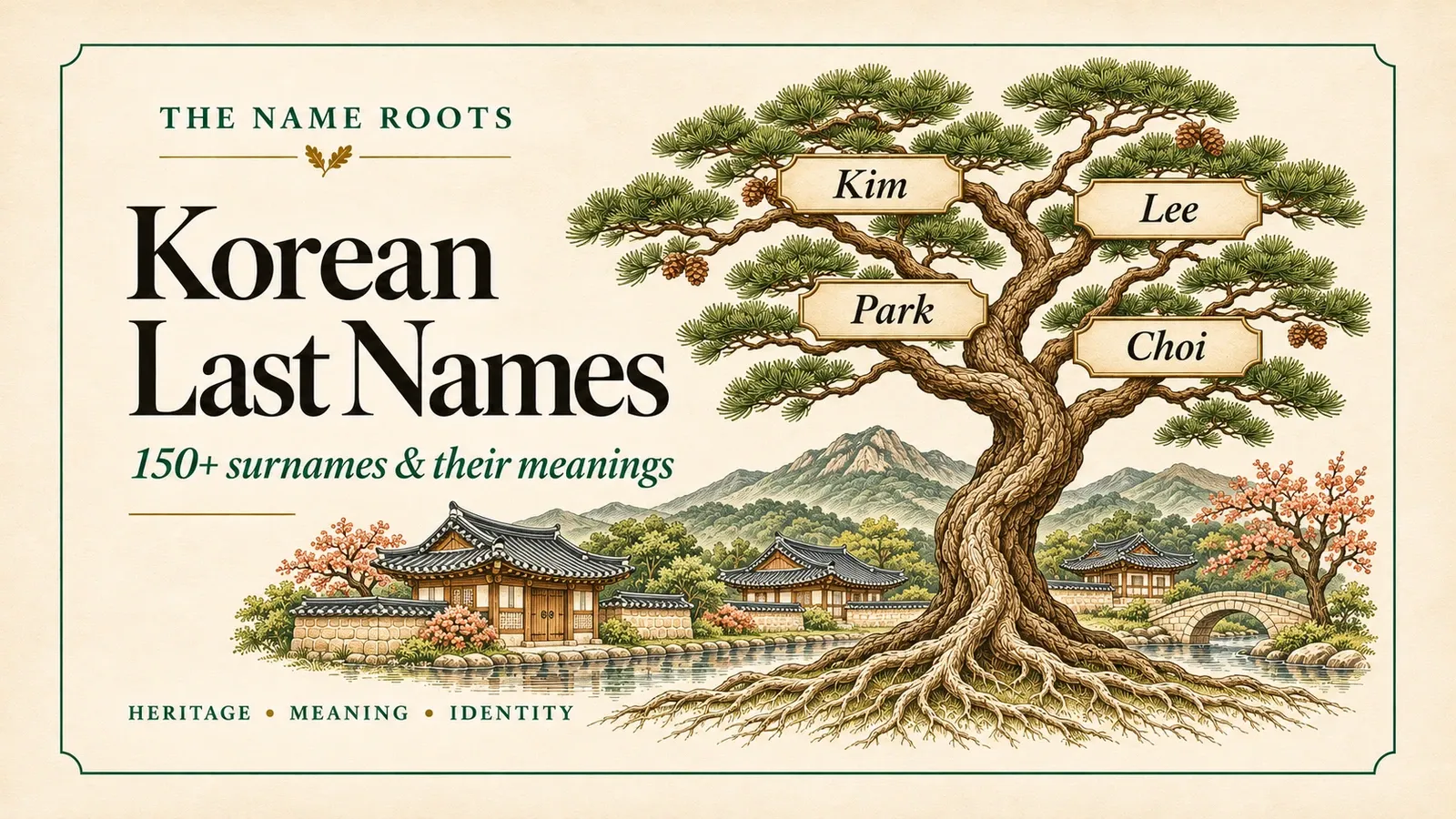
Korean last names are almost always one syllable, written in Hangul and usually backed by a Chinese character (Hanja) that gives them meaning. Kim (金) means “gold.” Lee (李) means “plum tree.” Park (朴) means “gourd.”
In this guide, you’ll find more than 150 Korean surnames with Hangul, Hanja and meanings. You’ll also learn why so few surnames cover so many people, why two Kims might be completely unrelated, and why the same name appears as Lee, Yi, Rhee and Ri.
Korean Last Names at a Glance (Quick Facts)
| Fact | Answer |
|---|---|
| Most common Korean last name | Kim (김, 金), about 21.5% of South Koreans |
| Top 3 surnames | Kim, Lee and Park, together about 45% of the population |
| Top 10 surnames | About 64% of South Koreans |
| Total surnames in South Korea | 5,582 (2015 census), most of them new or very rare |
| Typical length | One syllable; a few rare surnames have two |
| Name order | Surname first: Kim Min-jun |
| Do women change surnames at marriage? | No. Korean women keep their own surname for life |
Statistics come from South Korea’s 2015 census, as reported by The Korea Times.
How to Read the Tables in This Guide
Each surname shows three things:
- Romanization: the common English spelling (plus variants).
- Hangul: the Korean alphabet.
- Hanja and meaning: the Chinese character behind the name, and what it means.
The Most Common Korean Last Names and Their Meanings
The most common Korean last names are Kim, Lee, Park, Choi and Jung. Those five alone cover more than half of South Korea.
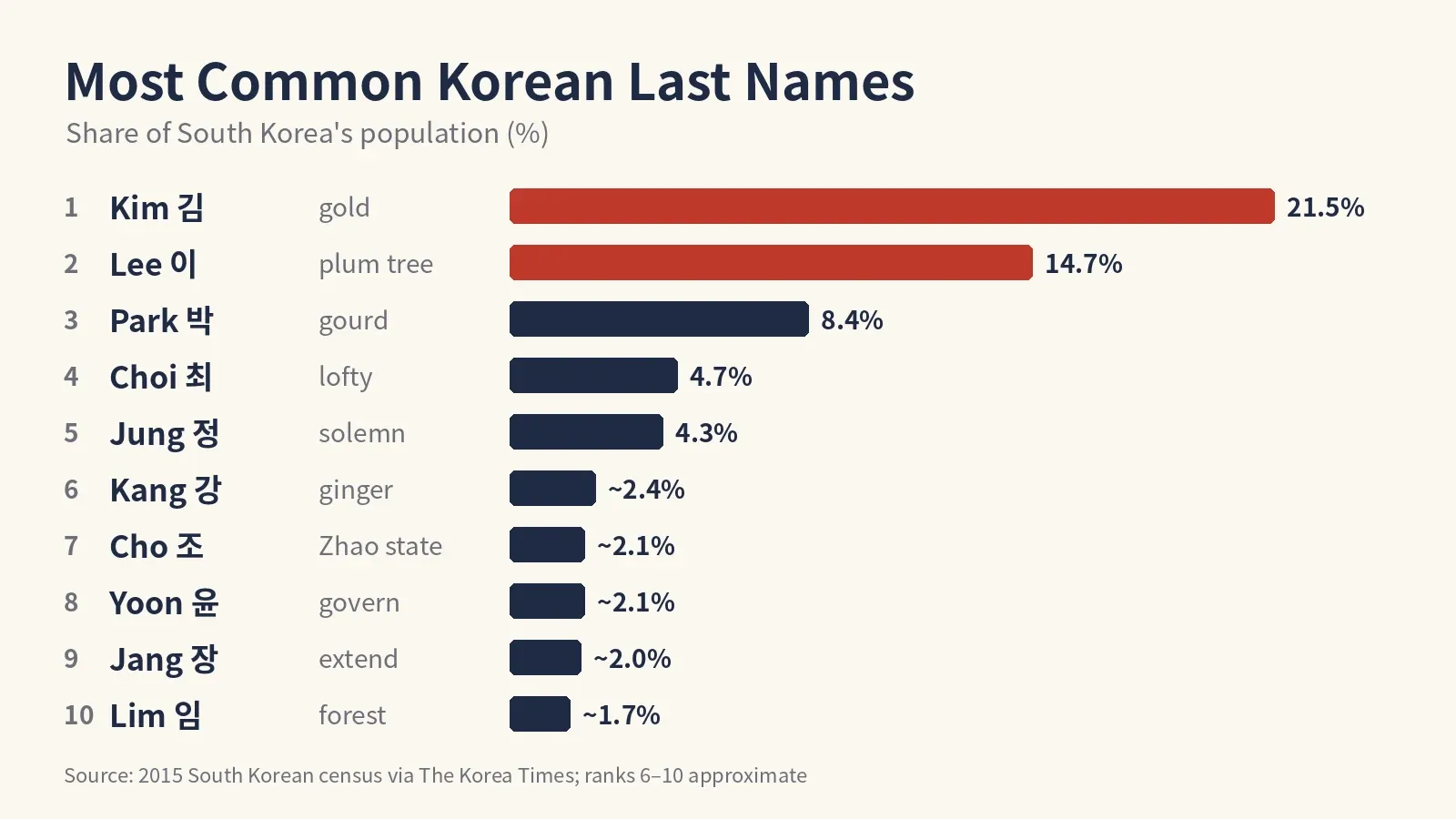
| Rank | Surname | Hangul | Hanja | Meaning | Share of population |
|---|---|---|---|---|---|
| 1 | Kim (Gim) | 김 | 金 | Gold, metal | 21.5% |
| 2 | Lee (Yi, Rhee) | 이 | 李 | Plum tree | 14.7% |
| 3 | Park (Bak) | 박 | 朴 | Gourd; simple | 8.4% |
| 4 | Choi (Choe) | 최 | 崔 | High, lofty | 4.7% |
| 5 | Jung (Jeong, Chung) | 정 | 鄭 | Solemn; an ancient state | 4.3% |
| 6 | Kang (Gang) | 강 | 姜 | Ginger; a river name | About 2.4% |
| 7 | Cho (Jo) | 조 | 趙 | An ancient state (Zhao) | About 2.1% |
| 8 | Yoon (Yun) | 윤 | 尹 | To govern | About 2.1% |
| 9 | Jang (Chang) | 장 | 張 | To stretch, extend | About 2.0% |
| 10 | Lim (Im) | 임 | 林 | Forest | About 1.7% |
Top five shares are from the 2015 census; ranks 6–10 are approximate.
More Common Korean Last Names (Ranks 11–40)
| Surname | Hangul | Hanja | Meaning |
|---|---|---|---|
| Han | 한 | 韓 | Korea; an ancient state |
| Oh | 오 | 吳 | An ancient state (Wu) |
| Seo (Suh) | 서 | 徐 | Slow, dignified |
| Shin | 신 | 申 | To state, extend |
| Kwon | 권 | 權 | Authority, power |
| Hwang | 황 | 黃 | Yellow |
| Ahn (An) | 안 | 安 | Peace, comfort |
| Song | 송 | 宋 | An ancient state (Song) |
| Jeon (Chun) | 전 | 全 | Complete, whole |
| Hong | 홍 | 洪 | Flood, vast |
| Yoo (Yu, Ryu) | 유 | 柳 | Willow |
| Ko (Go) | 고 | 高 | High, tall |
| Moon (Mun) | 문 | 文 | Writing, culture |
| Yang | 양 | 梁 | Bridge, beam |
| Son (Sohn) | 손 | 孫 | Grandchild, descendant |
| Bae | 배 | 裵 | Long robe |
| Baek (Paik) | 백 | 白 | White |
| Heo (Huh) | 허 | 許 | To permit |
| Nam | 남 | 南 | South |
| Noh (Roh) | 노 | 盧 | Black; a vessel |
| Ha | 하 | 河 | River |
| Kwak | 곽 | 郭 | Outer city wall |
| Sung (Seong) | 성 | 成 | To accomplish |
| Cha | 차 | 車 | Cart, carriage |
| Joo (Ju) | 주 | 朱 | Vermilion red |
| Woo (U) | 우 | 禹 | Legendary King Yu |
| Koo (Gu) | 구 | 具 | To equip, prepare |
| Min | 민 | 閔 | Compassion |
| Na (Ra) | 나 | 羅 | Silk; net |
| Jin | 진 | 陳 | To display; an ancient state |
Why Is Kim So Common? The Top 3 Explained
- Kim (金): Kim was the royal family of the Silla kingdom for centuries. Another Kim line, the Gimhae Kims, traces back to King Kim Su-ro, founder of the Gaya confederacy. Royal prestige made the name hugely attractive.
- Lee (李): The ruling family of the Joseon dynasty (1392–1910) was the Jeonju Lee clan. Five centuries of royal Lees did the rest.
- Park (朴): Legend says Silla’s founder, Park Hyeokgeose, hatched from an egg shaped like a gourd. His descendants carried the name.
Here’s the counter-intuitive part. For most of Korean history, commoners didn’t have surnames at all. When they finally took them in the late Joseon period and the early 1900s, many chose the prestigious royal and noble names. That’s why a handful of surnames now dominate the country (Britannica).
To build a complete Korean name, pair this family-name guide with Korean given names. Chinese names offer a useful comparison for character-based writing, while still requiring their own pronunciation and naming conventions.
Bon-gwan: Why Two Kims Aren’t Always Related
Every Korean surname is split into clans called bon-gwan (본관), based on the ancestral hometown. A Gimhae Kim and a Gyeongju Kim share a surname but come from different family lines.
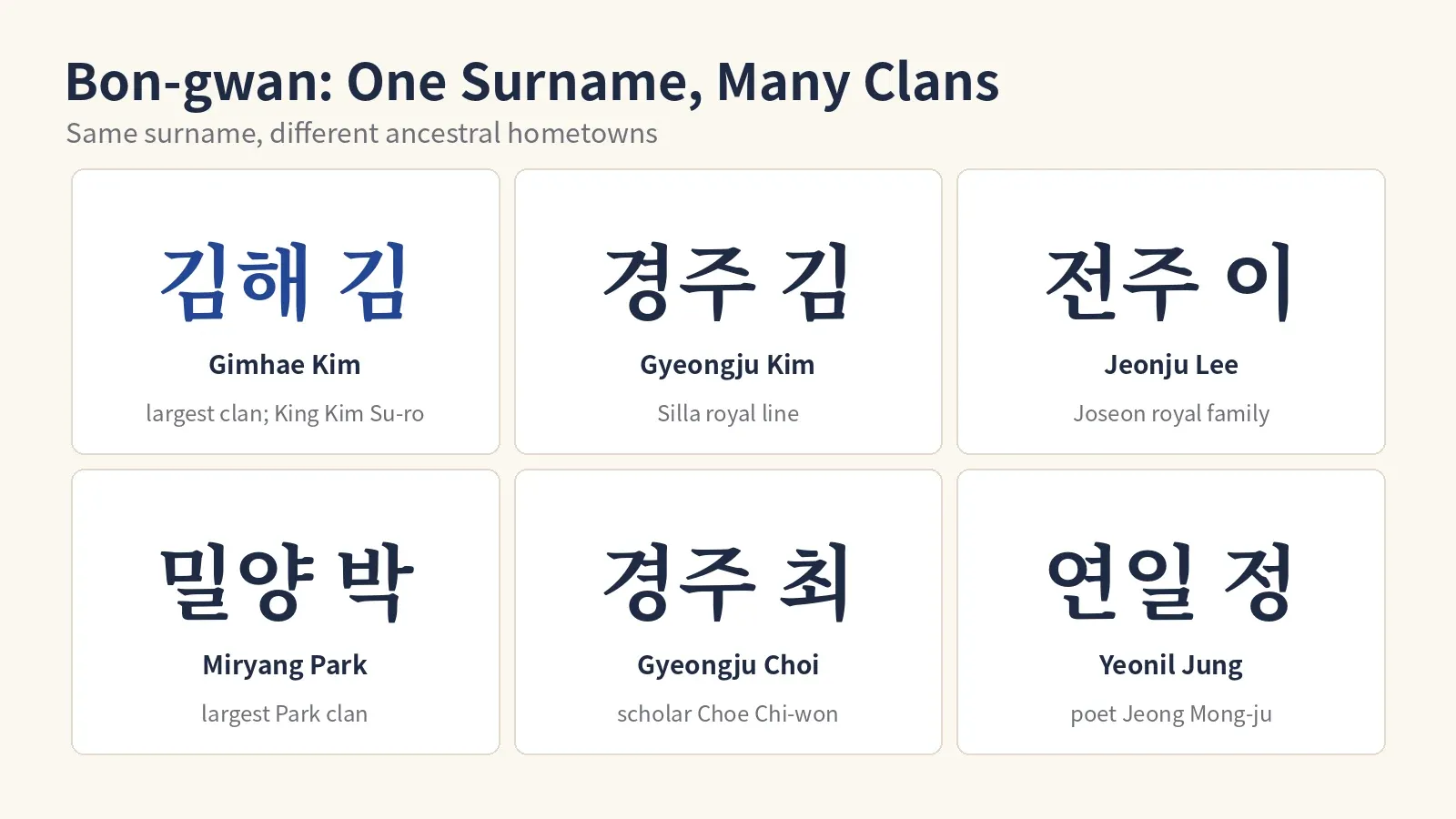
| Surname | Major bon-gwan clans | Famous founder or link |
|---|---|---|
| Kim | Gimhae, Gyeongju, Andong, Gwangsan | King Kim Su-ro (Gimhae); Silla royals (Gyeongju) |
| Lee | Jeonju, Gyeongju, Seongju | Joseon royal family (Jeonju) |
| Park | Miryang, Bannam, Hamyang | Silla founder Park Hyeokgeose |
| Choi | Gyeongju, Haeju, Jeonju | Scholar Choe Chi-won (Gyeongju) |
| Jung | Dongnae, Yeonil, Gyeongju | Poet Jeong Mong-ju (Yeonil) |
According to the 2015 census, South Korea had 36,744 bon-gwan clans. The Gimhae Kim clan alone has more than 4 million members, making it the largest.
The Old Same-Surname Marriage Ban
Until the late 1990s, Korean law banned marriage between people with the same surname and the same bon-gwan, even if they weren’t closely related. A 1997 court ruling struck the ban down, and the law was later revised. Today, only close relatives can’t marry.
Why Lee Is Also Yi, Rhee and Ri: Korean Romanization
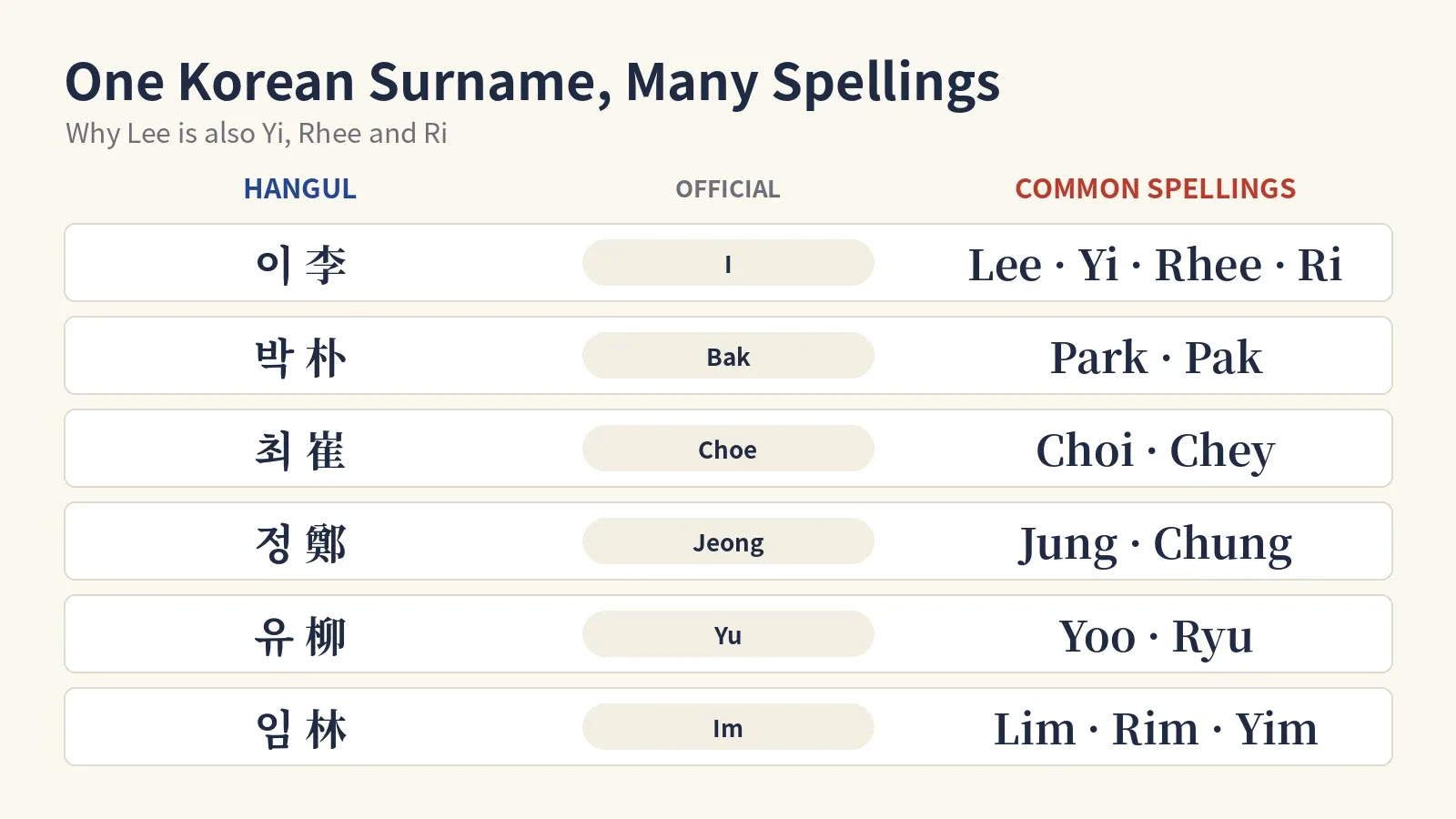
The surname 이 (李) has one Korean spelling but many English ones. The spelling depends on when and where the family romanized it.
| Hangul | Revised Romanization (official) | Common spellings |
|---|---|---|
| 이 (李) | I | Lee, Yi, Rhee, Rhie, Ri (North Korea) |
| 박 (朴) | Bak | Park, Pak |
| 김 (金) | Gim | Kim |
| 최 (崔) | Choe | Choi, Choe, Chey |
| 정 (鄭) | Jeong | Jung, Chung, Cheong |
| 강 (姜) | Gang | Kang |
| 조 (趙) | Jo | Cho, Joe |
| 유 (柳) | Yu | Yoo, Ryu, Rhyu |
| 노 (盧) | No | Roh, Noh |
| 임 (林) | Im | Lim, Rim, Yim |
Why the “R”? In South Korean speech, an initial “r/l” sound on some names drops away, so 류 (Ryu) is often said “Yu.” North Korea keeps the “R,” which is why the same family can be Ryu in Pyongyang and Yoo in Seoul.
Why “Park” instead of “Bak”? Early English speakers heard the Korean “b” as closer to “p,” and the “r” was added to suggest a longer vowel. Families kept the familiar spelling even after official rules changed.
Compare the spelling discussion in Japanese last names before assuming an English-letter form has only one original spelling. For another writing-system comparison, Russian names separates original script from familiar English renderings.
Rare and Unique Korean Last Names
Rare Korean surnames include two-syllable names like Namgung, Hwangbo and Jegal. They’re striking because almost every other Korean surname has just one syllable.
Two-Syllable Korean Surnames
| Surname | Hangul | Hanja | Meaning |
|---|---|---|---|
| Namgung | 남궁 | 南宮 | Southern palace |
| Hwangbo | 황보 | 皇甫 | Great emperor |
| Jegal | 제갈 | 諸葛 | Various + kudzu (from Chinese Zhuge) |
| Seonu | 선우 | 鮮于 | An ancient two-syllable family name |
| Dokgo | 독고 | 獨孤 | Solitary, lone |
| Sagong | 사공 | 司空 | Minister of works |
| Seomun | 서문 | 西門 | West gate |
Uncommon One-Syllable Korean Surnames
| Surname | Hangul | Hanja | Meaning |
|---|---|---|---|
| Ji | 지 | 池 | Pond |
| Eom (Um) | 엄 | 嚴 | Strict, stern |
| Chae | 채 | 蔡 | An ancient state |
| Won | 원 | 元 | Origin, first |
| Cheon (Chun) | 천 | 千 | Thousand |
| Bang | 방 | 方 | Direction, square |
| Kong | 공 | 孔 | Hole; Confucius’s family name |
| Hyun | 현 | 玄 | Dark, mysterious |
| Byun | 변 | 卞 | Rule, law |
| Yeom | 염 | 廉 | Honest, pure |
| Yeo | 여 | 呂 | Spine; musical pitch |
| Choo | 추 | 秋 | Autumn |
| Do | 도 | 都 | Capital city |
| So | 소 | 蘇 | Revive |
| Seok | 석 | 石 | Stone |
| Seol | 설 | 薛 | A kind of grass |
| Maeng | 맹 | 孟 | Eldest; Mencius’s family name |
| Ok | 옥 | 玉 | Jade |
| Tak | 탁 | 卓 | Excellent, lofty |
| Pyo | 표 | 表 | Surface, express |
| Ma | 마 | 馬 | Horse |
| Gil | 길 | 吉 | Lucky |
| Yeon | 연 | 延 | To extend |
| Bong | 봉 | 奉 | To offer |
New Korean Surnames From Naturalized Citizens
Here’s a modern twist most lists skip. Of South Korea’s 5,582 surnames, more than 4,000 are written only in Hangul, with no Hanja. Most belong to naturalized citizens who adopted new Korean surnames. Some created their own clans, too.
A well-known example: Robert Holley, an American who became a Korean citizen, took the name Ha Il and founded the “Yeongdo Ha” clan, named after the Busan neighborhood where he lived.
Korean Last Names by Meaning
Because each surname has a Hanja character, you can group them by meaning. This is handy if you want a name with a specific feel.
| Theme | Surnames |
|---|---|
| Nature and plants | Lee (plum tree), Lim (forest), Yoo (willow), Ha (river), Ji (pond), Seok (stone) |
| Colors | Hwang (yellow), Baek (white), Joo (vermilion), Hyun (dark) |
| Directions | Nam (south), Namgung (southern palace), Seomun (west gate) |
| Power and status | Kwon (authority), Yoon (govern), Choi (lofty), Ko (high) |
| Values and luck | Ahn (peace), Gil (lucky), Yeom (honest), Min (compassion) |
| Precious things | Kim (gold), Ok (jade), Moon (writing, culture) |
Korean Last Names and Women: Female Surnames Explained
Korean women keep their own surname after marriage. There’s no separate “female” form of a Korean surname. A woman born Park stays Park for life, even when married to a Kim.
So when people search for “Korean last names for females,” the honest answer is: any Korean surname works for a woman. Children, however, have traditionally taken the father’s surname. Since a 2008 legal reform, parents can agree to give the mother’s surname instead.
Popular choices for female characters often use elegant Hanja meanings:
| Surname | Meaning |
|---|---|
| Yoo (柳) | Willow |
| Seo (徐) | Dignified |
| Ahn (安) | Peace |
| Han (韓) | Korea |
| Song (宋) | An ancient dynasty |
| Ok (玉) | Jade |
| Choo (秋) | Autumn |
| Baek (白) | White |
When researching gender and name structure across cultures, consult Greek last names, Greek given names and Italian names separately. A rule for a first name or surname in one language does not automatically transfer to Korean.
How Korean Names Work
A Korean name has two parts: a one-syllable surname and a (usually) two-syllable given name.
| Full name | Surname | Given name |
|---|---|---|
| Kim Min-jun | Kim | Min-jun |
| Park Ji-min | Park | Ji-min |
| Lee Seo-yeon | Lee | Seo-yeon |
Polite Ways to Use Korean Surnames
- Add a title, not just the surname. Calling someone “Kim” alone can sound rude. Say “Kim Min-jun ssi” or use a job title, like “Kim seonsaengnim” (teacher Kim).
- Don’t use “ssi” with just the surname. “Kim-ssi” can sound disrespectful. Use the full name.
- In the West, many Koreans flip the order. “Min-jun Kim” is common in the US.
Expert Insights and Real-World Examples
Case Study: A Korean-American Family Name in 3 Countries
Take the surname 이 (李). A grandfather who emigrated in the 1970s might have used Rhee on his US documents. His American-born son might spell it Lee. A cousin in North Korea would write Ri.
Same family, same Hanja, three spellings. For genealogy, the key is the Hanja plus the bon-gwan, not the English spelling.
Real Examples: Famous Korean Surnames
- Son Heung-min (손): The soccer star’s surname means “grandchild, descendant.”
- BTS members: Kim Nam-joon (RM), Kim Seok-jin (Jin), Min Yoon-gi (Suga), Jung Ho-seok (J-Hope), Park Ji-min (Jimin), Kim Tae-hyung (V) and Jeon Jung-kook (Jungkook). Three of seven are Kims.
- Bong Joon-ho (봉): The Parasite director has one of the rarer surnames on this list.
- Ban Ki-moon (반): The former UN Secretary-General’s surname is also uncommon.
Common Mistakes With Korean Surnames
| Mistake | Why it’s wrong | Do this instead |
|---|---|---|
| Assuming all Kims are related | There are hundreds of Kim clans | Ask about the bon-gwan |
| Treating Lee, Yi and Rhee as different names | They’re the same surname | Check the Hanja |
| Putting the surname last in Korean | Korean order is surname first | Say “Park Ji-min” |
| Expecting a married woman to change surnames | Korean women keep their own | Use her birth surname |
| Calling someone by surname alone | Can sound rude | Add the full name or a title |
How to Choose a Korean Last Name for a Character
- Go common for realism. Kim, Lee, Park and Choi make a character instantly believable.
- Go rare for distinction. Namgung, Hwangbo or Jegal will stand out in any story.
- Pick the meaning. A calm character named Ahn (“peace”) or a fierce one named Kwon (“authority”) adds subtle depth.
- Pair it with a two-syllable given name. “Seo Ha-eun” and “Kang Do-yun” sound natural.
Find Your Perfect Name With Our Korean Last Name Generator
Use the Korean Last Name Generator at the top of this page. Filter by common or rare, one- or two-syllable surnames, and meaning theme. Each result shows the Hangul, Hanja and meaning.
Exploring more? See our guides to Japanese last names, Chinese last names, Asian last names and Korean names.
FAQs About Korean Last Names
What is the most common Korean last name?
Kim is the most common Korean last name, carried by about 21.5% of South Koreans, followed by Lee (14.7%) and Park (8.4%).
Why do so many Koreans have the same last name?
Most commoners didn’t have surnames until the late Joseon period and early 1900s. Many chose prestigious royal and noble names like Kim, Lee and Park.
How many Korean last names are there?
South Korea’s 2015 census counted 5,582 surnames, but more than 4,000 are Hangul-only names mostly used by naturalized citizens. Traditional Hanja-based surnames number about 1,500.
What does bon-gwan mean?
Bon-gwan is a clan’s ancestral hometown. It separates families that share a surname, such as Gimhae Kims and Gyeongju Kims.
Why is Lee sometimes spelled Yi or Rhee?
They’re all spellings of the same surname, 이 (李). The spelling depends on the romanization system and the family’s choice. North Korea uses Ri.
Do Korean women change their last name when they marry?
No. Korean women keep their own surname for life.
What are some rare Korean last names?
Rare surnames include the two-syllable Namgung, Hwangbo, Jegal, Seonu and Dokgo, and one-syllable names like Tak, Pyo, Ok and Maeng.
What does Kim mean in Korean?
Kim (金) means “gold” or “metal.”
What are common Korean last names for girls?
Korean surnames aren’t gendered, so any surname works. Common ones include Kim, Lee, Park, Choi, Jung, Kang and Yoon.
Why do Koreans put the last name first?
In Korean, the family name comes first to show the family before the individual, just like in Chinese and Japanese.
The Bottom Line
- Kim, Lee and Park cover about 45% of South Korea, thanks to royal history and late adoption of surnames.
- The bon-gwan clan matters more than the surname when it comes to real family ties.
- Spelling varies wildly, so always go by the Hangul and Hanja.
Try the Korean Last Name Generator at the top of this page to find your favorite.
Looking for more? Explore name origins and meanings across all eight categories.